21st Century Workplace Seated Massage

This article originally appeared in MASSAGE Magazine‘s October 2012 issue.

From the first days of professional seated massage in the mid 1980s, massage in the workplace has been a significant market segment. When my business was providing chair, or seated, massage at companies such as Apple Computer, the service was clearly positioned as a workstyle benefit that set progressive 20th century businesses apart from their stodgy, suit-and-tie counterparts.

While that motivation still exists and evolved, another trend has emerged, driven by a shift in the health care industry that, if seized upon, has the potential to completely reshape the face of massage and the workplace.

The tradition

For the past three decades, chair massage has ebbed and flowed with the growth and recession cycles of the economy. The high-tech and bio-tech sectors, in particular, typically lead the upswing and provide fertile ground for workplace massage. These companies are often created, managed and staffed by a younger generation more interested in quality of life issues. Benefits such as free meals, childcare, concierge services and massage therapy are often part of benefits packages.

Theresa Crisci, who has been doing workplace chair massage for nearly 20 years in Connecticut, identified a big shift in corporate attitudes over the past two decades “For the most part, we no longer have to worry about sexual harassment issues being a barrier for chair massage in the workplace.” Crisci believes that chair massage actually holds a certain cachet for the current generation of young people in the workforce and the companies who employ them.

Another two decade practitioner, Tom Darilek, owner of Seize the Day Energizing Chair Massage, in Austin, Texas, believes employers consider regular massage to be simply another tool for attracting and retaining top tech talent. Darilek also notes that in the past, while companies occasionally would give lip service to chair massage as a wellness tool, they basically treated it as a fad that would fade as soon as the economy began to tighten.

Now, there are significant signs that the wellness fad may finally be here to stay—and there is every reason to believe that chair massage therapists may benefit.

The revolution

The future of workplace massage is tied to the economics of health care policy. At long last, corporate, governmental and academic policy makers have come to the conclusion that a health care system whose primary focus is sickness care is doomed to bankruptcy. They have concluded the ultimate foundation of an economically viable health care system has to be prevention and wellness.

This radical paradigm shift is stamped indelibly into the Affordable Care Act (ACA) of 2010. While the media and partisan politicians were obsessing about the constitutionality of ObamaCare and its new framework for financing health care, mostly overlooked was the fact that the 954-page ACA legislation specifically “directs the creation of a national prevention and health promotion strategy.”

The law created the National Prevention, Health Promotion, and Public Health Council (National Prevention Council), composed of the heads of 17 Federal agencies and chaired by the Surgeon General. This high-level federal action group works closely with a 25-member Advisory Group on Prevention, Health Promotion, and Integrative and Public Health, also mandated in the legislation. Both of these groups are developing plans and recommendations that will impact every strata of society, including workplace wellness.

Happily, massage therapy has a seat at the table of this health care revolution. One of the members of the Advisory Group is the esteemed Janet R. Kahn, Ph.D., a 30-year massage professional and the director of research of the Massage Therapy Research Consortium from 2003 to 2008. Her background in massage and integrative health makes her an ideal advocate for the inclusion of massage as these panels refocus the health care system on prevention and health promotion, two areas in which massage excels.

The National Prevention Council and the Advisory Group have already targeted the workplace as one of the primary arenas for implementing this new strategy. I will make the case that seated massage is ideally suited to lead the way in workplace wellness. Then, armed with a clear idea about how to describe and position the unique strengths of chair massage, I will make a few practical suggestions about finding companies ready to hear the message of chair massage.

This might be a good time to note that, while most of the following rationales could also be applied to table massage, the twin barriers of time and money make chair massage a far better fit for the vast majority of workplaces. Experience has shown that, in general, only the very largest companies include the option of table massage in their menu of wellness services.

The prevention intervention

The medical community has traditionally limited prevention to proven clinical screenings—mammograms, colonoscopies, blood pressure screenings, treadmill tests and the like. In the new health care model, prevention also includes dealing with lifestyle and pre-clinical conditions, a particular strength of chair massage.

Seated massage has always been good at preventing little problems from becoming big problems. The reason someone wakes up with a crick in her neck is never because, as she might claim, she “slept wrong.” Rather, it is because of weeks or months of accumulated psychological or physical stress finally reaching a tipping point that resulted in a muscle spasm. Regular chair massage alleviates the results of these minor stresses and prevents muscles from reaching that involuntary contraction threshold.

Too much mental stress is the primary or secondary cause of many medical conditions as well as an inhibitor to healing virtually all injury and disease processes. Most people will agree that high-quality chair massage is an instant stress reducer. While we don’t yet know all the exact mechanisms involved, there is sufficient scientific evidence to support the claim that massage is effective at reducing anxiety and depression.

Human beings were made to move. When employees are immobilized by their jobs at desks and keyboards, their bodies will eventually break down and rebel. The coin of movement has two sides: active movement where people move themselves, which we call exercise, and passive movement where someone else creates the movement, which we call massage. Regular seated massage moves the tissue, which enhances circulation, which lets the body’s own self-healing mechanisms work most efficiently. Neither movement nor circulation is optional and chair massage provides a heaping serving of both.

Immobilized bodies that don’t move result in what Thomas Hanna, the great somatics pioneer, more elegantly termed sensory-motor amnesia. That is to say, chronically contracted muscles which eventually stop giving feedback to the higher cortex of conscious awareness. When this happens we are no longer able to feel the imbalances we have created and we begin to think that our bad posture is normal.

Seated, or chair, massage restores the mind-body connection and we feel better in two important ways: First, we feel the relief of the multi-tiered rebalancing that comes at the end of a massage; second, our capacity for experiencing sensation inside our bodies increases.  We can now feel more and we can feel better. If we are not getting accurate feedback about the state of our health, we see no reason to change. Massage restores that feedback loop and shows us that we have control over how we feel.

This enhanced self-awareness brings us to the second set of rationales for seated massage in the workplace.

Making wellness work

Advocates of wellness and health promotion know in order for the health care paradigm to shift from treatment to prevention, people must be motivated to make significant lifestyle changes.

We have known for decades that five chronic diseases–heart disease, cancer, stroke, chronic obstructive pulmonary disease and diabetes–are responsible for more than two-thirds of all deaths in the United States. We also know the progression of all these conditions is heavily influenced by lifestyle. Studies have repeatedly shown we would save billions of health care dollars every year if we ate better, exercised more, reduced chronic stress and didn’t smoke.

So why haven’t we change our lifestyles? Because change requires effort and motivation.

One of the unique aspects of chair massage, unlike any other workplace wellness modality, such as smoking cessation, dietary modification, exercise, Yoga or meditation, is it requires no motivation to change. It works immediately with no effort or intervention required on the part of the recipient. With massage, people also come to realize that they have far more control over how they feel than they ever imagined and thus become more motivated to change.

The frosting on the cake is that chair massage also supports every lifestyle change. No matter where you are on the spectrum of wellness, from couch potato to super athlete, if you want to break a habit, start a new one or support any transition in your life, adding massage will immediately make you feel better and positively reinforce your efforts.

Finally, seated massage is the most egalitarian of all wellness programs. You don’t have to be overweight or a smoker or have high blood pressure or even be stressed out to qualify and benefit from regular massage. The only ultimate contraindication for massage is an individual’s reluctance to be touched.

A major transition

Chair massage in the workplace is at a moment of major transition. In the emerging health care economy the time is right to position yourself as a serious wellness consultant who provides massage services. There has never been a better time to showcase the benefits of massage and create a true health care system, one body at a time.


For further marketing tips, check out Four Ways to Market Workplace Chair Massage.

How Culture Mediates Massage

Whenever customers sit in my massage chair, I know that their subjective experience of my touch will be the result of at least four factors:

  1. Their genetic profile (Are they male/female? Do they have biological disorders such as autism).
  2. Their personal touch history (Have they had massage before? Have they experienced healthy touch or abusive touch in the past? Have they experienced touch at all?).
  3. The attitudes and experiences with touch they had in the family (Were they breastfed, or not? Was their family highly affectionate, or not?).
  4. The customs and attitudes toward touch that are emphasized by the culture in which they are immersed.

This fourth element is the subject of this article. As the world continues to shrink and multi-cultural societies becomes the norm rather than the exception, understanding the cultural environment in which a customer was raised is crucial to healthy professional touch relationships. In this article I will give two examples of how culture affects how we touch.

Defining pain

I began my massage career in 1980 working at Kabuki Hot Spring, a spa in San Francisco’s Japantown. I was the only Caucasian male working in a sea of mostly Asian, mostly female faces. While I had been trained in traditional Japanese massage at a school that was run by the owners of the Hot Spring, a majority of the other practitioners had been trained in Japan. It was at Kabuki that I began to understand why Japanese massage had gotten a reputation in the United States as “beat-me-up” massage.

While the Kabuki had private rooms, most of the customers availed themselves of the public baths and the communal massage room, which had 14 massage tables lined up in an open space. Doing massage alongside Japanese practitioners introduced me to what I have since come to understand is a differentiation in how cultures define pain.

I would regularly notice a poor customer at another table squirming uncomfortably under the strong thumbs of a Japanese colleague. If the customer tried to get the practitioner to ease up they were likely to get a slap on the back and be commanded to, “Relax! Relax!”

In the immortal line from Cool Hand Luke, “What we got here is a failure to communicate.”

In Japan, China and many other Asian cultures, if you are feeling a strong sensation while getting a massage, you are happy because you believe the massage is working. In the West, we often interpret the same strong sensation as pain and we think it is a bad massage.

The Japanese practitioners I was working alongside were clearly mystified that anyone would want a lighter massage. From their point of view the problem was not that the massage was too strong, but that the customer was resisting the benefits. To the American customers, the massage simply hurt.

This mistake is still being perpetuated by the flood of Chinese immigrants providing chair massage in malls throughout the U.S. Nobody has taught them that they need to regularly ask their customers for feedback about the pressure and there is often a serious language barrier making it difficult to do so.

For my part, every time I have someone in my massage chair born in the Far East I keep that cultural difference in mind. More often then not they like pressure on the strong side of the spectrum. In all cases, of course, I ask for feedback.

The French form of connection

I use a martial arts approach to teach massage through “Katas,” highly choreographed sequences of select acupressure points and Japanese massage techniques.

Over the years hundreds of people have used my DVDs and other curriculum material as the basis for training thousands of chair massage practitioners around the world. Last year, for example, I discovered that my basic chair massage Kata was famous in France and literally thousands of practitioners were using some variation. They even have a name for it: the Amma Kata.

When I saw a video of one chair massage trainer demonstrating his work, I was amazed. He had been trained by a person who had been trained by a person who had been trained by me. Despite this fourth generational relationship, I was impressed that my original Kata was plainly visible.

What caught my eye, however, was not what was similar, but what was different. The trainer had added two full minutes of slow, deep, luxurious scalp massage at almost the end of the 15-minute sequence.

Recently I had an opportunity to meet with this trainer, Xavier Court, in Paris and spend a week working on the Kata with him and the other trainers working with him. When I experienced his head massage in a chair, I loved it. He had given thousands of chair massages to French people in the workplace and at events and was convinced that the additional work on the scalp was essential to a satisfying experience for his customers.

I explained to him that, in the United States, we had almost exactly the opposite experience. If there is one part of the massage that people most often ask us to leave out, it is the scalp. Here it seems that customers want us to get to the parts of the body that they perceive “need” the work—most often the neck, shoulders and back. If we spent two minutes “just” doing the scalp, people would feel like they were not getting their money’s worth.

In France, on the other hand, there is a cultural recognition that deep relaxation is a goal in and of itself. This is the land dedicated to the 35-hour workweek, five weeks of annual vacation and dinners that don’t start until 9 p.m. Unlike its neighbors to the north (Germany, Netherlands, England, Scandinavia), France is an essentially Mediterranean country with all of the sensuousness and slow pace that implies. It was truly an eye-opening experience that reminded me of an analysis by Virginia Postrel about what is missing from American attitudes toward massage.

What do you see?

These examples highlight the need for cultural sensitivity when doing massage. There are many more differences in cultural perceptions of massage most obviously ones that stem from cultural attitudes and norms about touch and sexuality. Please share your cross-cultural insights in the comments section below.

Positioning for a Chair Massage Without a Massage Chair

I love to introduce people to massage. I have massaged people in restaurants, on airplanes, at dinner parties and even outdoors in parks. When I go to visit my family on the East Coast, I consider it my pleasure to gift them with massage.

If I want to do a thorough job of it, I like to give a complete upper body massage. But what if I don’t have my massage chair handy? This 3-minute video demonstrates how to position massage recipients over a table top so that they are comfortable and you are able to access all parts with ease.

Of course, the other option for my family was to finally buy a massage chair that stays on the East Coast permanently.

Introducing Touch

Whenever I am in an unfamiliar room, full of people I don’t know, my shy parts come out. I feel isolated, vulnerable and fearful and immediately begin looking for the nearest exit.
However, I also know that the best thing to do is to force myself to go up to someone in the room and introduce myself. Once I have made a connection with another person, my shy parts start to relax and my more social parts start to take charge.

For many people about to get the first massage of their life from a stranger, often in a strange environment, the situation is many times more scarier. These are the people we often encounter when doing chair massage.

That’s why it is crucial that the massage practitioner takes the initiative to quickly make new customers feel welcome. I walk toward the customer with my hand extended, greet the customer by name and introduce myself while shaking their hand. Then I lead them to my massage chair.

The handshake is important because it is the first step in our physical touch relationship and, for most people, a handshake represents safe touch. Stepping forward first is a way to let them know that you resonate with their vulnerability and are willing to step into their space, before they step into yours.

There is generally a lot of verbal interaction that goes on in the first 60 seconds of that relationship. Most importantly I want to know about the customer’s previous experience with professional touch. “Have you ever had a massage before?”, “Have you ever had a chair massage?”, “Have you ever had an acupressure massage?” are all questions that will give valuable information as to their comfort level with touch.

Secondarily, with new customers I want to always ask for and receive permission to touch specific parts of their bodies. “I am going to work on your shoulders, arms, upper back, lower back, neck and scalp.”

As I mention each body part I touch the same area on myself. I find that helps slow me down and not make the introduction sound so much like a rote recitation while, at the same time, giving customers two sensory pathways through which to absorb what I am telling them. Remember, these folks are often nervous and overwhelmed. My job is to help them gain a sense of control. I do this by clearly outlining the structure and content of our relationship.

After I have described where I am going to be touching, I ask them if there is anyplace in their upper body where I need to be cautious, where they have aches, pains, strains, cuts bruises, rashes, injuries, surgeries or the like.

This is their cue to inform me of any musculoskeletal issues that I need to know about, but also the point at which they can ask me not to touch certain areas of their body, if they choose. The most common area that people mention not wanting touched is their hair or scalp.

After I have asked for and received permission to touch specific parts of their body, next I need to know how to touch those parts. Since I do traditional Japanese massage on a sequence of acupressure points, for me that mostly means making certain that my touch pressure be appropriate.

I always verbally give customers permission to give me feedback about my pressure. “If at any time during the massage anything feels uncomfortable, you will let me know, all right?” After getting their assent, I also tell them, “You are going to be in charge of the amount of pressure that I use. When I start working on the acupressure points, I am going to ask you for feedback about the pressure.”

This is an important piece. It is not enough to give people explicit permission to give you feedback; you must also make them practice giving you feedback so they will know you are serious about having them control their experience.

When I start working on the first line of acupressure points, I ask something like, “How’s the pressure? Would you like more, less or should I keep it about the same?” It is important to frame it as a question so that your customers are forced to commit to a response and take responsibility for their bodies.

Many people are so out of touch with their bodies that they have no frame of reference from which to respond. Or, since they perceive you as the “expert,” customers sometimes believe that you have some magic ability to know what the perfect pressure will be for their body.

Thus, I may add any of the following explanations to the mix for further clarification:

“The pressure doesn’t have to hurt to be effective.”

“We are looking for enough pressure so that your body want to go, “Ahhh…” but not so much pressure that it wants to go, “Ow!!”

“Any amount of pressure will activate circulation in the area.”

“It is not a no pain, no gain situation.”

“This massage is not supposed to hurt. It is supposed to make you feel better, not worse.”

And, as my friend Ken Bridgman notes: “Unlike Bill Clinton, I can’t feel your pain, so you are going to have to tell me if it hurts.”

Here are a couple of other notes about solidifying the touch relationship during a massage.

  • For new customers, depending on the length of the chair massage, I will ask for feedback about pressure 2 to 5 times during a massage.
  • Anytime I get feedback from a customer I always thank the person for letting me know.
  • If I get the pressure wrong on one side of the body, I always ask for feedback when I get to the same section on the other side of the body.

If you have any other suggestions about how to make people comfortable receiving touch from a stranger during a chair massage, leave a comment below.

The Great Frame-Up

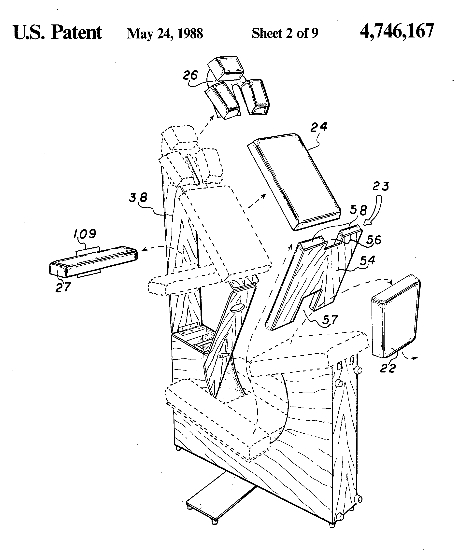
While dozens of massage chairs have been developed since the first one debuted in 1986, today there are only four basic designs that have survived the intense competition of the marketplace. What distinguishes each design is the unique metal frame to which all of the other cushioned parts that support the face, arms, knees and seat attach.

Patent drawing of the first massage chairDesigning and building a massage chair is far more complicated than creating a massage table. Massage chairs have four surfaces on four different planes that need to fit to the customer’s face, chest, shins and seat, rather than the one surface required for a massage table. Each surface must be adjustable enough to accommodate a wide range of lengths and weights and the chair itself should be adjustable for tall and short practitioners. Add to that the requirement that the chair must fold into a transportable package that is lighter and smaller than the typical massage table and you end up with a major engineering challenge.
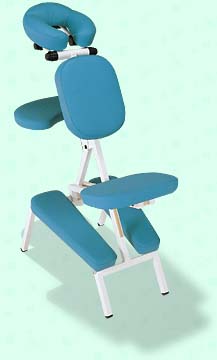
In the spirit of acknowledging, for the first time, the unsung innovators of chair massage development, I will categorize each frame by name of its designer in descending order of popularity.

The Beyer Frame

Scott Beyer is the consummate tinkerer. In 1987, he attended a seminar I taught in Dallas where he saw the original massage chair-in-a-box I had developed with Living Earth Crafts. The next year Scott moved to San Francisco and began developing what has become the most popular massage chair design in the world.

The Beyer Frame on the Quicklite Massage ChairThe reason for its popularity is the simplicity of the design, which made it relatively easy to manufacture and eventually, easy to copy. Scott sold his design to a manufacturer in Montana called Golden Ratio which named the chair the QuickLite. Golden Ratio neglected to get any patent protection and by the mid 1990s multiple versions were being made throughout North America, Europe and Australia.

Golden Ratio went out of business about ten years ago, giving imitators even more leeway to copy the design. Today, with the advent of Chinese manufacturing, this design totally owns the sub-$200 massage chair market. Even the major manufacturers of the best massage chairs sell versions of this design as their low end or entry level chair.

The primary selling points of the Beyer frame are its light weight (as little as 14 pounds) and its ease of adjustability, which is to say, it had very little adjustability and thus is very easy. Some manufacturers have tried to add features that would increase the adjustability for the customer and/or practitioner but inevitably they also increased the chair weight. This design also has the shortest assembly and fold up time of any chair, about ten seconds each.

Besides limited adjustability, the Beyer frame has another drawback. Its defining characteristic is a support beam that runs next to the crotch of the customer. While some customers may actually enjoy the extra “massage” it provides, the message it telegraphs to our unconscious parts is less than desirable for professional massage.

There is one safety issue inherent in this frame design. A portion of the seat extends past the back legs of the chair, meaning if customers lower themselves to far back onto the seat, the whole chair will flip up into their face and they will land on the ground.

A low price also sometimes means low manufacturing standards. Welds have been known to break on the cheaper chairs creating serious liability issues for practitioners. My best advice is to buy only from a reputable company with a good warranty.

Unfortunately, Scott did not make a fortune off his creativity, but he deserves a top seat in the Massage Inventors Hall of Fame for his design.

The Riach Frame

The second most popular chair design was created on the back of a paper napkin by Linda Riach and welded into reality by her engineering husband, Jeff. The Riachs are legendary in their own right as the founders, owners and current operators of Oakworks, a 35-year old massage manufacturing company.

The Riach Frame on the Portal ProThe Portal Pro chair that Linda sketched was defined by the unique cable system that linked the front and back leg braces providing an entirely new level of support and independent adjustability for the face, leg, shin and seat pads.

While patent protection on their chair prevented exact duplicates, similar designs abound such as the Avila by EarthLite. Any time you see a chair that folds like an ironing board, you are looking at a relative of the Riach design.

However, every feature has a trade off. The compromise with the cable adjustment system is that moving the cable up or down a notch changes the relative relationship between the seat, chest pad and knee rest, which requires a second and sometimes, third, adjustment.

The Portal Pro weighs only 19 pounds and retails for $449 with a carry case included.

The Lloyd Frame

After Living Earth Crafts stopped production of my original massage chair in the late 1990s, I began scouting for a new manufacturer to work with. At that time, Stronglite owners, John and Laney Lloyd, were developing a second-generation massage chair and invited my participation.

While they were kind enough to give me co-design credit for the resulting chair, the truth is John had already come up with the basic frame design by the time I arrived on the scene. Since this article is defining chairs by their frames, it is the Lloyd name that goes on this design.

The Lloyd Frame on the Ergo ProThe great innovation of the Lloyd frame was the elimination of any cabling holding the legs together. That meant that the seat height/angle and chest pad height/angle could be adjusted independently. In addition, the back legs can be raised or lowered for the height of the seat and comfort of the practitioners without changing any angles or requiring adjustments for the customer.

The first version of the chair was made out of wood but that was retired a few years after the introduction of the current, metal version, called the Ergo Pro. The Ergo Pro weighs 19 pounds, currently retails for $379 and includes a carry case. [Available for a discount at the TouchPro store.]

Occasionally the Lloyd Frame has been copied, but its relative complexity has not made it an easy target for knock-off manufacturers. Also, like Oakworks, Stronglite has developed a robust international distribution network that has a vested interest in keeping a lid on copycats.

The Lloyds sold their company to EarthLite a few years back, which also owns the Living Earth Craft brand.

The Gillotti Frame

Michael Gillotti is a guy who knows how to think outside the box. His late 1990s design for a massage chair is still the most aesthetically pleasing chair on the market today. Michael was the founder and former owner of Pisces Productions, which he ran for over 30 years.

His chair, the Dolphin II, is the only massage chair in this group still manufactured and assembled in the United States, but retailing at $525 (carry case extra), it has effectively priced itself into niche status.

The Gillotti Frame on the Dolphin IIIf the Riach Design was based on an “X,” the Gillotti Design was based on an “O.” The frame is built on three curved, nesting tubes that telescope in and out of each other allowing the chest pad and face cradle attached to one end to move from a totally horizontal to a totally vertical position. On the other end of the frame the seat can perform the same maneuver.

One unique advantage of this design is that, unlike the other three frame designs,  the Gillotti frame allows the customer to step into the chair from the side, making it easy for people who have difficulty raising their legs to sit down, e.g. if the customer has a range of motion limitation or is wearing a tight skirt.

Structurally, the most glaring problem is lateral stability. With one long length of tubing and no struts supporting either end, the lateral flexion is unnerving for both the customer and the practitioner.

Michael also wanted to create a massage chair that could also function as a table. Unfortunately, when adjusted for the prone position all of the weight of the customer goes into the chest or the shins and virtually none into the seat making it uncomfortable for more than a few minutes.

As beautiful as it is, I have never seen a knock-off of the Gillotti design.

The Future

All of the manufacturers keep tweaking the designs of their portable chairs, but it is unlikely that we will see any true innovation in frame design, such as the four described in this article.

Where the real frontier exists is in designing stationary massage chairs. With the explosion of chair massage in retail settings, thanks to the current wave of mainland Chinese immigrant workers, there are now hundreds of fixed location chair massage studios where a stationary chair would be appropriate. When you remove the constrictions of weight and portability a whole new range of possibilities for comfort and functionality emerge.

Just as the original chair unleashed the first wave of the chair massage industry, a stationary massage chair will signal the arrival of the second wave. I am currently looking for a development partner, so if you have any interest…