The Fainting Phenomenon

This week I got an email from Katy who writes: “I was about 20 minutes into the chair massage when the massage therapist began to work in and around my right shoulder blade.  I began to feel clammy and tried to breathe deeply and out of nowhere, I began to black out.  I sat up and just said “water” and wasn’t really aware of anything around me.  I almost dropped the water he had handed to me.  I sat down on a different chair (with much help) and in about 5 minutes felt much better.  I declined the offer to finish the massage.”

In the mid-1980’s, when chair massage was shifting from an occasional massage tool to being a discrete bodywork specialty, practitioners began to notice a phenomenon almost never encountered in table massage: seated customers experiencing symptoms of fainting or even passing out completely.

While a rare occurrence, episodes happened often enough that those of us practicing and teaching chair massage became concerned about its cause, prevention, and management when it did occur.

Why on a chair?

The medical term for fainting is “syncope” [sing’kuh-pee] and is defined as a sudden, brief loss of consciousness. “Pre-syncope” is the experience of symptoms leading up to a loss of consciousness. All syncope is caused by a loss of adequate blood flowing to the brain.

If a person is upright when this happens, then oxygen no longer reaches the brain in sufficient quantities to maintain consciousness and the individual passes out. The cure for fainting is simple. Get the customer horizontal, preferably with his knees up to allow gravity to restore blood flow to the brain. If the person is only experiencing near syncope, then it may be enough for them, while in a seated position, to drop their head between their knees.

In one sense, fainting is nature’s way of telling us to lie down by falling down. This is the reason table massage practitioners rarely experience customers  fainting. They are already lying down and gravity is working in their favor.

The three most important things to know about syncope are:

  • Most episodes are transient; that is, they happen once and never again.
  • Fainting is rarely life threatening, unless someone hits their head on the way to the floor.
  • Everyone who faints revives spontaneously.

Etiology

There are literally dozens of possible causes of syncope but the ones that concern chair massage practitioners most are:

  1. Low blood volume is most often caused by stimulation of the vasovagal nerve reflex, which expands the blood vessels (vasodilation) causing a rapid drop in blood pressure. That reflex can be triggered by such factors as anxiety, pain and fatigue.  Dehydration also causes a drop in blood volume so recent exercise or overheating need to be considered.
  2. Reduced blood flow because of medical conditions that narrow the blood vessels (smoking, high blood pressure, high cholesterol, diabetes) or mechanical restriction of blood flow to the brain. This last point has been highlighted by some practitioners who believe that the positioning of the customer’s head in the face cradle is key. Some lower edges of a face cradle may press in to the carotid artery and trigger a syncope reaction.
  3. Low blood sugar can also cause a sudden drop in blood pressure often times in combination with another risk factor. That means empty stomachs can actually be a hazard in this regard.
  4. Certain medications such as diuretics, beta blockers, calcium blockers, and other CNS depressants that might slow the heart rate, cause fainting symptoms to more likely to occur.
  5. Other conditions where syncope and pre-syncope have been seen include migraines, epileptic seizures, hyperventilation (extremely nervous customers), alcohol intoxication, and cardiac arrhythmia.

Given these known causes, a practitioner should be especially alert to nervousness, hot days, recent exertion and careful positioning of the neck in the face cradle of the massage chair.

Screening and monitoring

While the actual incidence is low, the single greatest determining factor for syncope is whether you screen before and monitor your customers during a massage. Thorough screening and monitoring can eliminate 100% of the episodes of customers passing out. With proper management, the occasional customer who does feel symptoms of fainting will not lose consciousness.

Before you seat customers in your massage chair, they should be screened just as you would for your table massage, preferably with a written card to save time. If the customer has any current or chronic medical conditions or is taking medications, pay particular attention to the ones discussed above in Etiology.

In addition, we recommend screening for the following:

Consumption of food or liquids (other than water) within the past five hours. Not having eaten may signal a hypoglycemic state. If convenient, suggest the customer get a glass of juice or a muffin before the massage.

A history of fainting. Carefully question a customer to determine if the recurrent syncope is related to a low blood pressure or other medical condition. What does their primary health care professional attribute these episodes to?

Just having an empty stomach, a history of fainting or a medical condition does not mean that a customer can’t receive the seated massage. But it does mean that, if you decide to give the massage, you will need to be extra alert.

If there are any yellow flags raised during screening, then it is a good idea to ask the customer to report any dizziness or queasiness during the massage.

Finally, as with all screening protocols, the ultimate rule is “when in doubt, don’t.” If you have any question in your mind about whether to work on a particular customer, then you should not proceed. Tell the customer that you are not certain whether the massage is appropriate for their condition and that they, or you, should check with their primary care provider. Never practice beyond the level of your training and experience.

During the massage

Since syncope can occur for so many reasons, during the massage you will also pay particular attention to syncope precursors in the customer’s body. The most common sign is a customer fidgeting in the chair or lifting the head slightly out of the face cradle as though to yawn or take a breath. These are involuntary reactions to not enough oxygen getting to the brain.

Less frequently you might feel the customer’s skin become hot and sweaty or cold and clammy. If you become aware of any of these symptoms, immediately stop the massage and ask the customer if he or she is feeling okay. If not, then you need to quickly either get him or her turned around in the massage chair or into another chair with the head dropped between the knees, or lying on the floor with the knees pulled up.

After an episode has occurred

Customers who have near syncope experiences will recover within a few minutes. Explain that they have had a temporary drop in blood pressure and reassure them that they will be fine as soon as normal circulation resumes. After the episode has subsided, you might spend a few minutes exploring the causes of the episode. If there were red flags raised during the screening, you probably already know the reason associated with the episode. If the initial screening brought nothing obvious to the surface, ask the customer if this has ever happened to them before and then go over the screening questions again. Perhaps you will discover they are diabetic or have low blood pressure and it didn’t come out in the initial screening.

In any case, let them know that most fainting spells are benign, but they should mention it to their primary care provider at the earliest opportunity. There are, in fact, some serious cardiac and neurological conditions that might underlie syncope and pre-syncope and this episode should become part of the customer’s medical history.

Summary

While the incidence of syncope or pre-syncope in a customer receiving a chair massage is slight, an ounce of prevention is worth a pound of cure. Proper screening and awareness of symptoms during a massage will prevent virtually all syncope episodes. Knowledgeable management of syncope and near-syncope occurrences will prevent undue distress on the part of the customer and the practitioner. Being competent and knowing your limits will buy you the cheapest and most effective liability policy you can own.

If you have your own fainting experience, I would love to hear your stories.

Chair Massage: A foundation for fitness

While I am a big believer in making every moment a fitness moment (see Creating a Fitness Lifestyle), the reality is many people don’t have even the most basic motivation to move to a healthier lifestyle. That’s where chair massage fits in because it not only requires minimal motivation, it actually provides motivation and support for getting off and staying off of the couch.

The reason why I consider chair massage foundational fitness is because, of all the activities that fall into the fitness/wellness category, chair massage is the one that requires the least time and effort, while offering the greatest value. The only motivation required for chair massage is to sit down and do nothing. The chair massage specialist does the rest.

This is one of the most unique and important features of chair massage. All other wellness modalities require high degrees of motivation, practice, support or cost, for example, dieting, exercise, smoking cessation, Yoga, meditation, table massage and Tai Chi.

The foundation of fitness is movement. It is movement that creates circulation in the body/mind and, as I am fond of saying, circulation is not optional. Without good circulation your body and your mind literally wither away and eventually die. Much of what we define as the “aging process” is simply a result of inhibited circulation/movement.

Exercise, which requires a high degree of motivation, is active movement, where you move yourself. Massage is passive movement, where someone else creates the movement/circulation within you and requires minimal motivation.

In addition, over time, as people experience regular massage, they reopen the communication links between their brains and their bodies. That is to say, massage heightens awareness of our internal sensations about what makes us feel good. As a result, recipients tend to become more motivated to lose weight, stop smoking, eat better and even develop a regular exercise program.

As lifestyle changes go, regular chair massage is a great place to start. It triggers the pleasure centers while enhancing circulation. On an ongoing basis it supports all other fitness/wellness activities and lifestyle changes. Each massage rebalances the body/mind by smoothing out the rough edges created by exercise, dieting or withdrawal from smoking and other addictive substances.

Best of all, you don’t have to be overweight or a smoker or in shape or out of shape to benefit from a chair massage. It is the most egalitarian of all wellness modalities and provides a solid foundation for fitness. Given its low cost, chair massage clearly provides the greatest value.

Change-ability: Mastering the Inevitable

Note: This is the fourth and last of a series of articles called “C”-ing Your Way to Success about  the value of Conviction, Clarity, Consistency and Change-ability in business.

The first three “C”s discussed in this series (Conviction, Clarity, Consistency) are paths, not destinations. While the successful development and execution of a business plan may use these guideposts, it is a mistake to think that the ultimate goal is 100% conviction, clarity or consistency in your operation. That is because other than death, change is the only certainty. In fact, the one often defines the other. When something ceases growing or responding, it is considered dead.

Our job then, is to become experts at understanding the nature of change, the patterns of growth.

While the quality of consistency gives your business stability, nurturing “change-ability” gives your business flexibility. Both are essential. One of the best books you can study on the subject of change is not a business book at all. It is a philosophical treatise disguised as a book of divination. The I Ching, or Book of Changes, is one of the classics of Chinese literature and is at least three thousand years old. The I Ching catalogs sixty-four aspects of change, in the same number of chapters, which are essentially meditations on the patterns of growth in the universe.

Mastering change-ability is important in two ways. It makes you increasingly skillful at predicting what will happen next in your business, and it makes you flexible in your ability to respond to change.

Predictability

When you study the nature of change you become expert at seeing the larger patterns in which your business operates. The most common example of these patterns are business cycles. This is the normal ebb and flow of the activity in your business. These patterns repeat daily, weekly, monthly, yearly, or over even longer periods of time. The more skillful you are at recognizing these patterns the more accurately you will be able to create reliable forecasts in your business plan.

Let’s look at some examples of business cycles.

  • The street fairs you work at tend to be slow in the morning, busy through the afternoon, with a late rush of customers, mostly people who worked in the other booths at the fair. Knowing that you will be about the last one to pack up and leave, you make certain that there is adequate staff and energy, for this final wave of business.
  • You notice that when you provide chair massage in the workplace certain types of clients prefer to have a massage at the beginning of the week, others in the middle, and still others at the end of the week. Because you also have a table massage business on Mondays and Tuesdays, you can more easily target your marketing to the mid and late week groups.
  • Your business increases the first and third week of every month because that is when you client base tends to get paid and can afford a massage. Consequently you plan your marketing and administrative chores for the second and fourth weeks of the month.
  • You anticipate that you will always sell more gift certificates around holidays and special occasions and you know you have to begin your promotion plans at least two months in advance.
  • Perhaps your business focus is on relaxation massage and you anticipate that most of your customers, after a year or so of allowing touch into their lives, will seek out other types of bodywork. To plan for that transition you establish mutual referral relationships with remedial therapists, Rolfers, Feldenkrais practitioners, sports massage bodyworkers, and the like.

The greater your ability to understand the processes of change, the more refined and accurate your business forecasts will be. As you become increasingly expert at recognizing the patterns inherent in your business you will develop an intuitive sense of what steps are needed at any given moment to keep your business healthy. Intuition, despite what some people claim, does not come from the cosmos. It is most often the result of awareness–paying attention to the smallest shifts in the world around us–and experience, lots of experience, over many years. The more we consciously accumulate business experience, the better we become at asking the right questions when faced with a business decision, and the more likely we are to arrive at the right answer.

Flexibility

Change-ability also means the ability to respond to the constantly changing business climate. When external and internal conditions alter, do we resist modifying our plans and actions, or do we smoothly adapt to the new circumstances? Developing flexibility in business is essential to long-term survival. There is no hiding from rapid change in our world. Being conscious of change makes it more predictable and being prepared for change makes it more manageable. Flexibility is the key to preparedness.

Practicing flexibility starts with exercising a flexible mind. Hopefully, the older we get, the more we appreciate the importance of accepting that what we believe is not always the way things are. Prejudice has no role in a flexible mind. When you start saying things like, “I can’t stand Republicans/Democrats/Jews/Mormons,” be careful. Not only are you limiting your options, but the world has a funny way of creating circumstances that may turn exactly those people into your next market.

A flexible mind also sees opportunities where other people see only problems. When circumstances in the business climate change it is always an opportunity for you to learn something new about your market, your service, the nature of business, or yourself. Don’t resist change, embrace it. Without change the world would be a very dull place. With change our businesses remain fresh, vibrant, and exciting places to spend our time.

Hygiene Protocol for Chair Massage

Click on the picture to view the video demonstration

While there are probably more infectious agents on the doorknob customers touch as they enter your massage space than are on your massage chair, the public nature of chair massage makes a solid hygiene protocol essential. It is a matter both of perception and professionalism.

I have seen potential customers stand in front of a line of massage chairs at an event carefully scrutinizing the hygiene habits of the various practitioners to find the one that best lives up to their standards. As the media continues to spotlight drug-resistant infections and virulent pathogens spreading around the globe, the general public is becoming increasingly germ-phobic.

Since we are trying to reduce stress, rather than increase it, we need to set customer’s minds at ease by being proactive about hygiene. There should never be a concern about customers spreading bugs to one another, or to me, or from me to them.

In terms of liability, having a simple, consistent hygiene protocol makes it easier to explain clearly to customers, health department personnel and lawyers the impossibility of someone, for example, having acquired herpes from sitting in your chair.

Wipe down. Cover up.

The two-step protocol TouchPro recommends starts with a canister of hospital-grade sanitary wipes. We use two sheets, one in each hand, to sanitize the chair at the start of the day as well as between each customer.

At the beginning of the shift, every vinyl surface is wiped, along with the adjustment hardware and any other metal or plastic parts around the face cradle. Between each customer the minimum rule is to wipe down the face cradle, arm rest and any other part of the chair that might have had skin to vinyl contact, typically the leg rests if the previous customer was in a skirt or shorts. The final step is to put the two sanitizer sheets together and wipe your own hands thoroughly.

Here’s a note about the wipe down process. The basic rule is, the juicier the better. The effectiveness of the sanitizers at killing the bugs is directly related to how long the moisture stays on the vinyl or your hands. That’s why we recommend wiping down the chair immediately after a massage, so you don’t have to keep the customer waiting before a massage for the alcohol to evaporate.

After the wipe down, the face cradle should be covered up to prevent the customer’s face from touching vinyl. The preference of the practitioner determines whether paper towels, cut-out or form-fitted disposable covers, or washable cloth covers are used.

Back in 1986, we started with paper towels but quickly moved to the round, disposable nurses caps with a breathing hole or slit cut into the center. When the form-fitted disposable face cradle covers came on the market around 2005, we switched to those and never looked back.

Addition hygiene issues

Obviously, everything you learned in massage school about keeping your fingernails, hands, breath and “pits” clean applies to chair massage, but there are a couple of other issues that should also be considered in your hygiene protocol.

In 2009, during the H1N1 avian flu pandemic scare, the media was in a frenzy over the potential deadly effects of the virus. To allay any fears of our customers, I wanted to advertise that all of the chair massage practitioners in our studio had been vaccinated to prevent them from contracting and/or spreading the virus. Unfortunately, because it was a new strain, the vaccine was rationed to the very young, old, immune-suppressed and front-line healthcare workers. Because of the shortage we were never able make that guarantee but every year since, I get myself vaccinated as early as possible. Annual flu vaccination as part of a chair massage hygiene policy just makes sense.

And, finally, what about those doorknobs? In a chair massage studio, I do disinfect them at the beginning of every day, unless they are brass. Brass doorknobs disinfect themselves in about eight hours, while stainless steel and aluminum knobs never do. It’s called the “oligodynamic effect.”

In summary, have a hygiene policy, write it down, and make sure everyone in your business follows it.

Check out the companion video.

The Leg Problem in Chair Massage

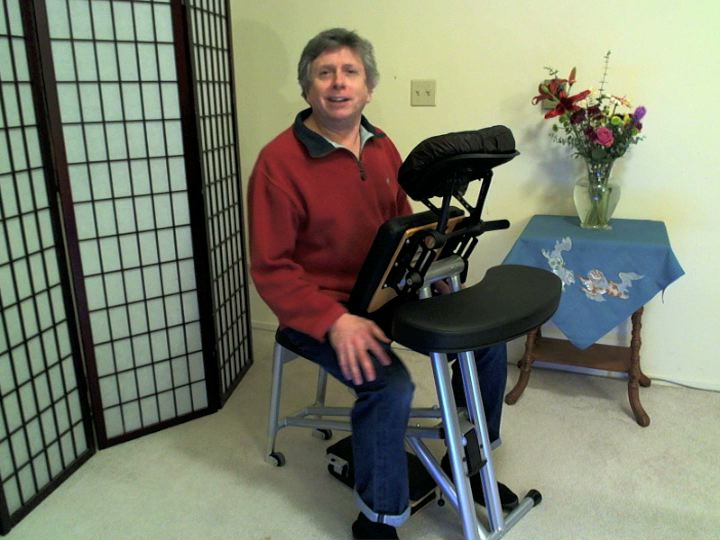
Steve Knobles called today from North Seattle Community Acupuncture clinic. He recently started seating patients in a massage chair because it allowed easy access to their necks, backs and arms for needling and was often more comfortable than lying on a table. However, some of the patients complained of tired shins after sitting in a massage chair for longer than 30 minutes and he wanted to know if there was any way to extend their comfort time.

This is a phenomenon noted soon after the first massage chair came on the market in 1986. While spreading the weight among the seat, leg rest, chest pad and face cradle is great for support, it is not great for fidgeting. And, despite what your 3rd grade teacher may have told you, humans are made to fidget and be in motion, not to “sit still.” Movement creates circulation and, as we all know, circulation is not optional, even when we are asleep. Just check out the nearest napping infant.

Thus, we have always recommended a maximum 30-minute length for a chair massage. Unlike a massage table where people can fidget to their hearts content, in a massage chair using the lower legs as a support prevents movement and having the knees bent can reduce circulation and create discomfort. While it is true that some people can tolerate longer periods in that position, since a significant percentage cannot, the 30-minute rule is the safest compromise.

However, there are a couple of ways to compensate if, for whatever reason, you want to do a longer massage. My suggestion to Steve was simple. Since he was using a Stronglite Ergo Pro massage chair, I told him to remove the leg rests and flatten the seat so that it was parallel to the floor. Voila! No leg rests, no problem. Customers can now squirm to their hearts content.

Removable leg rests are so essential on a massage chair that I am surprised all manufacturers don’t include them. Even if you are only doing short massages, you need them. I would guess that 5% of chair massage customers have knee or leg issues that make leg rests uncomfortable. While putting your legs straddling or in front of the knee rests is the solution used on other chairs, it is less than optimal or professional. [Full disclosure: I helped co-designed the Stronglite chair, of course…]

Another way we got around the 30-minute limit was developed in the TouchPro retail chair massage studio business model. There we offered up to 30-minutes of upper body massage and 10- or 20-minutes of lower leg/foot massage meaning people could receive up to 50-minutes of massage in a chair. However, the catch was that, before the foot massage, the customer had to get up and reverse themselves in the chair, which was adjusted for the massage.

If you want to see how it all works in action, click here to view a video demonstration.