Are We Solving the Wrong Problem?

Why the Interstate Massage Compact Misses a Larger Regulatory Opportunity.
By David Palmer

Over the past several years, a significant amount of attention, funding, and professional energy in the U.S. massage field has been devoted to the proposed Interstate Massage Compact. Its aim is straightforward: allow licensed massage therapists to practice across state lines without navigating multiple, duplicative licensure systems.

Portability matters. For therapists who move frequently, serve mobile populations, or live near state borders, the current system is inefficient and frustrating. The Compact seeks to address a real problem.

But an important question remains largely unexamined:

Is licensure portability the most important regulatory problem facing the massage profession today? Or has the profession focused on a technically complex issue that affects a relatively small segment of practitioners, while overlooking reforms that could have delivered broader public benefit?

A Solution for a Subset

The Interstate Massage Compact is designed to help massage therapists who wish to practice in multiple states. By definition, this is a subset of the profession. Most massage therapists practice in one state, often in one community, and do not routinely cross state lines for work.

For these practitioners, the primary regulatory challenges are not portability. They are barriers to entry, access to employment, scope-of-practice limitations, and the cost and duration of training relative to earning potential.

From a public-policy standpoint, this distinction matters. Regulation should prioritize changes that produce the greatest benefit for the greatest number—both practitioners and the public they serve. Measured against that standard, the Compact’s impact is limited.

At the same time, one of the most accessible and scalable forms of massage—chair massage—remains constrained by regulations that fail to reflect how it is actually practiced.

Chair Massage: Common in Practice, Absent in Policy

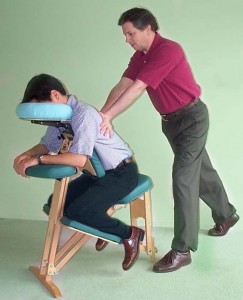
Chair massage is already woven into everyday life. It appears in workplaces, airports, conferences, healthcare facilities, senior centers, and community events. It is typically delivered:

    • Fully clothed
    • In open, observable settings
    • For short, defined periods
    • Without oils, lotions, or disrobing
    • Without diagnostic or therapeutic claims

In terms of risk profile, chair massage is fundamentally different from full-body table massage performed in private rooms. Yet in most states, it is regulated as if that distinction does not exist.

Chair massage is rarely recognized as a distinct modality. Instead, it is folded into full-scope massage licensure frameworks designed decades ago for a different practice context. As a result, practicing chair massage often requires the same regulatory investment—time, money, and education—as practicing unrestricted table massage.

The Consequences of Regulatory Mismatch

When regulation fails to distinguish between different kinds of practice, the result is not increased public safety. It is reduced access.

Overregulation of chair massage contributes to:

    • Fewer practitioners available for workplaces and public settings
    • Higher barriers to entry for new and career-changing practitioners
    • Reduced access to low-cost, preventive, stress-reducing services
    • Missed opportunities in community health and institutional care

Ironically, these outcomes undermine the very goals regulation is meant to serve: public protection, ethical practice, and a sustainable profession.

Good regulation is proportional. It differentiates based on actual risk and context. Treating all massage modalities as if they carry identical risks is not evidence-based policymaking—it is regulatory inertia.

The Opportunity Cost of the Compact

The Interstate Massage Compact has required years of coordinated effort, including federal funding, multistate legislative advocacy, administrative infrastructure, and extensive professional debate.

That investment represents an opportunity cost. Time, money, and political capital devoted to one regulatory pathway are not available for another.

Had even a portion of those resources been directed toward modernizing chair massage regulation, the results could have been immediate and tangible. Potential reforms might have included:

    • Explicit recognition of chair massage as a limited-scope practice
    • Tiered or entry-level credentials aligned with chair massage only
    • Education requirements calibrated to actual risk
    • Clear regulatory guidance for public and institutional settings

Such reforms would not eliminate full licensure pathways. They would complement them—creating legitimate on-ramps into the profession rather than guarding a single gate.

Public Safety and Public Access Are Not Opposites

Advocates of the Compact often frame their arguments around public protection. This concern is valid. But public safety is not enhanced by ignoring meaningful differences in practice context.

Chair massage’s defining characteristics—clothing, visibility, time limits, and public settings—already mitigate many of the risks regulators are rightly concerned about, including boundary violations and misconduct. These features make chair massage particularly well suited to scoped regulation.

Failing to account for these differences does not make regulation stronger. It makes it less precise.

A Question of Priorities

The debate over the Interstate Massage Compact has exposed divisions within the profession about governance, standards, and access. But beneath those disagreements lies a more fundamental question:

What kind of profession is massage becoming, and who is it for?

A regulatory strategy focused primarily on interstate portability benefits established practitioners who already meet full licensure standards. A strategy that also modernizes chair massage regulation would serve a wider range of stakeholders: new entrants, community programs, employers, institutions, and the public.

Conclusion

The Interstate Massage Compact may still move forward, and it may ultimately benefit a segment of the profession. But it is worth acknowledging what was not pursued with the same urgency.

Chair massage—safe, public, and widely accepted—has been hiding in plain sight, constrained by regulations that no longer reflect reality. If the goal of regulation is truly to protect the public while supporting a healthy profession, then the energy spent chasing portability may have been better spent opening doors.

The next chapter of massage regulation should focus less on crossing state lines—and more on removing the barriers that no longer make sense.
Separating Safety from Gatekeeping: The Case for Chair Massage as Entry-Level Practice

Why the regulations designed to protect the profession actually limit its reach

By David Palmer

The American massage profession has spent decades fighting for legitimacy. At the heart of this struggle has been a critical mission: separating professional massage from prostitution and the exploitation and trafficking that accompany it. This fight has been necessary, important, and ongoing. State regulations requiring 500-1000 hours of training have served as one tool in this battle, establishing clear professional standards and creating distance from illegal activities masquerading as massage.

But in pursuing this necessary goal, the profession has created an unintended casualty: accessibility. More specifically, we’ve allowed the regulations designed to address the real risks of table massage to inadvertently stifle a fundamentally different practice—chair massage—that poses none of the same concerns while holding the promise of dramatically expanding the market for all massage services.
I began experimenting with massaging seated customers in 1982 with a specific vision: making skilled touch accessible to the greatest number of people. What I’ve witnessed since is a regulatory structure that prioritizes professional acceptability over this accessibility, requiring practitioners to complete hundreds of hours of table massage training before they can practice a form of massage that, by its very nature, addresses the core concerns that justified those regulations in the first place.

It’s time to examine whether our regulatory structure actually serves its stated purpose—or whether it simply serves itself.

Understanding the Original Problem

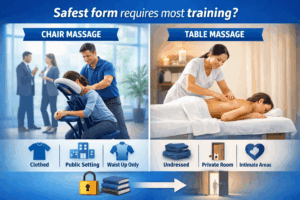
Let’s be clear about why table massage required robust regulation. The concerns were legitimate and remain so:

The Risk Profile of Table Massage:

  • Clients undress and require draping protocols
  • Work occurs in private rooms behind closed doors
  • Practitioners access intimate and vulnerable body areas
  • Clients are in prone or supine positions, limiting their mobility and agency
  • The setting creates opportunities for exploitation and illegal activity
  • Without clear standards, illegitimate businesses could operate under the guise of massage

These regulations addressed real harm. They created professional boundaries, established training standards, required background checks, and built a framework that helps law enforcement distinguish legitimate practice from criminal enterprise. This framework has been essential to protecting both clients and the profession’s legitimacy.

The question is not whether these regulations are necessary for table massage. They are. The question is whether these same regulations make sense for a practice with none of the same risk factors.

Chair Massage: A Different Practice Entirely

Consider what chair massage actually is:

The Structure of Chair Massage:

  • Clients remain fully clothed throughout
  • Work is performed from the waist up or knees down only
  • Sessions occur in public or semi-public settings—airports, corporate offices, health fairs, farmers markets
  • The client sits in a specialized chair with their face in a cradle, able to stand and leave at any moment
  • No closed doors, no private rooms, no disrobing, no draping protocols
  • The practice is inherently transparent and observable

In other words, chair massage is designed around the very features that address the core concerns of massage regulation. It is massage practice with built-in safeguards.

The practitioner cannot access intimate body areas. The client never disrobes. The setting provides natural oversight. The positioning gives the client complete agency and easy exit. There are no closed doors behind which exploitation could occur.

If the regulatory mission is to prevent exploitation, trafficking, and illegitimate business operations, chair massage already accomplishes this through its structure. Requiring 500-1000 hours of table massage training to practice chair massage is like requiring a driver’s license to ride a bicycle—the safety concerns that justify the license simply don’t apply to the activity being regulated.

The International Perspective

This becomes even clearer when we look beyond US borders. In most countries, there is no training minimum for practicing chair massage. In France, where I helped establish professional standards, we created a 150-hour training program specifically for chair massage practitioners.

Are clients in these countries experiencing exploitation or harm? Is chair massage being used as a front for illegal activity? No. The structural features of chair massage—clothed, public, limited body areas—create inherent protection regardless of training requirements.

The US is one of the few countries requiring extensive table massage training for a practice that bears little resemblance to table massage. And we stand alone not because we’ve identified risks others have missed, but because we’ve applied a regulatory framework designed for one practice to a fundamentally different one.

The Cost of Regulatory Overreach

This misalignment has consequences:

For Aspiring Practitioners:

Consider someone who wants to work for themselves or for a company providing chair massage services in corporate offices, at trade shows, or in retail settings—the most common work path for chair massage practitioners. Or a single parent working full-time who wants to offer chair massage at community health fairs. Both must invest 500-1000 hours and thousands of dollars in training they don’t need for their actual practice. Many simply can’t make this investment, so they never enter the profession—and the businesses that would employ them can’t find enough qualified practitioners. We lose their skills, their perspectives, their potential service to their communities, and the economic opportunities this accessible work could provide.

For Underserved Communities:

Populations unfamiliar with massage, those with limited financial resources, those in rural areas—they’re most likely to encounter massage through chair massage at community events, workplaces, or public settings. But because we’ve made it so difficult to become a chair massage practitioner, there are fewer practitioners available, particularly in these underserved markets.

For the Profession:

We claim we want to normalize skilled touch, to make it part of everyday wellness rather than a luxury service. But chair massage is the most safe, convenient, and affordable way for people to experience professional touch for the first time. By restricting access to chair massage practice, we limit the profession’s ability to reach new populations and grow the overall market.

For Professional Legitimacy:

Perhaps most ironically, this regulatory structure actually undermines the profession’s legitimacy. When regulations appear arbitrary—when they can’t be justified by the actual risk profile of the practice—they invite criticism and resistance. They suggest gatekeeping rather than public protection.

A Risk-Appropriate Regulatory Model

What would regulations look like if they were designed around actual risk rather than regulatory inertia?

For Table Massage (higher risk profile):

  • 500-1000 hours of training covering anatomy, pathology, draping, ethics, boundaries, and therapeutic applications
  • Background checks and screening
  • Continuing education requirements
  • Clear scope of practice and professional standards
  • Robust enforcement mechanisms

For Chair Massage (lower risk profile):

  • 125-175 hours of training focused on the actual skills needed: pressure techniques, body mechanics, client communication, safety, professional boundaries in public settings, a theory of touch, and business practices
  • Background checks (same as table massage)
  • Clear scope of practice definition: clothed, from waist up or knees down, public or semi-public settings
  • Option to advance to table massage through additional training

This model aligns training burden with risk profile. It protects clients while expanding access. It maintains professional standards while removing unnecessary barriers.

The Acceptability vs. Accessibility Choice

The massage profession has made a choice, perhaps unconsciously, to prioritize acceptability over accessibility. In our quest for legitimacy—to be seen as serious, therapeutic, professional—we’ve adopted the trappings of medical professions: extensive training hours, complex licensing requirements, therapeutic positioning.

This strategy has brought real benefits. We are more accepted, more respected, more integrated into healthcare settings.

But we’ve paid a price. We’ve become less accessible—to practitioners who can’t afford extensive training, to communities that can’t access our services, to clients who find our profession intimidating or unfamiliar.

Chair massage was developed to address this accessibility gap. It’s massage for people who would never book a table massage session. It’s practice for practitioners who can’t or won’t invest 500-1000 hours in training. It’s skilled touch in everyday settings—the workplace, the shopping center, the community event—rather than only in therapeutic or spa environments.

By forcing chair massage through the same regulatory framework as table massage, we’ve eliminated its accessibility advantage. We’ve preserved acceptability at the cost of accessibility.

Moving Forward: A Call to Action

For the massage profession to truly serve the public, we need regulations that distinguish between different practices based on their actual risk profiles. This isn’t about lowering standards—it’s about right-sizing them.

To Regulators: Create a separate licensing pathway for chair massage that reflects its lower risk profile and its role as an entry point to the profession. Study outcomes in the many countries where chair massage is practiced with minimal training requirements. Ask whether current regulations serve public safety or simply protect the status quo.

To Schools: Develop chair massage certification programs lasting no longer than 200-hours that serve the students who actually want this training. Create articulation agreements so these hours can count toward table licensure for those who want to advance. Recognize that not every student wants or needs to practice table massage.

To Professional Associations: Advocate for risk-appropriate regulations. Acknowledge that chair massage and table massage are different practices requiring different training. Recognize that expanding accessibility doesn’t threaten professional legitimacy—it enhances it by demonstrating that we care more about serving the public than protecting our gates.

To Practitioners: Support pathways that make the profession more accessible. Mentor new chair massage practitioners. Recognize that someone practicing clothed massage in public settings isn’t competing with your therapeutic practice—they’re expanding the overall market for skilled touch.

Conclusion: Legitimacy Through Service

The massage profession fought hard to separate itself from prostitution and exploitation. That fight was necessary. The regulations that emerged from it have protected clients and established professional standards.

But chair massage was designed from the start to embody the features that address those concerns: clothed, public, limited body areas, inherent oversight. Applying table massage regulations to chair massage doesn’t enhance safety—it simply reduces access.

Real professional legitimacy comes not from how high we build our walls, but from how well we serve the public. Chair massage, as the true entry point into professional skilled touch, should be regulated as what it is: a distinct, lower-risk practice that makes skilled touch accessible to the greatest number of people.

The regulations designed to protect the profession shouldn’t be the same regulations that limit its reach. We can maintain rigorous standards for table massage while creating appropriate pathways for chair massage. We can protect clients while expanding access. We can be both legitimate and accessible.

But only if we’re willing to separate safety from gatekeeping—and build a regulatory structure that serves the public as much as it serves the profession.


David Palmer began experimenting with seated massage on stools in the early 1980s in Silicon Valley and San Francisco at such places as Apple Computer. In 1986, he introduced the first professional massage chair into the world, and his trainings have become the foundation for tens of thousands of practitioners around the globe. You can access a library of his writings at www.touchpro.com.

Elementary Touch Education

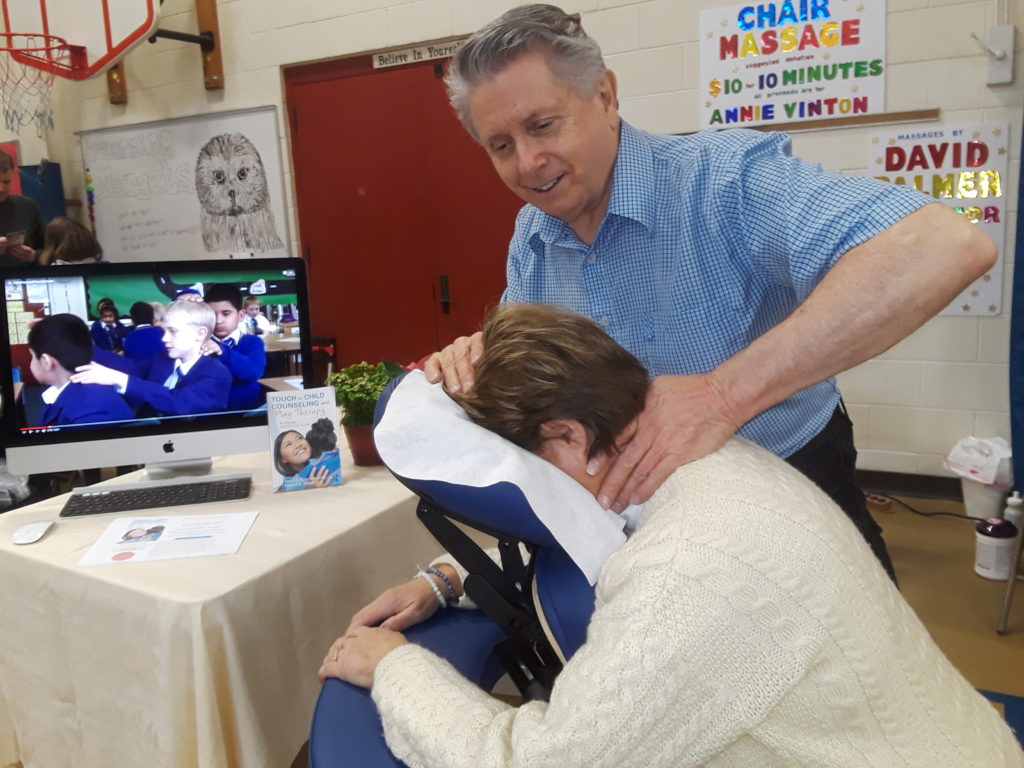
Last Saturday I had the opportunity to share chair massage at a PTO fundraising event for our local Annie Vinton Elementary School. It felt good to be promoting positive touch in this era of such nasty news. For some subliminal education, in the background I looped a couple of YouTube videos describing the benefits of child-to-child massage in classrooms. On the table I featured Touch in Child Counseling and Play Therapy: An Ethical Guide.

France recognizes seated massage as an occupational title

[Click to download a PDF of the press release version.]

France recently became the first country in the world to recognize seated massage as an occupational category with a professional certification. On June 7, 2016, the National Professional Certification Commission (Le Répertoire National des Certifications Professionnelles) approved Xavier Court Training as the sole provider of diplomas for Practitioners of Seated Massage.

Xavier and David

Xavier and David

Xavier Court, owner of the school, began the application process three years ago after joining forces with chair massage pioneer, David Palmer, and becoming an affiliate of Palmer’s organization, TouchPro International. Their application received a Level 2 certification under the French grading system (Level 1 is University diplomas) giving it a high degree of professional credibility. Throughout Europe the training is also rated as EuroPass Level 6 (the highest being Level 8) making the credential easily portable between all EU countries.

The approved curriculum is 170 hours and includes training in the TouchPro acupressure approach to chair massage developed by Palmer in 1986. While over 40,000 table massage practitioners around the globe have already been taught this system in continuing education seminars, this is the first time it has been the centerpiece of an entry-level massage program. Besides mastering the TouchPro technique, requires training in anatomy, physiology, hygiene, ethics, customer relations, and marketing to qualify graduates as world class chair massage specialists.

This also marks the first time that France has approved a specific credential for any massage services. Up to this point, the physiotherapists have prevented massage practitioners from being recognized as an independently titled profession. Palmer speculates that because seated massage was specifically defined in this instance as non-therapeutic, relaxation massage the French physiotherapists found it less objectionable than table massage therapy being provided as a health care service.

Another TouchPro affiliate in Trinidad & Tobago has an application in process for Caribbean-wide chair massage credentialing as a discrete occupation and Palmer looks forward to other countries adopting similar curriculum. The likelihood of North America following suit is slim as both Canada and the United States still require practitioners to complete 500- to 2200-hour table massage programs in most states and provinces before practitioners can legally offer chair massage services.

[For further information, please contact David Palmer at dp@touchpro.com.]

The History Channel Features the Massage Chair

[Jim Everett and David Palmer tinkering with the massage chair]

Jim Everett and David tinkering with the original massage chair

When I was first approached by The History Channel last July (2015) about filming a segment on the massage chair for a series on contemporary inventions and inventors, I didn’t get my hopes up. After all, how many of these programs actually get made? But, after the production company spent three days last Fall filming in San Francisco and Zurich (where they met my co-designer, Serge Bouyssou) I felt like, “OK, this is really going to happen.”

Then, in February I found out they titled the 10-part series Million Dollar Genius and, since I was neither, I thought: “Drat, they must have cut me out!”

But, fortunately, my segment is still in the show and is scheduled to air Friday, April 1, 2016 at 11pmET/10CT/9MT/11PT. It is the sixth episode in the series and is titled Bigger is Better, whatever that means. You can find additional information on the History Channel website about the program and view episodes that have already aired. You will need credentials from a cable provider to view it online. Since I don’t have a television, I use my sister’s account. It will also play at other times next week so check the program schedule for your time zone.

[Update: The segment has aired and you can view it here.]

I haven’t seen what they put together for the massage chair segment, but the episodes so far have had very high production values and create a good story. They interviewed myself, Serge Bouyssou, and my friend, Carlin Holden. I am still a little nervous that it is being aired on April Fool’s Day, but keeping my fingers crossed that it won’t make me look like a jerk.

The timing, however, is great since this is the 30th anniversary of the appearance of first massage chair. We are enhancing our website and collecting stories and pictures about the original Living Earth Crafts (LEC) chair and the very earliest days of seated massage (pre-1986) when there were no chairs. This collection will be the permanent archive dedicated to the original massage chair and the pioneers of seated massage.

If you would like to contribute photos, videos or audio stories to this effort, you can email me at dp@touchpro.com. If you have memories you would like to share, please leave comments below. What was your reaction the first time you saw a massage chair? The first time you received a chair massage? What happened the first time you tried to assemble or disassemble an LEC chair? What was the reaction of your first customers? Right now you also can read some wonderful memories in the comments section at the end of this article: The Story of the First Massage Chair.

From Chair to Table: How to Convert Your Chair Massage Clients

This article first appeared in the June 2015 of MASSAGE Magazine.

onsite massage copyChair massage often turns out to be just the right introduction people need to experience the joys and benefits of all varieties of structured touch. While not all chair massage clients will turn into table clients, often conversion success is simply a matter of not missing the opportunities presented by clients during the course of a chair massage encounter.

Here are three ways you can take advantage of such opportunities—and possibly win new table massage clients because of it.

Give massage away

Massage therapist Russ Borner can trace 80 percent of the $9,000 per month he typically grosses doing table massage to one specific chair massage he gave 30 years ago—for free—at a charity golf event in Westchester County, New York. His team had set up on the ninth hole to give each foursome of players a massage as they reached the halfway mark of the course.

After working a full day, they gathered in the lobby with all the players, who were getting ready for cocktails and dinner. Russ noticed a group of seven dedicated but very tired volunteers across the room, who looked like they also might appreciate a chair massage, so the team decided to offer their services.

One particular woman Russ worked on, Betsy, turned around in the chair after the massage was over and asked, “Do you make house calls?” She lived 40 miles away and was not wealthy enough to cover his travel expenses but, with a little negotiation, Russ agreed that if she could get two or three other friends to commit to a massage, he would be happy to make the trip. By the time Russ got home that night his answering machine was filled with requests from people saying, “Betsy told me you will be in our area next week. Can I book a massage with you?”

Betsy and her friends, and eventually their friends’ friends, kept making one positive word-of-mouth referral after another, until Russ had as much table massage work as he could handle. He and his wife Candice now run three spas, along with his thriving outcall practice of loyal table clients who pay $150 to $175 per massage. And, yes, Russ still gives Betsy her weekly massage—at half-price, with every fourth massage free in appreciation of her amazing networking skills.

Explain how you can help

Another typical scenario is people seeking a chair massage complaining of pain in their head, neck, shoulders, arms, hands or back. That is a perfect opportunity to educate clients about at least two levels of massage: systemic massage and focused work. Here is a sample script for moving those clients to your table:

“Chair massage is a systemic massage designed to help your body heal itself. So, although I won’t be addressing your specific problem, whether or not your complaint disappears by the end of this 10-minute session, I can guarantee you will feel better. If you prefer that I focus on your specific issue, I can make an appointment for you in my table practice, where we will have the time to thoroughly evaluate your issue and find the most effective solution.”

Make chair massage an appetizer

At one-time chair massage events, where you never expect to see the client again, you can often position chair massage as a sample of your regular table work. In these situations, at the end of each massage, Russ Borner will ask clients if they have ever had a table massage before. If not, he hands them a business card and invites them to experience one. People are much more likely to book their second massage with the practitioner who gave them their first massage, as long as the first experience was positive.

If his chair massage clients have previously had table massage, Russ makes this offer: “If you are willing to try a table massage from me and it is not one of the top three massages you have ever had in your life, then you don’t have to pay me.” In this case, clients have just had a sample of how good he can make them feel, and the guarantee makes the table massage virtually risk-free.

Massage marketing is ultimately about education, and the best way to educate someone about the value of your massage is to give them a sample. Chair massage is the perfect appetizer.