Are We Solving the Wrong Problem?

Why the Interstate Massage Compact Misses a Larger Regulatory Opportunity.
By David Palmer

Over the past several years, a significant amount of attention, funding, and professional energy in the U.S. massage field has been devoted to the proposed Interstate Massage Compact. Its aim is straightforward: allow licensed massage therapists to practice across state lines without navigating multiple, duplicative licensure systems.

Portability matters. For therapists who move frequently, serve mobile populations, or live near state borders, the current system is inefficient and frustrating. The Compact seeks to address a real problem.

But an important question remains largely unexamined:

Is licensure portability the most important regulatory problem facing the massage profession today? Or has the profession focused on a technically complex issue that affects a relatively small segment of practitioners, while overlooking reforms that could have delivered broader public benefit?

A Solution for a Subset

The Interstate Massage Compact is designed to help massage therapists who wish to practice in multiple states. By definition, this is a subset of the profession. Most massage therapists practice in one state, often in one community, and do not routinely cross state lines for work.

For these practitioners, the primary regulatory challenges are not portability. They are barriers to entry, access to employment, scope-of-practice limitations, and the cost and duration of training relative to earning potential.

From a public-policy standpoint, this distinction matters. Regulation should prioritize changes that produce the greatest benefit for the greatest number—both practitioners and the public they serve. Measured against that standard, the Compact’s impact is limited.

At the same time, one of the most accessible and scalable forms of massage—chair massage—remains constrained by regulations that fail to reflect how it is actually practiced.

Chair Massage: Common in Practice, Absent in Policy

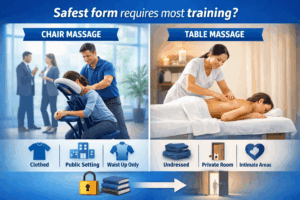
Chair massage is already woven into everyday life. It appears in workplaces, airports, conferences, healthcare facilities, senior centers, and community events. It is typically delivered:

    • Fully clothed
    • In open, observable settings
    • For short, defined periods
    • Without oils, lotions, or disrobing
    • Without diagnostic or therapeutic claims

In terms of risk profile, chair massage is fundamentally different from full-body table massage performed in private rooms. Yet in most states, it is regulated as if that distinction does not exist.

Chair massage is rarely recognized as a distinct modality. Instead, it is folded into full-scope massage licensure frameworks designed decades ago for a different practice context. As a result, practicing chair massage often requires the same regulatory investment—time, money, and education—as practicing unrestricted table massage.

The Consequences of Regulatory Mismatch

When regulation fails to distinguish between different kinds of practice, the result is not increased public safety. It is reduced access.

Overregulation of chair massage contributes to:

    • Fewer practitioners available for workplaces and public settings
    • Higher barriers to entry for new and career-changing practitioners
    • Reduced access to low-cost, preventive, stress-reducing services
    • Missed opportunities in community health and institutional care

Ironically, these outcomes undermine the very goals regulation is meant to serve: public protection, ethical practice, and a sustainable profession.

Good regulation is proportional. It differentiates based on actual risk and context. Treating all massage modalities as if they carry identical risks is not evidence-based policymaking—it is regulatory inertia.

The Opportunity Cost of the Compact

The Interstate Massage Compact has required years of coordinated effort, including federal funding, multistate legislative advocacy, administrative infrastructure, and extensive professional debate.

That investment represents an opportunity cost. Time, money, and political capital devoted to one regulatory pathway are not available for another.

Had even a portion of those resources been directed toward modernizing chair massage regulation, the results could have been immediate and tangible. Potential reforms might have included:

    • Explicit recognition of chair massage as a limited-scope practice
    • Tiered or entry-level credentials aligned with chair massage only
    • Education requirements calibrated to actual risk
    • Clear regulatory guidance for public and institutional settings

Such reforms would not eliminate full licensure pathways. They would complement them—creating legitimate on-ramps into the profession rather than guarding a single gate.

Public Safety and Public Access Are Not Opposites

Advocates of the Compact often frame their arguments around public protection. This concern is valid. But public safety is not enhanced by ignoring meaningful differences in practice context.

Chair massage’s defining characteristics—clothing, visibility, time limits, and public settings—already mitigate many of the risks regulators are rightly concerned about, including boundary violations and misconduct. These features make chair massage particularly well suited to scoped regulation.

Failing to account for these differences does not make regulation stronger. It makes it less precise.

A Question of Priorities

The debate over the Interstate Massage Compact has exposed divisions within the profession about governance, standards, and access. But beneath those disagreements lies a more fundamental question:

What kind of profession is massage becoming, and who is it for?

A regulatory strategy focused primarily on interstate portability benefits established practitioners who already meet full licensure standards. A strategy that also modernizes chair massage regulation would serve a wider range of stakeholders: new entrants, community programs, employers, institutions, and the public.

Conclusion

The Interstate Massage Compact may still move forward, and it may ultimately benefit a segment of the profession. But it is worth acknowledging what was not pursued with the same urgency.

Chair massage—safe, public, and widely accepted—has been hiding in plain sight, constrained by regulations that no longer reflect reality. If the goal of regulation is truly to protect the public while supporting a healthy profession, then the energy spent chasing portability may have been better spent opening doors.

The next chapter of massage regulation should focus less on crossing state lines—and more on removing the barriers that no longer make sense.
Separating Safety from Gatekeeping: The Case for Chair Massage as Entry-Level Practice

Why the regulations designed to protect the profession actually limit its reach

By David Palmer

The American massage profession has spent decades fighting for legitimacy. At the heart of this struggle has been a critical mission: separating professional massage from prostitution and the exploitation and trafficking that accompany it. This fight has been necessary, important, and ongoing. State regulations requiring 500-1000 hours of training have served as one tool in this battle, establishing clear professional standards and creating distance from illegal activities masquerading as massage.

But in pursuing this necessary goal, the profession has created an unintended casualty: accessibility. More specifically, we’ve allowed the regulations designed to address the real risks of table massage to inadvertently stifle a fundamentally different practice—chair massage—that poses none of the same concerns while holding the promise of dramatically expanding the market for all massage services.
I began experimenting with massaging seated customers in 1982 with a specific vision: making skilled touch accessible to the greatest number of people. What I’ve witnessed since is a regulatory structure that prioritizes professional acceptability over this accessibility, requiring practitioners to complete hundreds of hours of table massage training before they can practice a form of massage that, by its very nature, addresses the core concerns that justified those regulations in the first place.

It’s time to examine whether our regulatory structure actually serves its stated purpose—or whether it simply serves itself.

Understanding the Original Problem

Let’s be clear about why table massage required robust regulation. The concerns were legitimate and remain so:

The Risk Profile of Table Massage:

  • Clients undress and require draping protocols
  • Work occurs in private rooms behind closed doors
  • Practitioners access intimate and vulnerable body areas
  • Clients are in prone or supine positions, limiting their mobility and agency
  • The setting creates opportunities for exploitation and illegal activity
  • Without clear standards, illegitimate businesses could operate under the guise of massage

These regulations addressed real harm. They created professional boundaries, established training standards, required background checks, and built a framework that helps law enforcement distinguish legitimate practice from criminal enterprise. This framework has been essential to protecting both clients and the profession’s legitimacy.

The question is not whether these regulations are necessary for table massage. They are. The question is whether these same regulations make sense for a practice with none of the same risk factors.

Chair Massage: A Different Practice Entirely

Consider what chair massage actually is:

The Structure of Chair Massage:

  • Clients remain fully clothed throughout
  • Work is performed from the waist up or knees down only
  • Sessions occur in public or semi-public settings—airports, corporate offices, health fairs, farmers markets
  • The client sits in a specialized chair with their face in a cradle, able to stand and leave at any moment
  • No closed doors, no private rooms, no disrobing, no draping protocols
  • The practice is inherently transparent and observable

In other words, chair massage is designed around the very features that address the core concerns of massage regulation. It is massage practice with built-in safeguards.

The practitioner cannot access intimate body areas. The client never disrobes. The setting provides natural oversight. The positioning gives the client complete agency and easy exit. There are no closed doors behind which exploitation could occur.

If the regulatory mission is to prevent exploitation, trafficking, and illegitimate business operations, chair massage already accomplishes this through its structure. Requiring 500-1000 hours of table massage training to practice chair massage is like requiring a driver’s license to ride a bicycle—the safety concerns that justify the license simply don’t apply to the activity being regulated.

The International Perspective

This becomes even clearer when we look beyond US borders. In most countries, there is no training minimum for practicing chair massage. In France, where I helped establish professional standards, we created a 150-hour training program specifically for chair massage practitioners.

Are clients in these countries experiencing exploitation or harm? Is chair massage being used as a front for illegal activity? No. The structural features of chair massage—clothed, public, limited body areas—create inherent protection regardless of training requirements.

The US is one of the few countries requiring extensive table massage training for a practice that bears little resemblance to table massage. And we stand alone not because we’ve identified risks others have missed, but because we’ve applied a regulatory framework designed for one practice to a fundamentally different one.

The Cost of Regulatory Overreach

This misalignment has consequences:

For Aspiring Practitioners:

Consider someone who wants to work for themselves or for a company providing chair massage services in corporate offices, at trade shows, or in retail settings—the most common work path for chair massage practitioners. Or a single parent working full-time who wants to offer chair massage at community health fairs. Both must invest 500-1000 hours and thousands of dollars in training they don’t need for their actual practice. Many simply can’t make this investment, so they never enter the profession—and the businesses that would employ them can’t find enough qualified practitioners. We lose their skills, their perspectives, their potential service to their communities, and the economic opportunities this accessible work could provide.

For Underserved Communities:

Populations unfamiliar with massage, those with limited financial resources, those in rural areas—they’re most likely to encounter massage through chair massage at community events, workplaces, or public settings. But because we’ve made it so difficult to become a chair massage practitioner, there are fewer practitioners available, particularly in these underserved markets.

For the Profession:

We claim we want to normalize skilled touch, to make it part of everyday wellness rather than a luxury service. But chair massage is the most safe, convenient, and affordable way for people to experience professional touch for the first time. By restricting access to chair massage practice, we limit the profession’s ability to reach new populations and grow the overall market.

For Professional Legitimacy:

Perhaps most ironically, this regulatory structure actually undermines the profession’s legitimacy. When regulations appear arbitrary—when they can’t be justified by the actual risk profile of the practice—they invite criticism and resistance. They suggest gatekeeping rather than public protection.

A Risk-Appropriate Regulatory Model

What would regulations look like if they were designed around actual risk rather than regulatory inertia?

For Table Massage (higher risk profile):

  • 500-1000 hours of training covering anatomy, pathology, draping, ethics, boundaries, and therapeutic applications
  • Background checks and screening
  • Continuing education requirements
  • Clear scope of practice and professional standards
  • Robust enforcement mechanisms

For Chair Massage (lower risk profile):

  • 125-175 hours of training focused on the actual skills needed: pressure techniques, body mechanics, client communication, safety, professional boundaries in public settings, a theory of touch, and business practices
  • Background checks (same as table massage)
  • Clear scope of practice definition: clothed, from waist up or knees down, public or semi-public settings
  • Option to advance to table massage through additional training

This model aligns training burden with risk profile. It protects clients while expanding access. It maintains professional standards while removing unnecessary barriers.

The Acceptability vs. Accessibility Choice

The massage profession has made a choice, perhaps unconsciously, to prioritize acceptability over accessibility. In our quest for legitimacy—to be seen as serious, therapeutic, professional—we’ve adopted the trappings of medical professions: extensive training hours, complex licensing requirements, therapeutic positioning.

This strategy has brought real benefits. We are more accepted, more respected, more integrated into healthcare settings.

But we’ve paid a price. We’ve become less accessible—to practitioners who can’t afford extensive training, to communities that can’t access our services, to clients who find our profession intimidating or unfamiliar.

Chair massage was developed to address this accessibility gap. It’s massage for people who would never book a table massage session. It’s practice for practitioners who can’t or won’t invest 500-1000 hours in training. It’s skilled touch in everyday settings—the workplace, the shopping center, the community event—rather than only in therapeutic or spa environments.

By forcing chair massage through the same regulatory framework as table massage, we’ve eliminated its accessibility advantage. We’ve preserved acceptability at the cost of accessibility.

Moving Forward: A Call to Action

For the massage profession to truly serve the public, we need regulations that distinguish between different practices based on their actual risk profiles. This isn’t about lowering standards—it’s about right-sizing them.

To Regulators: Create a separate licensing pathway for chair massage that reflects its lower risk profile and its role as an entry point to the profession. Study outcomes in the many countries where chair massage is practiced with minimal training requirements. Ask whether current regulations serve public safety or simply protect the status quo.

To Schools: Develop chair massage certification programs lasting no longer than 200-hours that serve the students who actually want this training. Create articulation agreements so these hours can count toward table licensure for those who want to advance. Recognize that not every student wants or needs to practice table massage.

To Professional Associations: Advocate for risk-appropriate regulations. Acknowledge that chair massage and table massage are different practices requiring different training. Recognize that expanding accessibility doesn’t threaten professional legitimacy—it enhances it by demonstrating that we care more about serving the public than protecting our gates.

To Practitioners: Support pathways that make the profession more accessible. Mentor new chair massage practitioners. Recognize that someone practicing clothed massage in public settings isn’t competing with your therapeutic practice—they’re expanding the overall market for skilled touch.

Conclusion: Legitimacy Through Service

The massage profession fought hard to separate itself from prostitution and exploitation. That fight was necessary. The regulations that emerged from it have protected clients and established professional standards.

But chair massage was designed from the start to embody the features that address those concerns: clothed, public, limited body areas, inherent oversight. Applying table massage regulations to chair massage doesn’t enhance safety—it simply reduces access.

Real professional legitimacy comes not from how high we build our walls, but from how well we serve the public. Chair massage, as the true entry point into professional skilled touch, should be regulated as what it is: a distinct, lower-risk practice that makes skilled touch accessible to the greatest number of people.

The regulations designed to protect the profession shouldn’t be the same regulations that limit its reach. We can maintain rigorous standards for table massage while creating appropriate pathways for chair massage. We can protect clients while expanding access. We can be both legitimate and accessible.

But only if we’re willing to separate safety from gatekeeping—and build a regulatory structure that serves the public as much as it serves the profession.


David Palmer began experimenting with seated massage on stools in the early 1980s in Silicon Valley and San Francisco at such places as Apple Computer. In 1986, he introduced the first professional massage chair into the world, and his trainings have become the foundation for tens of thousands of practitioners around the globe. You can access a library of his writings at www.touchpro.com.

Soft Robotics Meets Traditional Acupressure Massage

Image of hand vs robotic massageA new study explores how “smart touch” technologies could expand the reach of manual therapy

The Chinese been working hard for the past few years on practical applications for robotics and artificial intelligence. One of the areas of focus has been improving mechanical massage far beyond the electronic recliners costing thousands of dollars. Here is the latest from a recent paper.

Re-imagining the Skilled Hand

In traditional Chinese medicine, acupressure massage has long been valued for its ability to regulate energy, ease tension, and promote recovery from stress or illness. Yet as every practitioner knows, the heart of this work lies in the hand—its sensitivity, precision, and intuitive adaptability. Training that hand takes years. Reproducing its skill mechanically has seemed almost impossible.

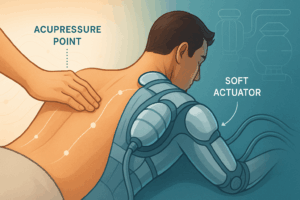
That challenge is now being addressed by a new generation of soft robots—machines made from flexible, compliant materials that can bend, compress, and conform to the body in ways rigid devices never could. A recent engineering study introduces a Soft Massage Physiotherapy Robot (SMPR) that uses these principles to replicate acupoint stimulation safely and precisely.


From Hard Motors to Soft Touch

Most mechanical massage devices rely on rigid motors and gears. While powerful, they can feel artificial or even unsafe for therapeutic work, especially in sensitive or clinical settings. Soft robotics replaces those hard joints with air-powered actuators—essentially inflatable bladders that expand and contract like living tissue.

In this design, the researchers created a wearable “armor” equipped with several of these pneumatic physiotherapy actuators (PPAs). Each actuator can press, roll, or release against specific acupoints under computer control, generating movement patterns similar to those used by human practitioners.

The potential is enormous: gentle, wearable systems capable of providing localized massage therapy, rehabilitation support, or even assisted self-treatment at home.


The Core Challenge: Teaching the Robot to “Feel”

The biggest obstacle wasn’t mechanical—it was behavioral. Soft materials don’t move in a perfectly predictable way. They exhibit hysteresis, meaning that their responses lag behind the commands they receive. For practitioners, this would be like having your hand react a split second late every time you tried to adjust pressure.

To solve this, the research team built a sophisticated control system that learns to predict and compensate for these delays. Their approach combined several advanced strategies:

  • Inverse compensation, which corrects for the lag in actuator response.

  • Fuzzy logic algorithms, which “learn” to handle uncertainties—similar to how an experienced therapist senses and adjusts to subtle feedback.

  • Adaptive fuzzy integral sliding-mode control (AFISMC), a robust method that continuously fine-tunes movement in real time to maintain accuracy and stability even under variable conditions.

Together, these methods allowed the robot to deliver consistent, precisely modulated acupressure without the jerky or inconsistent behavior typical of earlier devices.


What the Experiments Showed

Through multiple test scenarios, the researchers demonstrated that the SMPR could track desired pressure and movement patterns with remarkable accuracy. The device maintained stability even when faced with external disturbances or small modeling errors.

Mathematical proofs confirmed that the system’s performance is predictably reliable—a necessary step before any therapeutic application can be considered safe for human use.


Why This Matters for the Massage Field

The authors of the study make clear that their goal is not to replace massage practitioners, but to make acupressure therapy more accessible, consistent, and measurable. Still, their work should serve as a wake-up call to the massage profession.

By merging soft robotics with traditional healing knowledge, researchers are taking real steps toward intelligent systems that embody some of the same hallmarks of skilled touch—sensitivity, adaptability, and safety—qualities once thought to belong only to the human hand.

In recent years, hundreds of millions—perhaps billions—of dollars have been invested in understanding the mechanics of touch. Nearly all of it, however, has come from engineering and robotics, focused on quantifying what practitioners feel intuitively: pressure modulation, responsiveness, and safety. And they are making impressive progress. By contrast, research generated from within the massage field remains minimal.

It is almost certain that physical therapy and spa industries will embrace these technologies as a way to deliver standardized “touch” without the need for expensive human practitioners. If the massage profession wishes to remain vital and relevant, it must take the lead in educating the public about what human touch uniquely provides—the empathy, intuition, and relational intelligence no machine can replicate.

Unless that happens, the future of massage could, quite literally, be left in the hands of robots.


Massage is Sensational

Brain OrgasmA recent article in The Atlantic about a phenomenon called ASMR (autonomous sensory meridian response) reminded me of how little we celebrate the purely sensational nature of massage.

ASMR is a subjective sensory experience that typically includes highly pleasurable tingling in the head triggered by external audio or visual stimuli such as whispering, tapping or watching certain videos. Possibly because someone early on began referring to this sensation as a “brain orgasm,” the ASMR meme went viral with articles appearing on Slate, Time, and Huffington Post as well as numerous podcasts and radio programs. YouTube already lists nearly 2 million videos on the subject.

I had two reactions when I first read about ASMR. The first was, “What’s the fuss about? Every time I get a massage, I tingle all over, including in my head and brain.” My second thought was, “How come massage doesn’t have 2 million videos on how good massage feels?”

Professional massage exists on a social acceptability spectrum that can be summarized into four major categories: Sexual, sensual, wellness, and therapy. For the past 30 years the goal of the mainstream massage industry has been to highlight the latter two categories while downplaying the first two in an attempt to create as much distance as possible between massage and any hint of prostitution.

In the process, the fact that, first and foremost, massage feels good has gotten lost. That is unfortunate because, as science is now discovering, feeling good is probably one of the best things that we can do for our ongoing health and well being.

Learning how to stimulate a parasympathetic (relaxation) response, as massage does quickly and so effectively, is crucial to the daily health and renewal of virtually every physiological system in our bodies, not to mention the maintenance of a healthy psycho-social balance.

“Massage is not just pampering,” popular magazine headlines try to convince us. I say, what’s wrong with pampering if it boosts the immune system, lowers blood pressure, reduces stress hormones, increases oxytocin and heightens heart rate variability, a marker of parasympathetic response? A simple, caring massage is also an unconditional validation of my existence that nurtures both internal and external empathy. What’s not to like?

All massage is sensational. It makes us feel more and it makes us feel better. What a gift is the massage that banishes the numbness with which we armor our bodies and our spirits. Let us celebrate the sensational essence of massage and start making those videos.

Viewing Massage Through a Holonic Lens

One of the critical topics in the massage community is how to define and label what we do. How we define massage influences how we market our services, how we regulate them and how we educate new people coming into our profession.

Like the classic tale of the blind men trying to describe an elephant, how we define massage, to a great extent, depends on where we are standing. Massage is a very big elephant with many facets. So, when we talk about massage, at the least, we need to talk about where we are standing so we can also frame the limits of each perspective and how it relates to every other perspective.

Since 1998, I have been a student of integral theory, which presumes that every perspective is true but partial. The integral approach thus allows for an infinite number of perspectives while, at the same time, providing a framework that allows us to carefully examine and map, in this case, all dimensions of massage.

This article is the first in a series that will analyze massage from a wide range of perspectives using the integral framework. Each analysis will define a lens through which to consider the rich tapestry of massage. The first lens I will use is called the holonic perspective.

The holonic lens defines that every aspect of existence is at once both a whole and a part—a “holon.” Writer/philosopher Arthur Koestler coined the term holon in 1967 and called the hierarchical ordering of any sequence of whole/parts a holarchy.

For example, a human holon is composed of many organ parts. Each organ holon is composed of cells; each cell is composed of molecules; molecules are composed of atoms; atoms of particles and so on. This article is a holarchy starting with letters that make words that make sentences that make paragraphs that make the article.

Each fundamental holon can stand on its own but, when combined with other holons, more complex, more significant holons emerge. That is to say, a holon is not merely the sum of its parts. Each holon transcends and includes the previous structures. While a cell is composed of molecules, it also transcends cells to form a higher functioning, more complex structure.

This concept is imbedded in the origins of the Holistic Health movement that emerged in the 1970s. That movement was a reaction to the reductionism dominant in the specialization of mainstream medicine for most of the 20th century that treated only parts of people, not the whole person. Indeed, one of the reasons I was drawn to massage and bodywork forty years ago was the fact that its resurgence was driven by people committed to a holistic understanding of the body/mind.

There are many holarchies we can study in massage. I will give two examples in this article, one that looks at the physical, objective exterior of massage and one that considers an interior, subjective perspective. In future articles other holonic analyses will emerge.

A Massage Exterior

A complete professional massage holon is composed of a series of sequences or protocols applied to various parts of the body. Which sequences are selected (location) and how much time we spend on each part and in what order (choreography) has a lot to do with how we define any particular massage.

For example, foot reflexology, chair massage, Indian head massage, sports massage, remedial massage, and full-body Swedish or acupressure massage each select their locations and arrange their choreography very differently.

Each holonic sequence in a massage is a composition of various techniques that can be categorized into dozens of variations on compression, friction, stroking, holding, kneading, lifting, movement and mobilization, percussion, and vibration. These techniques and sequences, combined with a clearly defined intention and/or theoretical framework and/or worldview is what defines a particular massage modality.

Finally, every technique holon is composed of touch. Professional massage is a physical connection to and through the skin of the recipient. Most of the time this is done by the hands of the practitioner but can also include the intermediary of massage tools manipulated by the practitioner.

So, to summarize this analysis of massage we could say that fundamental to all massage is touch. But the particular kind of touch in a massage is not casual, accidental or spontaneous. Rather it is the trained touch of definable techniques. These techniques, in turn, compose the sequences that, informed by specific intentions, create what we call a massage.

A Massage Interior

One subjective (interior) analysis of another holarchy inherent to massage might point to the fact that every massage is fundamentally a relationship holon.

While there are many kinds of relationships (e.g. mathematical, organizational, mechanical), in massage the relationship is interpersonal, i.e. between two people.

Within the universe of all possible interpersonal relationships, massage is not a parental relationship or a friendship, but I would suggest it falls in the category of service relationships.

The kind of service that we provide, as noted in the first section, is fundamentally touch which, by definition, means that this service is one that requires physical intimacy.

So, we could summarize this point of view by saying that massage is subjectively experienced as an intimate, interpersonal, service relationship.

Practical Value

These two holarchies point to the internal and external constructions of a massage. Understanding that fundamentally massage is objectively about touch and subjectively about intimacy is critical to the health and growth of our profession. While these should be our primary areas of expertise, by and large, both of these aspects have been increasingly relegated to the shadows of our profession.

With the transformation of “massage” into “massage therapy” we have left behind the philosophical roots of the holistic health tradition.

Consequently an ever-increasing number of students are allowed to graduate from massage programs without knowing how to give and receive touch nor deal with the intimacy inherent in a touch relationship.

The latest striking example of touch-denying in our profession comes from the two surveys currently circulating in the industry—the FSMTB Job Task Analysis Survey and the companion Entry Level Analysis Project. Both are part of the attempt to define entry-level skills for our profession. Between the two, the word “touch” appears exactly one time. Of course the term “intimacy” does not appear at all.

Our refusal as a profession to embrace touch and the intimacy it represents by sterilizing it under the guise of massage therapy is clearly leading us down an unnecessarily self-limiting path. [See the related article Moving from Acceptability to Accessibility.] Our virtual culture is increasingly debilitated by the lack of authentic human validation and connection. We hold an answer literally in the palm of our hands. Let’s give people what they crave.

The Canyon Ranch Think Tank

Have you every wondered why the National Certification Board of Therapeutic Massage and Bodywork (NCBTMB) has such an awkward name? What’s with that business of “Therapeutic Massage and Bodywork?” Couldn’t they have stopped after the word “Massage?”

You can credit a fascinating but mostly forgotten piece of massage history, The Canyon Ranch Think Tank, for making certain that “Bodywork” was included in the name.

Canyon Ranch, located in Tucson, AZ, was one of the first of a new generation of high end spas in the late 1980s  looking to transform the image of “fat farms” into “wellness centers.” Founded by Mel and Enid Zuckerman in 1979, within ten years it was a recognized innovator in the spa industry and was spreading its message of wellness and integrative health through its non-profit arm, the Canyon Ranch Foundation.

It was this foundation that brought together a group of 13 independent bodywork leaders for four days in September of 1989 “to explore issues critical to the emerging bodywork professions. They were to examine some of the unifying characteristics of touch professionals, and the objective of this particular meeting was to study and contribute to the evolution of the core terminology.”

What this came to mean for the participants was a search for “THE WORD,” an umbrella term under which all skilled touch professions could unify. After hours of intense discussion, the word settled on was, you guessed it, “Bodywork.”

Interestingly, at that time, there were only three serious contenders: “bodywork,” “massage,” and “touch therapy.” Significant in its absence was the term “massage therapy” which, arguably, could be said to have actually won the terminology battle, at least within the mainstream massage community.

Indeed, probably the only specific impact the Think Tank actually had was making certain that the NCBTMB, whose development was spearheaded by a number of Canyon Ranch participants, included the term “bodywork” in its name. I have always used “bodywork” as my meta-term for all touch modalities and still thinks it makes the most sense.

If you are interested in reading the full report, including the formal definition of “bodywork,” you can download a PDF here.

If you would like to read more about why “massage therapy” dominates the terminology in our industry today, check out this related article.