Soft Robotics Meets Traditional Acupressure Massage
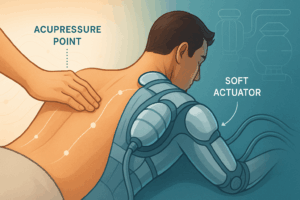
Image of hand vs robotic massageA new study explores how “smart touch” technologies could expand the reach of manual therapy

The Chinese been working hard for the past few years on practical applications for robotics and artificial intelligence. One of the areas of focus has been improving mechanical massage far beyond the electronic recliners costing thousands of dollars. Here is the latest from a recent paper.

Re-imagining the Skilled Hand

In traditional Chinese medicine, acupressure massage has long been valued for its ability to regulate energy, ease tension, and promote recovery from stress or illness. Yet as every practitioner knows, the heart of this work lies in the hand—its sensitivity, precision, and intuitive adaptability. Training that hand takes years. Reproducing its skill mechanically has seemed almost impossible.

That challenge is now being addressed by a new generation of soft robots—machines made from flexible, compliant materials that can bend, compress, and conform to the body in ways rigid devices never could. A recent engineering study introduces a Soft Massage Physiotherapy Robot (SMPR) that uses these principles to replicate acupoint stimulation safely and precisely.


From Hard Motors to Soft Touch

Most mechanical massage devices rely on rigid motors and gears. While powerful, they can feel artificial or even unsafe for therapeutic work, especially in sensitive or clinical settings. Soft robotics replaces those hard joints with air-powered actuators—essentially inflatable bladders that expand and contract like living tissue.

In this design, the researchers created a wearable “armor” equipped with several of these pneumatic physiotherapy actuators (PPAs). Each actuator can press, roll, or release against specific acupoints under computer control, generating movement patterns similar to those used by human practitioners.

The potential is enormous: gentle, wearable systems capable of providing localized massage therapy, rehabilitation support, or even assisted self-treatment at home.


The Core Challenge: Teaching the Robot to “Feel”

The biggest obstacle wasn’t mechanical—it was behavioral. Soft materials don’t move in a perfectly predictable way. They exhibit hysteresis, meaning that their responses lag behind the commands they receive. For practitioners, this would be like having your hand react a split second late every time you tried to adjust pressure.

To solve this, the research team built a sophisticated control system that learns to predict and compensate for these delays. Their approach combined several advanced strategies:

  • Inverse compensation, which corrects for the lag in actuator response.

  • Fuzzy logic algorithms, which “learn” to handle uncertainties—similar to how an experienced therapist senses and adjusts to subtle feedback.

  • Adaptive fuzzy integral sliding-mode control (AFISMC), a robust method that continuously fine-tunes movement in real time to maintain accuracy and stability even under variable conditions.

Together, these methods allowed the robot to deliver consistent, precisely modulated acupressure without the jerky or inconsistent behavior typical of earlier devices.


What the Experiments Showed

Through multiple test scenarios, the researchers demonstrated that the SMPR could track desired pressure and movement patterns with remarkable accuracy. The device maintained stability even when faced with external disturbances or small modeling errors.

Mathematical proofs confirmed that the system’s performance is predictably reliable—a necessary step before any therapeutic application can be considered safe for human use.


Why This Matters for the Massage Field

The authors of the study make clear that their goal is not to replace massage practitioners, but to make acupressure therapy more accessible, consistent, and measurable. Still, their work should serve as a wake-up call to the massage profession.

By merging soft robotics with traditional healing knowledge, researchers are taking real steps toward intelligent systems that embody some of the same hallmarks of skilled touch—sensitivity, adaptability, and safety—qualities once thought to belong only to the human hand.

In recent years, hundreds of millions—perhaps billions—of dollars have been invested in understanding the mechanics of touch. Nearly all of it, however, has come from engineering and robotics, focused on quantifying what practitioners feel intuitively: pressure modulation, responsiveness, and safety. And they are making impressive progress. By contrast, research generated from within the massage field remains minimal.

It is almost certain that physical therapy and spa industries will embrace these technologies as a way to deliver standardized “touch” without the need for expensive human practitioners. If the massage profession wishes to remain vital and relevant, it must take the lead in educating the public about what human touch uniquely provides—the empathy, intuition, and relational intelligence no machine can replicate.

Unless that happens, the future of massage could, quite literally, be left in the hands of robots.


Latest Stats on Workplace Stress

An article out today from The Atlantic outlines the conclusions of a recent working paper from Harvard and Stanford Business Schools on the impact of high workplace stress levels on employee health.

"The paper found that health problems stemming from job stress, like hypertension, cardiovascular disease, and decreased mental health, can lead to fatal conditions that wind up killing about 120,000 people each year—making work-related stressors and the maladies they cause, more deadly than diabetes, Alzheimer’s, or influenza.

"High levels of stress are costly in monetary terms, too. Researchers found that stress-related health problems could be responsible for between 5 to 8 percent of annual healthcare costs in the U.S. That amounts to about $180 billion each year in healthcare expenses."

Haptics: The Science of Touch

Last week I saw a commercial for the new Cadillac XTS that featured an innovative touch technology called the Safety Alert Seat. The system sends vibrating pulses to drivers through the seat cushion if they drift out of their lane without a turn signal activated or if there is threat from the front or rear, such as when backing blind out of a parking space.

“It’s akin to someone tapping on your shoulder in a crowd to get your attention,” said, General Motors Active Safety Technical Fellow Raymond Kiefer. “Using the tactile sense to communicate crash threat direction provides an effective and intuitive way to cut through the clutter of visual and auditory sensory information that drivers routinely experience.”

Cool!

Chart comparing Massage to Haptic research

Number of annual peer-reviewed research papers.
Source: EBSCOhost

This technology had been developed in a field of touch research that I have been following for the past 15 years called “haptics,” derived from the Greek word meaning “pertaining to the sense of touch.” Thus, if you are studying touch, you are studying haptics.

Since the only thing that all 100+ modalities of massage and bodywork have in common is that they are all based on touch, it would seem only natural that the massage industry would have a close association with the folks doing haptic research. Unfortunately, that is not the case. Even the recently published groundbreaking textbook on massage therapy research (Massage Therapy: Integrating Research and Practice) makes no mention of haptic research.

As noted in the accompanying chart, annual research in massage has actually leveled off in the past five years while annual haptic research surpassed massage research ten years ago and continues to grow steadily each year.

Who is doing haptics research?

There are scores of companies developing products based on haptics research. Many do their own research and others partner with academic institutions such as:

Disney Research is an example of a major corporation investing in touch research: Surround Haptics – Immersive Tactile Experiences

Why are they doing haptic research?

Most research in haptics has focused on extending the human ability to reach, explore, grasp, manipulate and get feedback from the world around us. Applications can be found in robotics, prosthetics, remote medicine and surgery, hazardous environments, manufacturing, communications and education.

Closer to home, the phone vibrating in your pocket and the joystick on your gaming console are both a result of haptics research.

In the future, haptics will become an essential aspect of virtual human interaction in such arenas as business meetings and classrooms. Sound waves are being studied for their ability to mimic touch making virtual handshakes within the realm of possibility.

How is this important to massage?

Since massage and haptics have never interfaced with one another, at first glance, they may not appear to have much in common. But that is definitely not the case. Here are some reasons why we should be working together.

Defining touch

One of the outcomes of haptics research has been to define the discreet constituents of touch mechanics (movement, friction control, vibration, contact force, pressure, duration) and to develop models for discriminating texture, softness, ridgidity, temperature, moisture, shape, proprioception/orientation and weight/heft.

All of these components are critical to massage and thus essential to informed massage education, practice, evolution and research.

Standardizing touch

A serious flaw in virtually all massage research to date is the lack of standardized protocols. “Subjects received ten-minutes of massage to the lower back,” is not a particularly useful sentence in a massage research paper because it is difficult, if not impossible, to duplicate.

We need to define a common vocabulary of touch far beyond effluerage, petrissage and tapotement. Iris Burman and Sandy Friedland made an attempt in their book TouchAbilities: Essential Connections, but far more refinement is required.

One of the reasons that I feel fortunate that my massage modality is Japanese acupressure is because there is a built in precision to the acupressure points, the channels they lie upon and the techniques that are used to stimulate them. I am a big fan of quality control in massage, so I also teach chair massage as one would a martial art, that is through “Katas,” highly choreographed sequences of techniques, point locations and body mechanics. The kata model is one of the few in massage that allows for high standardization of protocols.

Touch tools

As haptics has defined the parameters and functions of touch, out of necessity the field has also had to develop tools that apply and measure each aspect of touch. These tools can obviously be used by massage researchers to apply standardized touch, measure touch or used as controls in touch research.

The biology of touch

Haptics is as interested in the anatomy and neurophysiology of touch as is massage and they have the money to pay for functional MRIs. We need to be monitoring their work, sharing information and cross-fertilizing our fields.

The psychology of touch

Research into how haptic aspects affect the psychology of gaming (the thrill of driving on that racetrack), computer shopping (where you can feel the texture of the skirt you are viewing on your monitor), and mutual virtual touching continues to expand. Investigating the psychology of touch is in its infancy and the massage industry needs to be accessing research and resources wherever we can.

Massage is poor; commerce is rich

The massage industry has suffered from an inferiority complex (fighting a negative public perception) and consequent lack of imagination for decades. Because of our fear of embracing touch (see related article), we have allowed commercial interests outside of the profession to charge ahead with a touch research agenda that is almost totally off the radar of the massage industry.

The massage industry should be in the middle of all touch research, not standing on the sidelines. It is time to take off the blinders and begin dialoging and collaborating with the commercial and academic interests who are spending millions of dollars researching touch.

Let’s get in the driver’s seat, folks!