
Viewing Massage Through a Holonic Lens
 Like the classic tale of the blind men trying to describe an elephant, how we define massage, to a great extent, depends on where we are standing. Massage is a very big elephant with many facets. So, when we talk about massage, at the least, we need to talk about where we are standing so we can also frame the limits of each perspective and how it relates to every other perspective.
Since 1998, I have been a student of integral theory, which presumes that every perspective is true but partial. The integral approach thus allows for an infinite number of perspectives while, at the same time, providing a framework that allows us to carefully examine and map, in this case, all dimensions of massage.
This article is the first in a series that will analyze massage from a wide range of perspectives using the integral framework. Each analysis will define a lens through which to consider the rich tapestry of massage. The first lens I will use is called the holonic perspective.
The holonic lens defines that every aspect of existence is at once both a whole and a part—a “holon.” Writer/philosopher Arthur Koestler coined the term holon in 1967 and called the hierarchical ordering of any sequence of whole/parts a holarchy.
 For example, a human holon is composed of many organ parts. Each organ holon is composed of cells; each cell is composed of molecules; molecules are composed of atoms; atoms of particles and so on. This article is a holarchy starting with letters that make words that make sentences that make paragraphs that make the article.
Each fundamental holon can stand on its own but, when combined with other holons, more complex, more significant holons emerge. That is to say, a holon is not merely the sum of its parts. Each holon transcends and includes the previous structures. While a cell is composed of molecules, it also transcends cells to form a higher functioning, more complex structure.
This concept is imbedded in the origins of the Holistic Health movement that emerged in the 1970s. That movement was a reaction to the reductionism dominant in the specialization of mainstream medicine for most of the 20th century that treated only parts of people, not the whole person. Indeed, one of the reasons I was drawn to massage and bodywork forty years ago was the fact that its resurgence was driven by people committed to a holistic understanding of the body/mind.
There are many holarchies we can study in massage. I will give two examples in this article, one that looks at the physical, objective exterior of massage and one that considers an interior, subjective perspective. In future articles other holonic analyses will emerge.
A Massage Exterior
 A complete professional massage holon is composed of a series of sequences or protocols applied to various parts of the body. Which sequences are selected (location) and how much time we spend on each part and in what order (choreography) has a lot to do with how we define any particular massage.
For example, foot reflexology, chair massage, Indian head massage, sports massage, remedial massage, and full-body Swedish or acupressure massage each select their locations and arrange their choreography very differently.
Each holonic sequence in a massage is a composition of various techniques that can be categorized into dozens of variations on compression, friction, stroking, holding, kneading, lifting, movement and mobilization, percussion, and vibration. These techniques and sequences, combined with a clearly defined intention and/or theoretical framework and/or worldview is what defines a particular massage modality.
Finally, every technique holon is composed of touch. Professional massage is a physical connection to and through the skin of the recipient. Most of the time this is done by the hands of the practitioner but can also include the intermediary of massage tools manipulated by the practitioner.
So, to summarize this analysis of massage we could say that fundamental to all massage is touch. But the particular kind of touch in a massage is not casual, accidental or spontaneous. Rather it is the trained touch of definable techniques. These techniques, in turn, compose the sequences that, informed by specific intentions, create what we call a massage.
A Massage Interior
 One subjective (interior) analysis of another holarchy inherent to massage might point to the fact that every massage is fundamentally a relationship holon.
While there are many kinds of relationships (e.g. mathematical, organizational, mechanical), in massage the relationship is interpersonal, i.e. between two people.
Within the universe of all possible interpersonal relationships, massage is not a parental relationship or a friendship, but I would suggest it falls in the category of service relationships.
The kind of service that we provide, as noted in the first section, is fundamentally touch which, by definition, means that this service is one that requires physical intimacy.
So, we could summarize this point of view by saying that massage is subjectively experienced as an intimate, interpersonal, service relationship.
Practical Value
These two holarchies point to the internal and external constructions of a massage. Understanding that fundamentally massage is objectively about touch and subjectively about intimacy is critical to the health and growth of our profession. While these should be our primary areas of expertise, by and large, both of these aspects have been increasingly relegated to the shadows of our profession.
With the transformation of “massage” into “massage therapy” we have left behind the philosophical roots of the holistic health tradition.
Consequently an ever-increasing number of students are allowed to graduate from massage programs without knowing how to give and receive touch nor deal with the intimacy inherent in a touch relationship.
The latest striking example of touch-denying in our profession comes from the two surveys currently circulating in the industry—the FSMTB Job Task Analysis Survey and the companion Entry Level Analysis Project. Both are part of the attempt to define entry-level skills for our profession. Between the two, the word “touch” appears exactly one time. Of course the term “intimacy” does not appear at all.
Our refusal as a profession to embrace touch and the intimacy it represents by sterilizing it under the guise of massage therapy is clearly leading us down an unnecessarily self-limiting path. [See the related article Moving from Acceptability to Accessibility.] Our virtual culture is increasingly debilitated by the lack of authentic human validation and connection. We hold an answer literally in the palm of our hands. Let’s give people what they crave.
 Have you every wondered why the National Certification Board of Therapeutic Massage and Bodywork (NCBTMB) has such an awkward name? What’s with that business of “Therapeutic Massage and Bodywork?” Couldn’t they have stopped after the word “Massage?”
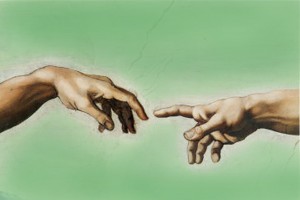 Which profession should hold the keys to the storehouse that contains all of the world’s knowledge about human touch? Besides bodyworkers, is there any other (legal) occupation with more practical and theoretical knowledge about touch? I don’t think so and yet I have been struck by the fact that the massage profession often seems to relate to touch the same way fish relate to water. We take it for granted.
 When I first began developing chair massage sequences in 1982, one of my students was also a student of