The Leg Problem in Chair Massage

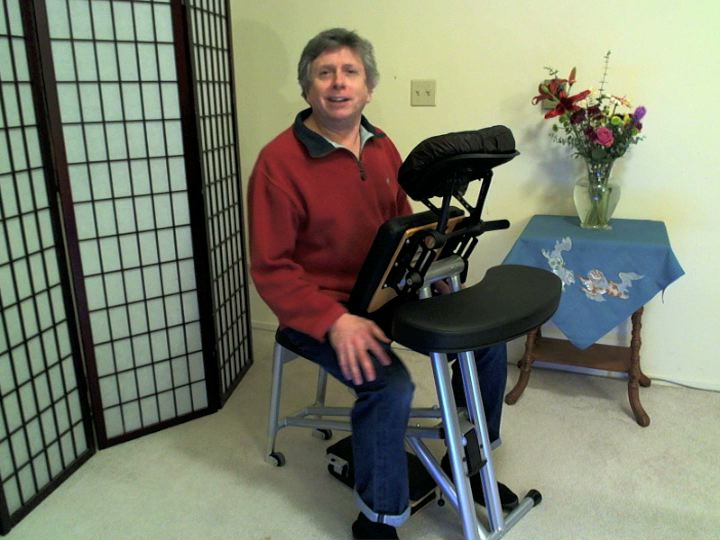
Steve Knobles called today from North Seattle Community Acupuncture clinic. He recently started seating patients in a massage chair because it allowed easy access to their necks, backs and arms for needling and was often more comfortable than lying on a table. However, some of the patients complained of tired shins after sitting in a massage chair for longer than 30 minutes and he wanted to know if there was any way to extend their comfort time.

This is a phenomenon noted soon after the first massage chair came on the market in 1986. While spreading the weight among the seat, leg rest, chest pad and face cradle is great for support, it is not great for fidgeting. And, despite what your 3rd grade teacher may have told you, humans are made to fidget and be in motion, not to “sit still.” Movement creates circulation and, as we all know, circulation is not optional, even when we are asleep. Just check out the nearest napping infant.

Thus, we have always recommended a maximum 30-minute length for a chair massage. Unlike a massage table where people can fidget to their hearts content, in a massage chair using the lower legs as a support prevents movement and having the knees bent can reduce circulation and create discomfort. While it is true that some people can tolerate longer periods in that position, since a significant percentage cannot, the 30-minute rule is the safest compromise.

However, there are a couple of ways to compensate if, for whatever reason, you want to do a longer massage. My suggestion to Steve was simple. Since he was using a Stronglite Ergo Pro massage chair, I told him to remove the leg rests and flatten the seat so that it was parallel to the floor. Voila! No leg rests, no problem. Customers can now squirm to their hearts content.

Removable leg rests are so essential on a massage chair that I am surprised all manufacturers don’t include them. Even if you are only doing short massages, you need them. I would guess that 5% of chair massage customers have knee or leg issues that make leg rests uncomfortable. While putting your legs straddling or in front of the knee rests is the solution used on other chairs, it is less than optimal or professional. [Full disclosure: I helped co-designed the Stronglite chair, of course…]

Another way we got around the 30-minute limit was developed in the TouchPro retail chair massage studio business model. There we offered up to 30-minutes of upper body massage and 10- or 20-minutes of lower leg/foot massage meaning people could receive up to 50-minutes of massage in a chair. However, the catch was that, before the foot massage, the customer had to get up and reverse themselves in the chair, which was adjusted for the massage.

If you want to see how it all works in action, click here to view a video demonstration.

How Steve Jobs Revolutionized the Massage Industry

Steve Jobs portraitThe first time we nervously walked into Apple Computer’s Macintosh division in 1984 to provide seated massage with our matching grey slacks, white polo shirts and blue blazers, we felt overdressed. At a time when the largest computer company in the world, IBM, was still requiring dark suits, white shirts and ties on all of its workers, while Apple employees were all about jeans and T-shirts. We immediately breathed a sigh of relief and settled in for a year that would change the massage industry forever.

Apple Computer was already a high-flying, high-tech legend helmed by 29 year old Steve Jobs who was revolutionizing the nascent personal computer industry. But equally significant, Jobs was also redefining the relationship between a company and its employees. With the casual dress code and the pirate flag that flew over the Macintosh building, Jobs was heralding and prototyping the shift away from the 20th Century paternalistic, conformist corporate culture that treated employees as replaceable parts working for a paycheck.

Instead, he was inventing a 21st Century ethic based on the belief that fundamentally work should be an outlet for creativity and that the most productive workers are those who are challenged to perform to their highest potential and whose work makes a difference in the world. At Apple, employees were judged not by their resume, education, clothes or experience but by their intelligence, passion, creativity and performance.

Jobs nurtured an employee-centric environment. He rejected the idea of a personnel department and instituted a human resources staff charged with creating a workplace that was inviting, exciting and supportive. Apple employees were expected to work 60 hours a week or more, but Jobs wanted them well taken care of.

One of the departments working long hours was in charge of writing the user manuals for the new hardware and software products and, at that particular moment, they were under deadline. The head of the department, Chris Espinosa, was trying to figure out how to spend his monthly budget allocated for employee amenities. They already had the beer busts on Fridays and the occasional private, first-run movie screening, but he was looking for something special. By chance, a friend handed him a flyer advertising a service that would bring massage right into the employee cubicles. Definitely a crazy idea, but that was exactly the kind innovative service that fit the Apple culture.

When I got the call from Chris, I was ecstatic. Up to that point seated massage was an experiment. We tried every way we could think of to market this new approach to professional massage. I knew we needed a high profile company to put its imprimatur on our work before we would ever be taken seriously. Apple was a perfect match for chair massage and ultimately turned out to be our ticket to success. But not in quite the way I had imagined.

After our first visit to Chris’s department, we were invited back the following week. That’s when the folks in accounting, a few cubicles over, said they would like to get in on some of that massage action. Each week we kept adding more departments and doing more massages.

At the peak of our work with Apple, seven practitioners were offering up to 350 chair massages a week with the company footing the entire bill. I had visions of megabucks dancing in my head. I thought that our little service would turn into a tsunami that would soon sweep across corporate America. I was wrong.

The honeymoon at Apple ended in 1985 when the first downturn hit the personal computer industry and Apple was forced to lay off 800 employees. The company could no longer justify paying for first class airline tickets, fresh orange juice, or massage. We withdrew our services from Apple for two months, until the dust of reorganization settled. When we returned, it was the employees who were now paying for seated massage. Our client base plummeted to about 60 massages a week.

There was going to be no tidal wave, at least not in the corporate world. What actually had occurred was that a company ahead of its time, Apple, found a service, seated massage, that was also ahead of its time. The bulk of the business world ignored us. Massages at work? Who were we kidding?

However, by taking a chance on chair massage Steve Jobs did revolutionize the massage industry. He helped us prove that, given the right conditions, chair massage was a viable service for the workplace. We were also able to leverage our experience at Apple into dozens of national and local stories in the press, television, and radio. It turned out that the media loved chair massage. It was an ideal “Cinderella” story. Out of the ashes of disrepute (read: massage parlors) and into the corporate boardroom came chair massage.

That publicity, in turn, laid the foundation for my revised long-range plan to bring professional touch to the masses. In 1986, I sold my portion of the business to a partner and began the task of creating a chair massage profession by training chair massage professionals. In May of that year, when the first massage chair came to market to coincide with the creation of the first training organization, On-Site Enterprises (now TouchPro) to teach table massage practitioners how to perform and market chair massage.

Then, finally, the tsunami did in fact hit. When I showed off the massage chair to 34 school directors at a meeting of the American Massage Therapy Association that August, the response was immediate and overwhelming. During the next 12-months, I taught 20 chair massage seminars at schools throughout the United States, Canada, Sweden, and Norway.

For the massage profession chair massage was truly an idea whose time had come. Within four years, by 1990, virtually every massage school in the United States was teaching their students about chair massage.

The revolution Steve Jobs inspired was not just a technological one, but a cultural one as well. It extended far beyond computers, phones, and media distribution systems and deep into our perception of work and the work environment. While a chair massage industry was probably inevitable, the innovative laboratory that was Apple Computer provided chair massage with the credibility it needed to move forward at a critical moment.

Today, thousands of companies around the world embrace chair massage as an essential part of the workplace and tens of thousands of practitioners make their living providing affordable chair massage services to hundreds of thousands of customers each year. Thanks, Steve. You changed the world in more ways than you will ever know.

Question: Do you have any stories to share about pre-1986 seated massage?

584 People Receive Seated Massage on Thai Beach

Last week Phuket, Thailand, featured two of its most famous tourist attractions–beaches and massage–as the Ministry of Health hosted one of five preliminary events leading up to an official attempt in November to break the Guinness World Record for most simultaneous massages (currently at 232 held by Tourism Victoria Australia).

In a connection that could only be made in Thailand, the number of bodies and pairs of professional hands in Phuket, 584, reflected the numerology of King Bhumibol Adulyadej’s birthday. On December 5th we will be 84.

The event was not only held on popular Kata Beach, but all of the massage practitioners were performing the same massage (a “Kata“) at the same time. If they break the official Guinness record, that should give additional credibility to their effort as well as make it more difficult for other do-your-own-thing massage nations to challange.

Halfway through this video is the official start of the event and some English description.

Quality Control Through Katas

When I first began developing chair massage sequences in 1982, one of my students was also a student of Haruyoshi Ito, who had introduced a Japanese movement form called Shintaido to the United States and Europe during the mid 1970s.

One day this practitioner came to me to say that he had given his teacher one of our chair massages and Mr. Ito’s response was to say, “That’s a good Kata.”

“A good what?” I asked. “What is a Kata?”

Thus began my introduction to a concept that is fundamental to Japanese society.

While there is no exact translation of the word, the basic concept of Kata has to do with the form or correct way by which something is accomplished. In the West the word is most often encountered in a martial arts context. Students practice Katas, or sequences of defensive and offensive movements, over and over again until they become automatic.

Katas are studied in all of the Japanese arts­—brush painting, theater, flower arranging, the tea ceremony, as well as the martial arts. But the word has a much broader meaning in Japanese culture, which places a great emphasis on the correct way to do anything, from how low to bow in greeting to brushing your teeth.

To begin thinking of teaching and learning massage as a Kata prompted a major shift in my understanding of our work.

For one thing, it was a way of honoring the vast history of Japanese massage that had come before us. The path we travel is well worn; only the scenery has changed over the years.

Practicing a Kata also relieves us of the burden of having to know everything about what we are doing. We now understand that the master of massage is not the practitioner, but the Kata itself. We adopt the point of view that the only way you can truly learn about massage is by doing massage. The Kata gives us the opportunity to practice (in the learning sense of the word) with confidence. We teach a Kata and it is the Kata that teaches us massage.

The Kata is like a very wise elder who has the wisdom of the centuries behind her. The Kata has a long lineage that extends from teacher to teacher and is based on a theoretical foundation and philosophical world view that transcends our individual understanding.

If you trust the Kata and develop an honest relationship with it, you will be rewarded with unlimited insights about the nature of touch, massage, service, relationships, yourself, and your place in the grand scheme of the universe.

Another advantage of practicing a Kata is that it becomes a discipline in the spiritual sense of the word. One of the hallmarks of every spiritual discipline is the practice of repetitive rituals that become automatic and allow for openings into higher states of consciousness. Praying the Catholic rosary, Buddhist meditation, yogic breathing, and Sufi dancing­ all fall into this category.

When you practice a ­­­massage Kata it eventually becomes something like a beautiful dance or a piece of classical music. Highly structured and cho­­­­­­reographed, it is the same each time it is performed and yet, each time, it is also different.

On a practical level, performing massage as a Kata allows for quality control to enter into the massage business equation. When you have a private practice doing table massage, you can basically do whatever you want. Your clients will either like it, or not. However, when you are doing 15-minute chair massages for someone else’s business in a convention hall alongside nine other practitioners, exactly what you are doing becomes crucial to providing a high quality, consistent service.

Finally, the Kata is eminently researchable. One of the reasons broad-based research has been so hard to do in our field is because everyone does something different. It’s nearly impossible to control for the differences in practitioners. The Kata solves a great many of these problems because it provides the consistency needed for good data collection.

In touch,
David

Why I Do Chair Massage – Part Two

When I was a kid, my Mom and I used to lie at opposite ends of the couch with our legs entwined. When I was a kid my Dad used to kiss me goodnight.

Then, somewhere around ten or eleven, I became too big or perhaps too much of a “boy” to get a leg cuddle or a Dad kiss. I don’t really know why. I just noticed that the good feelings, the physical affirmations of security and love were gone.

I also learned from my culture and my Catholic religion other things about kinds of touch and times when touch was inappropriate between myself and others and even with myself. Pre-adolescence was the beginning of the numbing of my body as I began to override the natural instinct to touch with the cortical control that resulted from social inhibitions.

I became increasingly awkward, cautious, self-conscious and stiff throughout my teenage years. By the time I was twenty, I had developed chronic torticollis and woke up with a painful stiff neck every morning. Some mornings it was too painful to even get out of bed.

A few years later, I decided that I had had enough of the pain and began altering my lifestyle. Daily stretching (this was before yoga), a Tai Chi class and, most importantly, ten sessions of Rolfing eliminated the torticollis and changed my life forever.

Rolfing was the first kind of structured touch I had ever experienced. It was an awakening and a remembering of how good it was possible to feel in my body and in the world. I never forgot the lesson and it is no accident that in 1980 I ended up attending massage school, becoming a massage professional and eventually owning my own school.

For me, and for many bodyworkers, touch has been pivotal to our personal development and well-being. But it is essential and no less dramatic for most people. While it is true that recent generations have been raised to be more comfortable with their bodies on an individual level, our cultural relationship to touch is more pathological than ever.

We can’t touch our neighbors’ kids, teachers can’t touch their students, pastors can’t hug their parishioners, and colleagues can’t offer a supportive touch in the workplace. Touch is the physical manifestation of relationship and, when we touch, it signals a deep intimacy, a deep connection and bond of trust between two human beings. Unfortunately, contemporary media tends to emphasize that touch means sex.

Thus, the fear of touch and a discomfort with intimacy, along with an impossibly high price point for table massage, are the biggest barriers our profession has to overcome if more than four percent of the population is going to get massage on a regular basis (see How Sticky is Massage?).

That is the second reason why I do chair massage. Of all forms of bodywork, it is the least threatening and requires the least vulnerability on the part of the customer. We let you keep your clothes on, there are no messy oils involved, you can sit down rather than lie down and it takes a fraction of the time required in table massage.

Chair massage is kindergarten touch. It doesn’t require a high investment of either money or trust and it doesn’t require you to have something wrong with you. It is the gift of touch for its own sake. The many varieties of table massage all require a secondary, college level or post-graduate level understanding of, or comfort level with touch.

A close friend of mine, Rika, tells the story of the ten-year old boy who wanted to get a chair massage from her at the hotel where she worked for many years. After receiving permission from his father, the boy jumped in the chair and proceeded to receive his chair massage like a pro. When he was paying for the massage, the father said, “You don’t remember us, but a year ago we were here and you gave us both a chair massage. Every night since then, my son asks for a back rub as part of his bedtime ritual. It has been one of the best parts of both of our days.”

And I’ll bet that is one kid who will never lose touch with his “sensational” body.

The Story of the First Massage Chair

The first massage chair was a box

My love affair with chair massage began in 1982, four years before the first professional massage chair came on the market. This is the story of what it took to get that first massage chair built.

The problem
The team I had assembled to begin providing seated massage in the workplace and at events were all graduates of the massage school I owned, The Amma Institute. One of the first questions we confronted was how to comfortably seat our customers for the massage.

Regular chairs had backs that limited the massage to the shoulders on up and we had already decided that our acupressure massage needed to include the “bladder channel” points traditional Chinese medicine that are located alongside the spine and run all the way down to the hips.

We tried turning chairs around and having the customer straddle the seat. That worked for some people on some chairs, but didn’t work at all for people in skirts or on chairs with arm supports. Then there was the fact that most office chairs had wheels.

To deal with all these considerations, I realized that we would always have to provide our own chairs for our customers.

Drummer's Stool

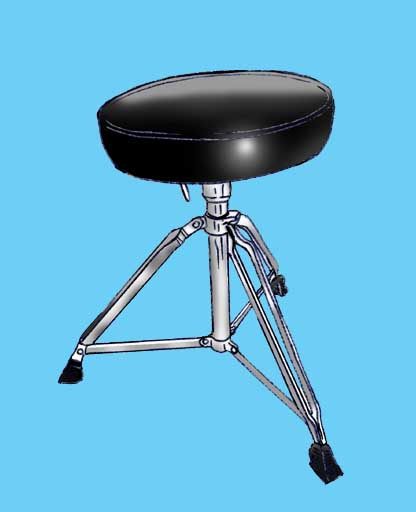
One of the first massage “chairs” was a drummer’s stool

Solution #1: Evolution
At that point in time, the best chair turned out to be a stool–no backs, no arm rests and relatively portable. We ruled out any stool with a hard seat (too uncomfortable) and looked for stools that folded and had good padding. Camp stools with canvas seats almost made the cut, but proved to be too uncomfortably low for most customers and practitioners.

We finally settled on a stool used by professional drummers. They had thick cushions, height adjustable seats and three sturdy metal legs that conveniently collapsed for portability. While they were expensive, $80-100, they added a very professional look to our enterprise.

Stool massage with no support

Stool massage with no support

Unfortunately, there were two problems with massaging on stools. Since we were providing Japanese acupressure, in order to apply pressure to points on one part of the body, the opposite side had to be braced. Not so much of a problem on the top of the shoulders and arms, but working on backs required some tricky coordination.

Consequently, part of the protocol involved making certain that the feet of the customers were in front of their knees and their hands were on their legs.The other issue was that the further we got into each massage, the more the customer relaxed and started listing forward, or backward, or to one side or the other. Either they had to hold themselves up or the practitioner did. The situation begged for another way.

Balans Chair

One design inspiration for the first massage chair

Solution #2: Revolution
Back in 1979 the first “kneeling” chair was developed in 1979 by Norwegian Peter Opsvik. Called the Balans chair, they hit U.S. shores in the early 1980’s. I loved the concept.

When I started seriously working on the first massage chair, I knew that the kneeling angle would be incorporated into the design.

In 1984, I crossed paths with a young French cabinet maker, Serge Bouyssou. The first time we met I explained the concept of seated massage and told him my specifications. “I want a chair with a Balans-style base that also supports the customer leaning forward into an angled chest and face support with a place to rest the arms. Oh, and by the way,” I said, “it has to be portable.”

Early Prototype of the chair. Notice the slot in the chest rest for the face.

Early Prototype of the chair. Notice the slot in the chest rest for the face.

Serge took this all in for a moment and then said, “Oh. You want a box.” “No, no,” I replied, “I want a chair.” More firmly he insisted, “No. You want a box.” Then he went to the whiteboard and proceeded to draw out how a chair could be built using a box as a base and with detachable supports–which could be stored inside the base–for the rest of the body. “You’re right,” I finally agreed, “I want a box.”

It took three prototypes to get to a version of the chair that a person could actually sit in. At that point I felt confident enough to show it to Jim Everett, the owner of Living Earth Crafts, an early manufacturer of massage tables in Santa Rosa, California. Over the next two years Serge and I worked with Jim to develop a series of pre-production models that kept refining the original idea.

Finally, in May, 1986, the first High Touch Massage Chair emerged from the Living Earth Crafts workshop and the face of an industry was born. Later that year, I showed off the chair for the first time to a group of 38 massage school owners and offered to come to their schools and teach their students how to use it. In the next 16 months I taught chair massage classes in 24 schools throughout the U.S., Canada and Europe. By 1990, all of the largest, and many of the smaller, table manufacturers had their own version of the massage chair and close to 100 massage schools were offering chair massage courses.

Jim Everett and David Palmer tinkering with the chair

Jim Everett and David tinkering with the chair

Living Earth Crafts retired the original chair in the mid-1990’s as more lightweight designs with tilting face cradles emerged. I joined forces with another company, Stronglite, and co-developed the chair I now work with – the Ergo Pro.

Jim Everett has passed away but I am forever grateful that he and Serge had the patience, foresight and courage to embrace an idea for which there was no discernible market and to invest their time and money to make it a reality. There is no doubt that all three of our names belong on the first patent for a portable, knock-down massage chair # 4,746,167, which you can read here . You can also view the original images included with the patent.

If you have any stories about the original chair or the early days of chair massage, please leave them below or send them directly to me.