Positioning for a Chair Massage Without a Massage Chair

I love to introduce people to massage. I have massaged people in restaurants, on airplanes, at dinner parties and even outdoors in parks. When I go to visit my family on the East Coast, I consider it my pleasure to gift them with massage.

If I want to do a thorough job of it, I like to give a complete upper body massage. But what if I don’t have my massage chair handy? This 3-minute video demonstrates how to position massage recipients over a table top so that they are comfortable and you are able to access all parts with ease.

Of course, the other option for my family was to finally buy a massage chair that stays on the East Coast permanently.

Introducing Touch

Whenever I am in an unfamiliar room, full of people I don’t know, my shy parts come out. I feel isolated, vulnerable and fearful and immediately begin looking for the nearest exit.

However, I also know that the best thing to do is to force myself to go up to someone in the room and introduce myself. Once I have made a connection with another person, my shy parts start to relax and my more social parts start to take charge.

For many people about to get the first massage of their life from a stranger, often in a strange environment, the situation is many times more scarier. These are the people we often encounter when doing chair massage.

That’s why it is crucial that the massage practitioner takes the initiative to quickly make new customers feel welcome. I walk toward the customer with my hand extended, greet the customer by name and introduce myself while shaking their hand. Then I lead them to my massage chair.

The handshake is important because it is the first step in our physical touch relationship and, for most people, a handshake represents safe touch. Stepping forward first is a way to let them know that you resonate with their vulnerability and are willing to step into their space, before they step into yours.

There is generally a lot of verbal interaction that goes on in the first 60 seconds of that relationship. Most importantly I want to know about the customer’s previous experience with professional touch. “Have you ever had a massage before?”, “Have you ever had a chair massage?”, “Have you ever had an acupressure massage?” are all questions that will give valuable information as to their comfort level with touch.

Secondarily, with new customers I want to always ask for and receive permission to touch specific parts of their bodies. “I am going to work on your shoulders, arms, upper back, lower back, neck and scalp.”

As I mention each body part I touch the same area on myself. I find that helps slow me down and not make the introduction sound so much like a rote recitation while, at the same time, giving customers two sensory pathways through which to absorb what I am telling them. Remember, these folks are often nervous and overwhelmed. My job is to help them gain a sense of control. I do this by clearly outlining the structure and content of our relationship.

After I have described where I am going to be touching, I ask them if there is anyplace in their upper body where I need to be cautious, where they have aches, pains, strains, cuts bruises, rashes, injuries, surgeries or the like.

This is their cue to inform me of any musculoskeletal issues that I need to know about, but also the point at which they can ask me not to touch certain areas of their body, if they choose. The most common area that people mention not wanting touched is their hair or scalp.

After I have asked for and received permission to touch specific parts of their body, next I need to know how to touch those parts. Since I do traditional Japanese massage on a sequence of acupressure points, for me that mostly means making certain that my touch pressure be appropriate.

I always verbally give customers permission to give me feedback about my pressure. “If at any time during the massage anything feels uncomfortable, you will let me know, all right?” After getting their assent, I also tell them, “You are going to be in charge of the amount of pressure that I use. When I start working on the acupressure points, I am going to ask you for feedback about the pressure.”

This is an important piece. It is not enough to give people explicit permission to give you feedback; you must also make them practice giving you feedback so they will know you are serious about having them control their experience.

When I start working on the first line of acupressure points, I ask something like, “How’s the pressure? Would you like more, less or should I keep it about the same?” It is important to frame it as a question so that your customers are forced to commit to a response and take responsibility for their bodies.

Many people are so out of touch with their bodies that they have no frame of reference from which to respond. Or, since they perceive you as the “expert,” customers sometimes believe that you have some magic ability to know what the perfect pressure will be for their body.

Thus, I may add any of the following explanations to the mix for further clarification:

“The pressure doesn’t have to hurt to be effective.”

“We are looking for enough pressure so that your body want to go, “Ahhh…” but not so much pressure that it wants to go, “Ow!!”

“Any amount of pressure will activate circulation in the area.”

“It is not a no pain, no gain situation.”

“This massage is not supposed to hurt. It is supposed to make you feel better, not worse.”

And, as my friend Ken Bridgman notes: “Unlike Bill Clinton, I can’t feel your pain, so you are going to have to tell me if it hurts.”

Here are a couple of other notes about solidifying the touch relationship during a massage.

  • For new customers, depending on the length of the chair massage, I will ask for feedback about pressure 2 to 5 times during a massage.
  • Anytime I get feedback from a customer I always thank the person for letting me know.
  • If I get the pressure wrong on one side of the body, I always ask for feedback when I get to the same section on the other side of the body.

If you have any other suggestions about how to make people comfortable receiving touch from a stranger during a chair massage, leave a comment below.

The Great Frame-Up

While dozens of massage chairs have been developed since the first one debuted in 1986, today there are only four basic designs that have survived the intense competition of the marketplace. What distinguishes each design is the unique metal frame to which all of the other cushioned parts that support the face, arms, knees and seat attach.
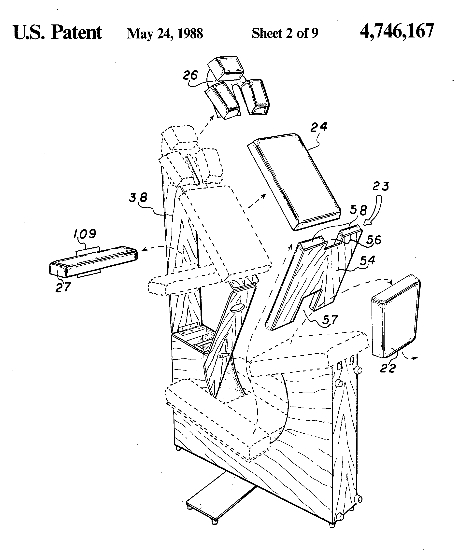
Patent drawing of the first massage chairDesigning and building a massage chair is far more complicated than creating a massage table. Massage chairs have four surfaces on four different planes that need to fit to the customer’s face, chest, shins and seat, rather than the one surface required for a massage table. Each surface must be adjustable enough to accommodate a wide range of lengths and weights and the chair itself should be adjustable for tall and short practitioners. Add to that the requirement that the chair must fold into a transportable package that is lighter and smaller than the typical massage table and you end up with a major engineering challenge.

In the spirit of acknowledging, for the first time, the unsung innovators of chair massage development, I will categorize each frame by name of its designer in descending order of popularity.

The Beyer Frame

Scott Beyer is the consummate tinkerer. In 1987, he attended a seminar I taught in Dallas where he saw the original massage chair-in-a-box I had developed with Living Earth Crafts. The next year Scott moved to San Francisco and began developing what has become the most popular massage chair design in the world.
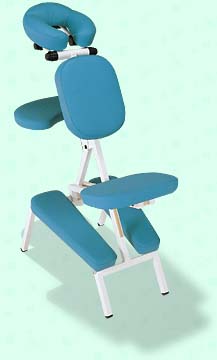
The Beyer Frame on the Quicklite Massage ChairThe reason for its popularity is the simplicity of the design, which made it relatively easy to manufacture and eventually, easy to copy. Scott sold his design to a manufacturer in Montana called Golden Ratio which named the chair the QuickLite. Golden Ratio neglected to get any patent protection and by the mid 1990s multiple versions were being made throughout North America, Europe and Australia.

Golden Ratio went out of business about ten years ago, giving imitators even more leeway to copy the design. Today, with the advent of Chinese manufacturing, this design totally owns the sub-$200 massage chair market. Even the major manufacturers of the best massage chairs sell versions of this design as their low end or entry level chair.

The primary selling points of the Beyer frame are its light weight (as little as 14 pounds) and its ease of adjustability, which is to say, it had very little adjustability and thus is very easy. Some manufacturers have tried to add features that would increase the adjustability for the customer and/or practitioner but inevitably they also increased the chair weight. This design also has the shortest assembly and fold up time of any chair, about ten seconds each.

Besides limited adjustability, the Beyer frame has another drawback. Its defining characteristic is a support beam that runs next to the crotch of the customer. While some customers may actually enjoy the extra “massage” it provides, the message it telegraphs to our unconscious parts is less than desirable for professional massage.

There is one safety issue inherent in this frame design. A portion of the seat extends past the back legs of the chair, meaning if customers lower themselves to far back onto the seat, the whole chair will flip up into their face and they will land on the ground.

A low price also sometimes means low manufacturing standards. Welds have been known to break on the cheaper chairs creating serious liability issues for practitioners. My best advice is to buy only from a reputable company with a good warranty.

Unfortunately, Scott did not make a fortune off his creativity, but he deserves a top seat in the Massage Inventors Hall of Fame for his design.

The Riach Frame

The second most popular chair design was created on the back of a paper napkin by Linda Riach and welded into reality by her engineering husband, Jeff. The Riachs are legendary in their own right as the founders, owners and current operators of Oakworks, a 35-year old massage manufacturing company.

The Riach Frame on the Portal ProThe Portal Pro chair that Linda sketched was defined by the unique cable system that linked the front and back leg braces providing an entirely new level of support and independent adjustability for the face, leg, shin and seat pads.

While patent protection on their chair prevented exact duplicates, similar designs abound such as the Avila by EarthLite. Any time you see a chair that folds like an ironing board, you are looking at a relative of the Riach design.

However, every feature has a trade off. The compromise with the cable adjustment system is that moving the cable up or down a notch changes the relative relationship between the seat, chest pad and knee rest, which requires a second and sometimes, third, adjustment.

The Portal Pro weighs only 19 pounds and retails for $449 with a carry case included.

The Lloyd Frame

After Living Earth Crafts stopped production of my original massage chair in the late 1990s, I began scouting for a new manufacturer to work with. At that time, Stronglite owners, John and Laney Lloyd, were developing a second-generation massage chair and invited my participation.

While they were kind enough to give me co-design credit for the resulting chair, the truth is John had already come up with the basic frame design by the time I arrived on the scene. Since this article is defining chairs by their frames, it is the Lloyd name that goes on this design.

The Lloyd Frame on the Ergo ProThe great innovation of the Lloyd frame was the elimination of any cabling holding the legs together. That meant that the seat height/angle and chest pad height/angle could be adjusted independently. In addition, the back legs can be raised or lowered for the height of the seat and comfort of the practitioners without changing any angles or requiring adjustments for the customer.

The first version of the chair was made out of wood but that was retired a few years after the introduction of the current, metal version, called the Ergo Pro. The Ergo Pro weighs 19 pounds, currently retails for $379 and includes a carry case. [Available for a discount at the TouchPro store.]

Occasionally the Lloyd Frame has been copied, but its relative complexity has not made it an easy target for knock-off manufacturers. Also, like Oakworks, Stronglite has developed a robust international distribution network that has a vested interest in keeping a lid on copycats.

The Lloyds sold their company to EarthLite a few years back, which also owns the Living Earth Craft brand.

The Gillotti Frame

Michael Gillotti is a guy who knows how to think outside the box. His late 1990s design for a massage chair is still the most aesthetically pleasing chair on the market today. Michael was the founder and former owner of Pisces Productions, which he ran for over 30 years.

His chair, the Dolphin II, is the only massage chair in this group still manufactured and assembled in the United States, but retailing at $525 (carry case extra), it has effectively priced itself into niche status.

The Gillotti Frame on the Dolphin IIIf the Riach Design was based on an “X,” the Gillotti Design was based on an “O.” The frame is built on three curved, nesting tubes that telescope in and out of each other allowing the chest pad and face cradle attached to one end to move from a totally horizontal to a totally vertical position. On the other end of the frame the seat can perform the same maneuver.

One unique advantage of this design is that, unlike the other three frame designs,  the Gillotti frame allows the customer to step into the chair from the side, making it easy for people who have difficulty raising their legs to sit down, e.g. if the customer has a range of motion limitation or is wearing a tight skirt.

Structurally, the most glaring problem is lateral stability. With one long length of tubing and no struts supporting either end, the lateral flexion is unnerving for both the customer and the practitioner.

Michael also wanted to create a massage chair that could also function as a table. Unfortunately, when adjusted for the prone position all of the weight of the customer goes into the chest or the shins and virtually none into the seat making it uncomfortable for more than a few minutes.

As beautiful as it is, I have never seen a knock-off of the Gillotti design.

The Future

All of the manufacturers keep tweaking the designs of their portable chairs, but it is unlikely that we will see any true innovation in frame design, such as the four described in this article.

Where the real frontier exists is in designing stationary massage chairs. With the explosion of chair massage in retail settings, thanks to the current wave of mainland Chinese immigrant workers, there are now hundreds of fixed location chair massage studios where a stationary chair would be appropriate. When you remove the constrictions of weight and portability a whole new range of possibilities for comfort and functionality emerge.

Just as the original chair unleashed the first wave of the chair massage industry, a stationary massage chair will signal the arrival of the second wave. I am currently looking for a development partner, so if you have any interest…

The Fainting Phenomenon

This week I got an email from Katy who writes: “I was about 20 minutes into the chair massage when the massage therapist began to work in and around my right shoulder blade.  I began to feel clammy and tried to breathe deeply and out of nowhere, I began to black out.  I sat up and just said “water” and wasn’t really aware of anything around me.  I almost dropped the water he had handed to me.  I sat down on a different chair (with much help) and in about 5 minutes felt much better.  I declined the offer to finish the massage.”

In the mid-1980’s, when chair massage was shifting from an occasional massage tool to being a discrete bodywork specialty, practitioners began to notice a phenomenon almost never encountered in table massage: seated customers experiencing symptoms of fainting or even passing out completely.

While a rare occurrence, episodes happened often enough that those of us practicing and teaching chair massage became concerned about its cause, prevention, and management when it did occur.

Why on a chair?

The medical term for fainting is “syncope” [sing’kuh-pee] and is defined as a sudden, brief loss of consciousness. “Pre-syncope” is the experience of symptoms leading up to a loss of consciousness. All syncope is caused by a loss of adequate blood flowing to the brain.

If a person is upright when this happens, then oxygen no longer reaches the brain in sufficient quantities to maintain consciousness and the individual passes out. The cure for fainting is simple. Get the customer horizontal, preferably with his knees up to allow gravity to restore blood flow to the brain. If the person is only experiencing near syncope, then it may be enough for them, while in a seated position, to drop their head between their knees.

In one sense, fainting is nature’s way of telling us to lie down by falling down. This is the reason table massage practitioners rarely experience customers  fainting. They are already lying down and gravity is working in their favor.

The three most important things to know about syncope are:

  • Most episodes are transient; that is, they happen once and never again.
  • Fainting is rarely life threatening, unless someone hits their head on the way to the floor.
  • Everyone who faints revives spontaneously.

Etiology

There are literally dozens of possible causes of syncope but the ones that concern chair massage practitioners most are:

  1. Low blood volume is most often caused by stimulation of the vasovagal nerve reflex, which expands the blood vessels (vasodilation) causing a rapid drop in blood pressure. That reflex can be triggered by such factors as anxiety, pain and fatigue.  Dehydration also causes a drop in blood volume so recent exercise or overheating need to be considered.
  2. Reduced blood flow because of medical conditions that narrow the blood vessels (smoking, high blood pressure, high cholesterol, diabetes) or mechanical restriction of blood flow to the brain. This last point has been highlighted by some practitioners who believe that the positioning of the customer’s head in the face cradle is key. Some lower edges of a face cradle may press in to the carotid artery and trigger a syncope reaction.
  3. Low blood sugar can also cause a sudden drop in blood pressure often times in combination with another risk factor. That means empty stomachs can actually be a hazard in this regard.
  4. Certain medications such as diuretics, beta blockers, calcium blockers, and other CNS depressants that might slow the heart rate, cause fainting symptoms to more likely to occur.
  5. Other conditions where syncope and pre-syncope have been seen include migraines, epileptic seizures, hyperventilation (extremely nervous customers), alcohol intoxication, and cardiac arrhythmia.

Given these known causes, a practitioner should be especially alert to nervousness, hot days, recent exertion and careful positioning of the neck in the face cradle of the massage chair.

Screening and monitoring

While the actual incidence is low, the single greatest determining factor for syncope is whether you screen before and monitor your customers during a massage. Thorough screening and monitoring can eliminate 100% of the episodes of customers passing out. With proper management, the occasional customer who does feel symptoms of fainting will not lose consciousness.

Before you seat customers in your massage chair, they should be screened just as you would for your table massage, preferably with a written card to save time. If the customer has any current or chronic medical conditions or is taking medications, pay particular attention to the ones discussed above in Etiology.

In addition, we recommend screening for the following:

Consumption of food or liquids (other than water) within the past five hours. Not having eaten may signal a hypoglycemic state. If convenient, suggest the customer get a glass of juice or a muffin before the massage.

A history of fainting. Carefully question a customer to determine if the recurrent syncope is related to a low blood pressure or other medical condition. What does their primary health care professional attribute these episodes to?

Just having an empty stomach, a history of fainting or a medical condition does not mean that a customer can’t receive the seated massage. But it does mean that, if you decide to give the massage, you will need to be extra alert.

If there are any yellow flags raised during screening, then it is a good idea to ask the customer to report any dizziness or queasiness during the massage.

Finally, as with all screening protocols, the ultimate rule is “when in doubt, don’t.” If you have any question in your mind about whether to work on a particular customer, then you should not proceed. Tell the customer that you are not certain whether the massage is appropriate for their condition and that they, or you, should check with their primary care provider. Never practice beyond the level of your training and experience.

During the massage

Since syncope can occur for so many reasons, during the massage you will also pay particular attention to syncope precursors in the customer’s body. The most common sign is a customer fidgeting in the chair or lifting the head slightly out of the face cradle as though to yawn or take a breath. These are involuntary reactions to not enough oxygen getting to the brain.

Less frequently you might feel the customer’s skin become hot and sweaty or cold and clammy. If you become aware of any of these symptoms, immediately stop the massage and ask the customer if he or she is feeling okay. If not, then you need to quickly either get him or her turned around in the massage chair or into another chair with the head dropped between the knees, or lying on the floor with the knees pulled up.

After an episode has occurred

Customers who have near syncope experiences will recover within a few minutes. Explain that they have had a temporary drop in blood pressure and reassure them that they will be fine as soon as normal circulation resumes. After the episode has subsided, you might spend a few minutes exploring the causes of the episode. If there were red flags raised during the screening, you probably already know the reason associated with the episode. If the initial screening brought nothing obvious to the surface, ask the customer if this has ever happened to them before and then go over the screening questions again. Perhaps you will discover they are diabetic or have low blood pressure and it didn’t come out in the initial screening.

In any case, let them know that most fainting spells are benign, but they should mention it to their primary care provider at the earliest opportunity. There are, in fact, some serious cardiac and neurological conditions that might underlie syncope and pre-syncope and this episode should become part of the customer’s medical history.

Summary

While the incidence of syncope or pre-syncope in a customer receiving a chair massage is slight, an ounce of prevention is worth a pound of cure. Proper screening and awareness of symptoms during a massage will prevent virtually all syncope episodes. Knowledgeable management of syncope and near-syncope occurrences will prevent undue distress on the part of the customer and the practitioner. Being competent and knowing your limits will buy you the cheapest and most effective liability policy you can own.

If you have your own fainting experience, I would love to hear your stories.

Chair Massage: A foundation for fitness

While I am a big believer in making every moment a fitness moment (see Creating a Fitness Lifestyle), the reality is many people don’t have even the most basic motivation to move to a healthier lifestyle. That’s where chair massage fits in because it not only requires minimal motivation, it actually provides motivation and support for getting off and staying off of the couch.

The reason why I consider chair massage foundational fitness is because, of all the activities that fall into the fitness/wellness category, chair massage is the one that requires the least time and effort, while offering the greatest value. The only motivation required for chair massage is to sit down and do nothing. The chair massage specialist does the rest.

This is one of the most unique and important features of chair massage. All other wellness modalities require high degrees of motivation, practice, support or cost, for example, dieting, exercise, smoking cessation, Yoga, meditation, table massage and Tai Chi.

The foundation of fitness is movement. It is movement that creates circulation in the body/mind and, as I am fond of saying, circulation is not optional. Without good circulation your body and your mind literally wither away and eventually die. Much of what we define as the “aging process” is simply a result of inhibited circulation/movement.

Exercise, which requires a high degree of motivation, is active movement, where you move yourself. Massage is passive movement, where someone else creates the movement/circulation within you and requires minimal motivation.

In addition, over time, as people experience regular massage, they reopen the communication links between their brains and their bodies. That is to say, massage heightens awareness of our internal sensations about what makes us feel good. As a result, recipients tend to become more motivated to lose weight, stop smoking, eat better and even develop a regular exercise program.

As lifestyle changes go, regular chair massage is a great place to start. It triggers the pleasure centers while enhancing circulation. On an ongoing basis it supports all other fitness/wellness activities and lifestyle changes. Each massage rebalances the body/mind by smoothing out the rough edges created by exercise, dieting or withdrawal from smoking and other addictive substances.

Best of all, you don’t have to be overweight or a smoker or in shape or out of shape to benefit from a chair massage. It is the most egalitarian of all wellness modalities and provides a solid foundation for fitness. Given its low cost, chair massage clearly provides the greatest value.

Hygiene Protocol for Chair Massage

Click on the picture to view the video demonstration

While there are probably more infectious agents on the doorknob customers touch as they enter your massage space than are on your massage chair, the public nature of chair massage makes a solid hygiene protocol essential. It is a matter both of perception and professionalism.

I have seen potential customers stand in front of a line of massage chairs at an event carefully scrutinizing the hygiene habits of the various practitioners to find the one that best lives up to their standards. As the media continues to spotlight drug-resistant infections and virulent pathogens spreading around the globe, the general public is becoming increasingly germ-phobic.

Since we are trying to reduce stress, rather than increase it, we need to set customer’s minds at ease by being proactive about hygiene. There should never be a concern about customers spreading bugs to one another, or to me, or from me to them.

In terms of liability, having a simple, consistent hygiene protocol makes it easier to explain clearly to customers, health department personnel and lawyers the impossibility of someone, for example, having acquired herpes from sitting in your chair.

Wipe down. Cover up.

The two-step protocol TouchPro recommends starts with a canister of hospital-grade sanitary wipes. We use two sheets, one in each hand, to sanitize the chair at the start of the day as well as between each customer.

At the beginning of the shift, every vinyl surface is wiped, along with the adjustment hardware and any other metal or plastic parts around the face cradle. Between each customer the minimum rule is to wipe down the face cradle, arm rest and any other part of the chair that might have had skin to vinyl contact, typically the leg rests if the previous customer was in a skirt or shorts. The final step is to put the two sanitizer sheets together and wipe your own hands thoroughly.

Here’s a note about the wipe down process. The basic rule is, the juicier the better. The effectiveness of the sanitizers at killing the bugs is directly related to how long the moisture stays on the vinyl or your hands. That’s why we recommend wiping down the chair immediately after a massage, so you don’t have to keep the customer waiting before a massage for the alcohol to evaporate.

After the wipe down, the face cradle should be covered up to prevent the customer’s face from touching vinyl. The preference of the practitioner determines whether paper towels, cut-out or form-fitted disposable covers, or washable cloth covers are used.

Back in 1986, we started with paper towels but quickly moved to the round, disposable nurses caps with a breathing hole or slit cut into the center. When the form-fitted disposable face cradle covers came on the market around 2005, we switched to those and never looked back.

Addition hygiene issues

Obviously, everything you learned in massage school about keeping your fingernails, hands, breath and “pits” clean applies to chair massage, but there are a couple of other issues that should also be considered in your hygiene protocol.

In 2009, during the H1N1 avian flu pandemic scare, the media was in a frenzy over the potential deadly effects of the virus. To allay any fears of our customers, I wanted to advertise that all of the chair massage practitioners in our studio had been vaccinated to prevent them from contracting and/or spreading the virus. Unfortunately, because it was a new strain, the vaccine was rationed to the very young, old, immune-suppressed and front-line healthcare workers. Because of the shortage we were never able make that guarantee but every year since, I get myself vaccinated as early as possible. Annual flu vaccination as part of a chair massage hygiene policy just makes sense.

And, finally, what about those doorknobs? In a chair massage studio, I do disinfect them at the beginning of every day, unless they are brass. Brass doorknobs disinfect themselves in about eight hours, while stainless steel and aluminum knobs never do. It’s called the “oligodynamic effect.”

In summary, have a hygiene policy, write it down, and make sure everyone in your business follows it.

Check out the companion video.