Moving Massage from Acceptability to Accessibility

Acceptability-to-Accessibility ImageFor as long as people have been paying for therapeutic massage services, practitioners have feared being mistaken for prostitutes. That fear was the primary driving force that, in 1983, led the American Massage Therapy Association to re-brand “massage” into “massage therapy” in an attempt to define it as the health care profession. [Related article] I call this quest for professional legitimacy the “acceptability” strategy.

Within a decade this strategy was almost universally embraced by massage schools, educators, associations, regulators and vendors serving the industry. It seemed like an obvious strategy and the perfect solution. In point of fact, it was remarkably successful at validating therapeutic massage in the public mindset.

Unlike 20 years ago, nowadays no one blinks twice when a young woman announces her desire to attend massage school–no snickers, no raised eyebrows. The public generally perceives that there is a clear distinction between adult entertainment massage and therapeutic massage. The battle for acceptability has, for the most part, been won.

But now there is another front that needs our attention. What I call the “accessibility” problem.

While we have steadily increased the numbers of people who want a massage, the number of people who actually can get a regular massage has barely budged from less than 5% of the US adult population [see related article]. The reason is painfully simple. Massage therapy is  too expensive.

Since I am writing to a primarily professional audience, let me do a quick reality check. How many readers pay full price for at least one massage every two months? How many of your friends do? If you are at all like the typical massage practitioner in my continuing education classes, you can’t afford to pay $65 for a regular table massage, and neither can your friends. The primary reason people don’t get a massage is because they can’t afford it.

The only two significantly expanding models for massage services are the pay-by-the-month model pioneered by Massage Envy and chair massage in malls delivered by Chinese immigrants. What they both have in common is that they are lowering the price of massage.

Those of you who have experimented with online coupons also know what I am talking about. Discount massage shoppers rarely turn into full price regular customers. The only people who pay full price for regular table massage are the very wealthy, the very fanatical, and the very desperate people in pain.

While turning “massage” into “massage therapy” made our services more acceptable, it did little to make them more accessible. In fact, there is a case to be made that the effort to make massage into a health care profession has actually limited its growth.

Massage as health care

When you define massage as massage therapy in a health care context you are defining it as a treatment. The problem is that most massage is not performed as a health care treatment. Most massage, according to consumer surveys, is done for health promotion and relaxation. That has resulted in a huge disconnect between what massage practitioners think they are selling and the general public is looking to buy.

Massage schools graduates are encouraged to believe that they are training to become a health care professional–sort of junior physical therapist. [Indeed, I just searched “Physical Therapy Training” in Google and one of the three sponsored ads at the top was for a massage school.] But the reality is that the vast majority of graduates, if they are lucky enough to be working at all, will be doing massage, not massage therapy. While it may increase school enrollment to have them think otherwise, it does nothing for their level of frustration when the inner image of practitioners does not jive with their outer experience.

For massage customers, particularly new ones, defining massage as therapy often leads them to believe they have to have something wrong in order to get a massage. Every day that I work in a chair massage studio new customers invariably feel obligated to have a physical problem before they step through the front door.  “I woke up with a pain in my neck/back/shoulder,” being the most common statement.

Massage as personal care or fitness

If we want to make massage truly accessible, we need to recognize the difference between massage as a health care service and massage as a personal care service.

Defining massage as a health care profession only makes sense for that small, highly trained and experienced segment of practitioners that actually performs massage as treatment and for that small fraction of the public that actually needs and wants to pay for that service. Massage therapy should be defined for what it actually is–medical massage–and we should require far more than the standard 500 hours of training. Something closer to 2,300 or 3,000 hours of the Ontario and British Columbia models would be appropriate.

I admit that I am very conservative on the issue of training but, in my experience, 500 or 600 hours of training to become a massage therapist is totally inadequate, does nothing for creating credibility as a health care profession and sets totally unrealistic expectations for massage school graduates, the vast majority of whom will never make even a part-time living doing massage.

“Massage therapy” should never have been defined as entry-level into the profession. It is not. Plain old circulation/relaxation/prevention-oriented “massage” is entry-level. Let students focus on learning how to touch and be touched [Related article].

Massage has always rested comfortably in the personal care services arena along with spas, hair salons and nail studios. Over the past twenty-five years, massage has also grown up with the wellness and fitness industries. These two economic sandboxes are where the majority of massage practitioners should be playing and it is the kind of massage that massage schools should be selling and teaching.

Radically reinventing an industry

Knowing what we now know, if I was creating the U.S. massage industry from scratch, here is how it would be structured:

  • Entry-level into the field should be a 200-hour course in chair massage.
  • Table massage would be a second, optional level of training. Add on another 300-hours to make the current 500-hour standard and have the focus be on training practitioners to be wellness educators as well as table practitioners.
  • Massage Therapy would be true medical massage and require at least a masters level program.

There are some strong arguments for making chair massage entry-level. For the industry, chair massage provides a strong foundation:

  1. Chair massage is what the general public can afford and, because there is no disrobing or private rooms required, is more likely to try.
  2. Because it is affordable, people will get massaged more regularly.
  3. People who have had a chair massage are more likely to consider having a table massage or massage therapy.
  4. The net result will be far more work, more jobs, more successful students, and more sales for chair and table manufacturers.

For the budding massage practitioner, starting with chair massage will eliminate a lot of needless heartache and financial burden:

  1. Since there is really no way of knowing whether you will like doing massage professionally until you get into massage school, a 200-hour tuition mistake is a lot less painful than a 500-hour mistake.
  2. More students will be able to afford to go to massage school without going deep into debt and actually make a living doing upon graduation.
  3. After they are making a living doing chair massage, chair practitioners can save up money to pay for table massage school without taking out loans.
  4. It is easier for entrepreneurs to open chair massage businesses than table massage establishments resulting in more jobs.

The bottom line

Can my ideal industry model become real? Realistically, I doubt it. The massage schools, associations and regulatory agencies are far too entrenched to consider reforming the profession so radically. The quest for acceptability as a health care profession continues to be seen as the primary goal. Too bad. A lot of people just need to feel better through touch.
The Leg Problem in Chair Massage

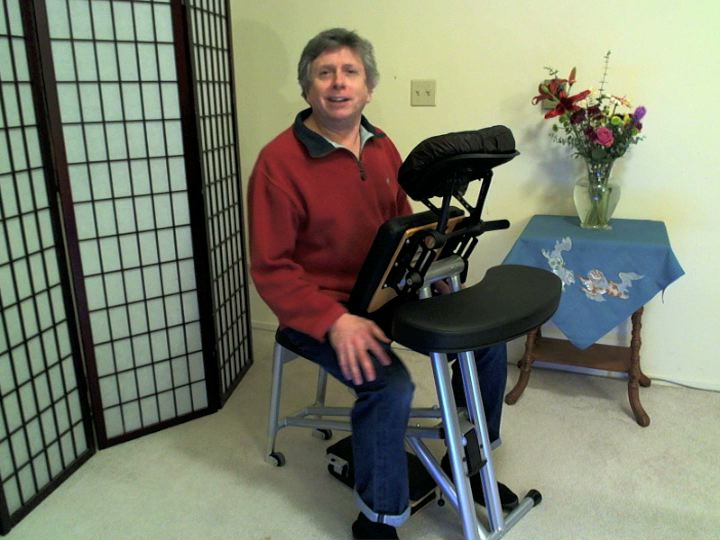
Steve Knobles called today from North Seattle Community Acupuncture clinic. He recently started seating patients in a massage chair because it allowed easy access to their necks, backs and arms for needling and was often more comfortable than lying on a table. However, some of the patients complained of tired shins after sitting in a massage chair for longer than 30 minutes and he wanted to know if there was any way to extend their comfort time.

This is a phenomenon noted soon after the first massage chair came on the market in 1986. While spreading the weight among the seat, leg rest, chest pad and face cradle is great for support, it is not great for fidgeting. And, despite what your 3rd grade teacher may have told you, humans are made to fidget and be in motion, not to “sit still.” Movement creates circulation and, as we all know, circulation is not optional, even when we are asleep. Just check out the nearest napping infant.

Thus, we have always recommended a maximum 30-minute length for a chair massage. Unlike a massage table where people can fidget to their hearts content, in a massage chair using the lower legs as a support prevents movement and having the knees bent can reduce circulation and create discomfort. While it is true that some people can tolerate longer periods in that position, since a significant percentage cannot, the 30-minute rule is the safest compromise.

However, there are a couple of ways to compensate if, for whatever reason, you want to do a longer massage. My suggestion to Steve was simple. Since he was using a Stronglite Ergo Pro massage chair, I told him to remove the leg rests and flatten the seat so that it was parallel to the floor. Voila! No leg rests, no problem. Customers can now squirm to their hearts content.

Removable leg rests are so essential on a massage chair that I am surprised all manufacturers don’t include them. Even if you are only doing short massages, you need them. I would guess that 5% of chair massage customers have knee or leg issues that make leg rests uncomfortable. While putting your legs straddling or in front of the knee rests is the solution used on other chairs, it is less than optimal or professional. [Full disclosure: I helped co-designed the Stronglite chair, of course…]

Another way we got around the 30-minute limit was developed in the TouchPro retail chair massage studio business model. There we offered up to 30-minutes of upper body massage and 10- or 20-minutes of lower leg/foot massage meaning people could receive up to 50-minutes of massage in a chair. However, the catch was that, before the foot massage, the customer had to get up and reverse themselves in the chair, which was adjusted for the massage.

If you want to see how it all works in action, click here to view a video demonstration.

Make Your Business Persistent with Consistence

Note: This is the third in a series of four articles called “C”-ing Your Way to Success about  the value of Conviction, Clarity, Consistency and Change-ability in business.

In a sense, consistency is the practical result of a commitment to clarity in your business. As you become clear about the complex nature of the services you provide and the market you have targeted, each small component of your business will add to and reflect the overall purpose and function of your business as a whole.

Consistency has something to do with integration. When anyone encounters a small part of your business, they encounter the whole. Each component reflects the larger service vision. Let’s briefly examine some of these elements.

  • Language: How you talk about your business needs to be consistent with the overall intention of your work. I once saw a flier advertising a massage chair that was comfortable and easy for the “patient” to use. Since the rest of the text did not lead me to believe the business was targeting their chair exclusively for use with sick people, the choice of that word was clearly inconsistent.
  • Marketing tools: Your brochures, business cards, letterhead, advertising, and even phone manner should all present the same image and message about the conviction and intention of your work.
  • Professional tools: Do you use the right equipment in the right way for the market and service you have chosen? Do you use paper towels, disposable face cradle covers or linens for you head rest? Each has a place in the appropriate practice.
  • Environment: Does the environment you create for your practice support or detract from your service goal? If customers find parking a hassle to find, they may feel the frustration is not worth the effort. Or perhaps they don’t feel safe walking in your neighborhood and it makes them nervous to think about leaving your office. For the internal environment, make certain that the flowers and air are fresh. Walk into your bodywork environment with beginner’s eyes and see what type of impression it makes. What do they see, hear, or smell? Get a massage on your table to see what the client will be looking at and experiencing for the length of the massage.
  • Personal style: Some people simply, who function well doing chair massage in the workplace are like fish out of water at a convention center. A New Yorker  may have to be toned down his or her personality a bit to be effective in California. What is your personal style? Does it fit well with the overall focus of your business?

Thomas Alva Edison portraitConsistent persistence
According to Thomas Alva Edison, “Genius is one percent inspiration, ninety-nine percent perspiration.” That perspiration is what I call persistence and persistence is just another facet of consistency and is an essential element for business success.

Consistency brings an essential level of stability and predictability to your business operations for yourself and your clients. Without consistency clients wouldn’t know when to call for an appointment or how to budget their time and money to make certain your service is a regular part of their lives. They also wouldn’t feel comfortable referring your service to a friend if they thought you were unreliable. Consistency means creating and sticking close to a business plan. How many clients can you expect to have this month? What will your expenses be? What type of referral network do you need to set up?

If you know you need to send out appointment reminders every week or make a presentation to the local nursing group in order to keep clients coming in, then do it. There are no shortcuts to doing what needs to be done. If you pay strict attention to accomplishing the small details of your marketing strategy, you will find yourself worrying less and less about cash-flow crises. If you take care of your bookkeeping every week, you will have little to fear from the IRS or the phone company.

When you operate a business with consistency it is easier to make changes and know whether or not they are effective. If everything is done differently every day, it is impossible to develop true expertise or intuition because you never know which actions cause which results. In a similar sense, consistency puts the qualities of conviction and clarity into a feedback loop. If a particular marketing approach does not seem to be working, perhaps it is because it is inconsistent with your overall vision or is not being communicated clearly to your market. Consistency provides a check and balance system for your business.

A good recourse policy is the best guarantee of consistency. Having a recourse policy, such as a money-back guarantee, says that you believe in the quality of your service and trust that the client will appreciate it. When you trust a client, particularly a new one, it is easier for them to trust you. If you don’t have a recourse policy there is no way for client feedback to alert you to problems with your business.

The impact of consistency on the success of your business is undeniable. Consistency provides the nuts and bolts, day to day operational stability that keeps you going in the direction intended. It is a type of consciousness that brings together the motivation provided by conviction and the communication provided by clarity into an organized plan of action. Without consistency your business is merely a ship without a rudder, tossed about by the waves and going in no particular direction.

How Massage Became Therapy

The year was 1983 and the oldest national association of massage practitioners was about to change the face of an industry by turning “massage” into “massage therapy.” This is the story of what led up to that moment.

The association making this pivotal shift was founded in 1943 by a group of 29 graduates of the College of Swedish Massage in Chicago. Originally calling itself the Association of Masseurs and Masseuses, fifteen years later it had changed its name to the American Massage & Therapy Association (AM&TA). Now, in 1983, the group was poised to take the conjunction “and” out of the middle of their name and become what we know today as simply the American Massage Therapy Association (AMTA).

The rationale for the name change was simple–to address the two primary forces that had always plagued the growth of massage: public perception and economics.

Managing the image of therapeutic massage has always been a public relations nightmare. There are only two occupations where skilled touch is the primary modality of service delivery. One is legal and (in most places) the other is not.

The confusion in the public mind between “adult entertainment” massage and “therapeutic” massage has been around in one form or another for centuries. Indeed, the mere mention of the word “massage” in 1983 was enough to provoke what was then called “the snicker response,”  as word evoked images of “masseuses” in skimpy outfits plying their trade late into the night in sleazy massage “parlors”.

While the mass media served up this image in large portions, it also offered a second association in movies and television: that of massage as a luxury service for the rich and famous. If one got past the first association, the second inevitably got in the way of people identifying with massage because the service was, quite simply, unaffordable for the vast majority of Americans.

So, in the early 1980’s the thought was, let’s reposition massage in the public mind and kill two birds with one stone. If massage could be turned into a legitimate health care profession, then people would no longer presume that massage practitioners were prostitutes. Likewise, as a health care service, massage could be covered by third party payments, as was already the case in some Canadian provinces.

And so, the name was changed and what was once two, massage and therapy, became one—massage therapy. In the next article, I will analyze the impact of this well-intentioned decision and argue that this minor alteration solidified a strategy that has had only limited success and, in some ways, has actually inhibited the effort to bring skilled touch to the masses.

Seeing Your Way Clearly to Success

Note: This is the second in a series of four articles called “C”-ing Your Way to Success about  the value of Conviction, Clarity, Consistency and Change-ability in business.

While having conviction about your work is fundamental to a successful value-based business, a second tool, clarity, is required to effectively communicate your conviction to the rest of the world so they can beat an enthusiastic path to your doorstep. Clarity has a number of important characteristics as it applies to business.

Full disclosure
To be “clear” presumes a commitment to be honest to your customers, to tell the whole truth about your business. This is the business standard that I call full disclosure. When entrepreneurs are not honest about their business it is generally because they either don’t know the whole truth about what they are doing, or they are afraid that if people found out the whole truth they wouldn’t buy the service.

If you don’t know the whole truth about your business—often the case when a person is just starting out—a healthy response is to own up to the fact that you are beginner. All too often new bodyworkers are embarrassed by the fact that they have little experience. The question feared most by bodyworkers beginning their careers is, “So, how long have you been doing massage?”

Rather than fudging an answer, I recommend that new practitioners proudly announce their beginner status. Don’t be ashamed of being a beginner. Celebrate it! Your beginner’s energy, when filled with a fresh conviction about the importance of your work, is unique. Your enthusiasm is infectious and is a marketing strength because it is pure and spontaneous. You only get to be a beginner once so try to hang onto the excitement of that moment for as long as possible.

Understanding your business
If you don’t know what you are doing, neither will your customers. A commitment to clarity is a commitment to an ongoing exploration of your business idea. The greater the clarity you bring to your business idea the easier it is to have conviction about your work and for other people to relate to you.

To say “I do massage” is only the most superficial layer of your business identity.

  • What is your personal intention for your work, i.e. what do you want to get out of your business?
  • What is your professional intention, i.e. what do you want your customers to get out of your services?
  • Are you aware of the deeper assumptions that underlie how you define your business, i.e. your personal philosophy, value system and/or world view?
  • How do you define the market you are trying to reach?
  • How do you define your short-term and long-term goals? The quality of your answers to these questions will reflect the level of maturity that you and your business, have reached.

The search for clarity in business is a process and it never ends. The questions, and the answers, are constantly changing. Your job is to be as clear as you can be, right now, about what you know and don’t know about your business so you can be clear with your customers, employees, suppliers, and supporters.

Translating your business idea
Clarity also means being able to translate your business idea in a language that people can understand. Skilled touch can be talked about in an infinite variety of ways. The words you use must be appropriate to the market you select and the way in which you define your service.

Are you communicating to truck drivers, corporate executives, teenagers, suburban shoppers, seniors, people from a Hispanic culture, or travelers? Each group requires words that are personally meaningful and rationales that make sense.

Telling a construction worker that your massage will improve his muscle tone and make him more beautiful may not have much of an impact. Using the same approach in a beauty salon, however, would be perfectly appropriate.

Openness
One of the most difficult characteristics of clarity to integrate into your business is the concept of openness. When something is clear, like a pane of glass, it is transparent, you can see through it, and nothing is hidden. Secrecy in our business culture—not to mention our governmental institutions—is almost an automatic reflex.

We think that it is normal to hide budgets, salaries, business plans, marketing strategies, and financial statements. But why? Doing business is, in its most basic sense, about having relationships, be it with customers, employees, suppliers, or observers of our business. Few would argue that openness and trust are hallmarks of healthy relationships and yet business relationships are often cloaked in secrecy and adversarial in nature.

Unfortunately, many businesses do, in fact, have something to hide. They do make inferior products. They do treat their customers and employees with disrespect. They do operate with policies that place short-term profits ahead of long-term concern for the environment, community welfare, and even customer’s lives.

Take, for example, salaries. Many corporations restrict information on individual employee compensation and, in the worst cases, make it a firing offence for an employee even to voluntarily reveal how much they get paid. The only reasons for such a policy that I can think of is that the company is embarrassed either by how little or by how much they are paying certain employees? While this secrecy may serve the highest paid executives, it does little to redress historical pay inequalities for women, minorities, and those further down the socioeconomic ladder.

Secrecy in business, like secrecy in a family, is almost always bad. It leads to mistrust, miscommunication, dishonesty, and an eventual breakdown of relationships. There are circumstances when a business is legally or morally bound to confidentiality, such as the shielding of personnel or customer files, but these circumstances are far fewer than corporations would like us to believe.

Openness when your business is dealing with external relationships should follow the same approach. In a business committed to honesty and integrity there is rarely a need to hide what you are doing from the outside world. Realize that every time you adopt a defensive business position you limit the potential for growth and creativity in a relationship.

Concordant competition
Our culture and institutions tend to promote an overly competitive mentality in business. We develop paranoid thoughts that everyone is out to steal our current customers, potential customers, business ideas, business names, whatever. This is not surprising, because the model that traditional business is based on is the military paradigm. When corporations arose in the late 19th and early 20th century the “captains” of industry were, literally, the captains and other officers from the military. The language of business–killing the competition, cutthroat competitors, beating, winning–is the language of war or its civilian surrogate, competitive team sports.

In the military, secrecy has been developed into a fine art and openness is frowned upon. Combined with the requirement for unquestioned obedience and you have the standard operating procedure for keeping the troops in line. In the corporate environment these two elements are too often seen as the best way to keep factory workers and keyboard jockeys at their most productive.

I am a fan of healthy competition which includes a business ethic I call concordance. Concordance means always operating with civility and respect for everyone, including perceived competitors. It rejects the zero-sum mentality that says you have to “lose” so that I can “win.” Focusing on areas of mutual interest is a strategy that builds cooperation and opportunities for synergy in an industry where one plus one equals three.

Mastery
Clarity has another implied characteristic. If you continually seek clarity in what you do, you naturally step on the path of mastery, which is the path toward expertise both in your business and your work. That expertise, in turn, is unique because it comes from walking a path that originates from the inside out.

A master craftsperson never fears competition from other artisans because she recognizes unique character of her contribution. The path of mastery is, by definition, a personal path that can never be duplicated. Nobody can do the job exactly the way that you would do it and clarity means you can explain exactly how your work is different. Not necessarily better than another person’s work, but definitely unique.

The educated customer
Finally, redefines the marketing approach in business from that of selling the customer to educating the customer. In traditional business “selling,” of course, is a euphemism for “manipulation” (masterfully dramatized by the hit TV show Mad Men).

For businesses dedicated to honest, open interactions with customers the only appropriate approach is to educate a customer about the value of your product. Of course, this only works if you, first, have something worthwhile or meaningful to offer and, second, if you understand your product or service well enough to be clear about its essential value. When you educate potential customers you increase their ability to discriminate between the meaningful and worthless and they make better choices about what to buy, and what not to buy.

Education is empowerment while ignorance breeds passivity and dependence, which is great for manipulators but bad for those who want to have healthy, mature relationships. Clarity, full-disclosure as a business standard, creates the best kind of customer—one who chooses your services because they believe that you offer a valuable resource in an honest business.

Summary

A business that operates with a commitment to clarity has a certain simple, ingenuous quality. Because it is transparent to all observers, what you see is what you get. There is no mystery; there are no hidden agendas. Customers intuitively are drawn to the business because of its obvious trustworthiness. They know that there will be no head-trips or rip-offs to worry about. Clarity in business is like a well-cast bell that resonates with a sincerity and authority that draws all within listening distance to its naked, honest ring.