My love affair with chair massage began in 1982, four years before the first professional massage chair came on the market. This is the story of what it took to get that first massage chair built.
The problem
The team I had assembled to begin providing seated massage in the workplace and at events were all graduates of the massage school I owned, The Amma Institute. One of the first questions we confronted was how to comfortably seat our customers for the massage.
Regular chairs had backs that limited the massage to the shoulders on up and we had already decided that our acupressure massage needed to include the “bladder channel” points traditional Chinese medicine that are located alongside the spine and run all the way down to the hips.
We tried turning chairs around and having the customer straddle the seat. That worked for some people on some chairs, but didn’t work at all for people in skirts or on chairs with arm supports. Then there was the fact that most office chairs had wheels.
To deal with all these considerations, I realized that we would always have to provide our own chairs for our customers.

One of the first massage “chairs” was a drummer’s stool
Solution #1: Evolution
At that point in time, the best chair turned out to be a stool–no backs, no arm rests and relatively portable. We ruled out any stool with a hard seat (too uncomfortable) and looked for stools that folded and had good padding. Camp stools with canvas seats almost made the cut, but proved to be too uncomfortably low for most customers and practitioners.
We finally settled on a stool used by professional drummers. They had thick cushions, height adjustable seats and three sturdy metal legs that conveniently collapsed for portability. While they were expensive, $80-100, they added a very professional look to our enterprise.

Stool massage with no support
Unfortunately, there were two problems with massaging on stools. Since we were providing Japanese acupressure, in order to apply pressure to points on one part of the body, the opposite side had to be braced. Not so much of a problem on the top of the shoulders and arms, but working on backs required some tricky coordination.
Consequently, part of the protocol involved making certain that the feet of the customers were in front of their knees and their hands were on their legs.The other issue was that the further we got into each massage, the more the customer relaxed and started listing forward, or backward, or to one side or the other. Either they had to hold themselves up or the practitioner did. The situation begged for another way.

One design inspiration for the first massage chair
Solution #2: Revolution
Back in 1979 the first “kneeling” chair was developed in 1979 by Norwegian Peter Opsvik. Called the Balans chair, they hit U.S. shores in the early 1980’s. I loved the concept.
When I started seriously working on the first massage chair, I knew that the kneeling angle would be incorporated into the design.
In 1984, I crossed paths with a young French cabinet maker, Serge Bouyssou. The first time we met I explained the concept of seated massage and told him my specifications. “I want a chair with a Balans-style base that also supports the customer leaning forward into an angled chest and face support with a place to rest the arms. Oh, and by the way,” I said, “it has to be portable.”

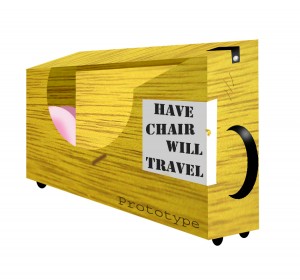
Early Prototype of the chair. Notice the slot in the chest rest for the face.
Serge took this all in for a moment and then said, “Oh. You want a box.” “No, no,” I replied, “I want a chair.” More firmly he insisted, “No. You want a box.” Then he went to the whiteboard and proceeded to draw out how a chair could be built using a box as a base and with detachable supports–which could be stored inside the base–for the rest of the body. “You’re right,” I finally agreed, “I want a box.”
It took three prototypes to get to a version of the chair that a person could actually sit in. At that point I felt confident enough to show it to Jim Everett, the owner of Living Earth Crafts, an early manufacturer of massage tables in Santa Rosa, California. Over the next two years Serge and I worked with Jim to develop a series of pre-production models that kept refining the original idea.
Finally, in May, 1986, the first High Touch Massage Chair emerged from the Living Earth Crafts workshop and the face of an industry was born. Later that year, I showed off the chair for the first time to a group of 38 massage school owners and offered to come to their schools and teach their students how to use it. In the next 16 months I taught chair massage classes in 24 schools throughout the U.S., Canada and Europe. By 1990, all of the largest, and many of the smaller, table manufacturers had their own version of the massage chair and close to 100 massage schools were offering chair massage courses.

Jim Everett and David tinkering with the chair
Living Earth Crafts retired the original chair in the mid-1990’s as more lightweight designs with tilting face cradles emerged. I joined forces with another company, Stronglite, and co-developed the chair I now work with – the Ergo Pro.
Jim Everett has passed away but I am forever grateful that he and Serge had the patience, foresight and courage to embrace an idea for which there was no discernible market and to invest their time and money to make it a reality. There is no doubt that all three of our names belong on the first patent for a portable, knock-down massage chair # 4,746,167, which you can read here . You can also view the original images included with the patent.
If you have any stories about the original chair or the early days of chair massage, please leave them below or send them directly to me.