
The “Death” of On-Site Massage
[This piece was originally published in Massage Therapy Journal Spring issue, 1995. Only a few people will remember that “seated massage” originally burst onto the scene as “on-site massage” when the first massage chair came on the market in 1986. Here is a bit more about the genesis of the early terminology.”
In 1986 I coined the term “On-Site Massage” and, in 1995, I thought perhaps I might kill it.
Okay, maybe that’s not exactly true. While it is true is that I coined the term “on-site massage” it is not exactly true is that I want to kill it. Rather, I am going to suggest that we need to redefine how we use the term. Let me discuss the original rationale for the term “on- site massage” and the current confusion around its use.
Giving massages to people who are seated has been going on for centuries. There are old Japanese woodcuts of people being massaged on low stools, next to their bath. In current times chair massage started with a few creative practitioners in the early 1980’s who were looking for a way to bring massage services into the workplace.
In 1982 I began experimenting with seated massage as a way of creating jobs for graduates from The Amma Institute of Traditional Japanese Massage, a school in San Francisco that I ran from 1982 until 1989.
We had significant success at Apple Computer Corporation and, throughout 1985 and 1986, our work was widely reported in the national media. This was the first time the concept of chair massage entered the broad public consciousness.
The “birth” of On-Site Massage came in May 1986. I coined the term at the same time that we introduced the first custom-designed chair for seated massage, manufactured by Living Earth Crafts. I specifically stayed away from calling the work “chair massage” because, up to that point, it seemed like every time we talked about chair massage, people would immediately try to figure out where they could plug it in.
So I selected “on-site massage” to emphasize the portability and convenience of the work. The term had a corporate feel to it which fit in with what I felt, at that time, was going to be the primary market for chair massage service–the workplace.
At the 1986 American Massage Therapy Association convention, I demonstrated chair massage at a meeting of the Council of Schools and began offering continuing education workshops throughout the country. Nine years later we have taught over 5,000 table practitioners the techniques and marketing strategies of chair massage.
Interest in chair massage has continued to grow. Here’s a quick survey of the evidence that confirms how chair massage has become a significant component of the bodywork industry.
- Virtually every massage school in the country now includes information about chair massage in their core curriculum.
- At last count there were at least 15 different massage chairs being sold by manufacturers. My conservative estimate is that over 3,000 chairs a year are currently being sold and that more than 15,000 chairs have already been purchased.
- The range of markets for chair massage is truly amazing. Massage chairs are being taken to offices, flea markets, airports, taxi stands, bookstores, health food stores, parks, beaches, shopping malls, salons, ski resorts, seminars, convention centers, health fairs, charity events, weddings, film sets, music studios, backstage at concerts, anywhere table massage has traditionally been done, and at dozens of other locations and events limited only by the imagination of the practitioner.
- Chair massage serves as the front line in our efforts to legitimize bodywork services in the eyes of the general public, elected officials, and the media. Because of its non-threatening nature and high visibility this work is often the first–but not the last–massage a new client receives.
With all the good news, why then is there a need for changing the terminology? Simply because serious inconsistencies have arisen with usage of the term “on-site massage.”
When chair massage began, most of it was, in fact, “on- site” massage. That is, most of the time practitioners took the chair to the location of the client to do the work. However, as chair massage began growing, clients began coming to the location of the practitioner, as primarily happens with table massage.
Another inconsistency in many people’s minds is that “on- site massage” doesn’t refer exclusively to chair massage anymore. I have seen many examples of bodyworkers referring to “on-site table massage.”
Finally, over the years, the term “on-site massage” is sometimes used synonymously with “workplace massage.” This came about because most of the stories in the mainstream media have described chair massage performed in the office setting.
I suggest it is time to end the confusion. My proposal is simple-let’s tell it like it is.
- When massage is brought to the location of the client it is clearly “on-site” massage. However, note that a more precise reference would be either “on-site chair massage” or “on-site table massage.”
- For a generic term to describe massage done on a seated client I propose the obviousÑ”chair massage.” This juxtaposes it well to “table massage.” Optionally the work could be called “seated massage” but since we don’t use the term “prone massage” for table clients it is not quite as neat.
Fortunately most of the practitioners who have invested time and money in developing business cards, brochures, and other advertising for on-site massage really are doing massage “on-site.” They would only need to add the modifier “chair” to be absolutely clear about what they mean.
For my part, I will no longer generically refer to my work as on-site massage but rather call it “chair massage.” This year I have also renamed my seminar organization from On- Site Enterprises to the Skilled Touch Institute of Chair Massage.
The important thing to remember is that on-site massage–oops! I mean, chair massage, is flourishing. It couldn’t be killed even if someone really wanted to. No matter what we call it, I will continue to be a primary advocate.
![[Jim Everett and David Palmer tinkering with the massage chair]](https://touchpro.com/wp-content/uploads/2011/05/JiM_DP_tinkering.jpg)
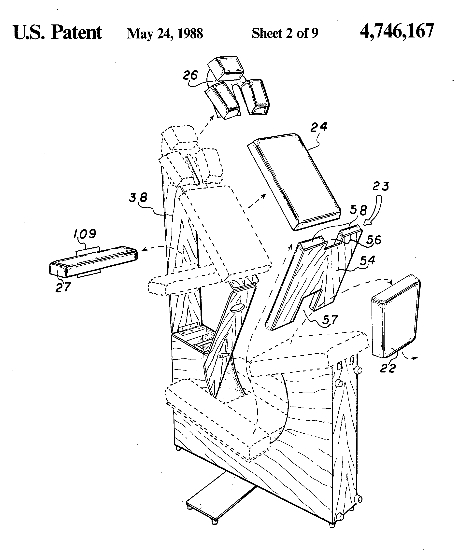 Designing and building a massage chair is far more complicated than creating a massage table. Massage chairs have four surfaces on four different planes that need to fit to the customer’s face, chest, shins and seat, rather than the one surface required for a massage table. Each surface must be adjustable enough to accommodate a wide range of lengths and weights and the chair itself should be adjustable for tall and short practitioners. Add to that the requirement that the chair must fold into a transportable package that is lighter and smaller than the typical massage table and you end up with a major engineering challenge.
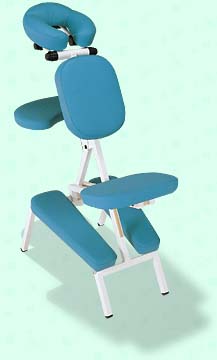 The reason for its popularity is the simplicity of the design, which made it relatively easy to manufacture and eventually, easy to copy. Scott sold his design to a manufacturer in Montana called Golden Ratio which named the chair the QuickLite. Golden Ratio neglected to get any patent protection and by the mid 1990s multiple versions were being made throughout North America, Europe and Australia.
 The Portal Pro chair that Linda sketched was defined by the unique cable system that linked the front and back leg braces providing an entirely new level of support and independent adjustability for the face, leg, shin and seat pads.
 The great innovation of the Lloyd frame was the elimination of any cabling holding the legs together. That meant that the seat height/angle and chest pad height/angle could be adjusted independently. In addition, the back legs can be raised or lowered for the height of the seat and comfort of the practitioners without changing any angles or requiring adjustments for the customer.
 If the Riach Design was based on an “X,” the Gillotti Design was based on an “O.” The frame is built on three curved, nesting tubes that telescope in and out of each other allowing the chest pad and face cradle attached to one end to move from a totally horizontal to a totally vertical position. On the other end of the frame the seat can perform the same maneuver.
 The year was 1983 and the oldest national association of massage practitioners was about to change the face of an industry by turning “massage” into “massage therapy.” This is the story of what led up to that moment.
 The first time we nervously walked into Apple Computer’s Macintosh division in 1984 to provide seated massage with our matching grey slacks, white polo shirts and blue blazers, we felt overdressed. At a time when the largest computer company in the world, IBM, was still requiring dark suits, white shirts and ties on all of its workers, while Apple employees were all about jeans and T-shirts. We immediately breathed a sigh of relief and settled in for a year that would change the massage industry forever.