by David Palmer | Jun 11, 2015 | Chair Massage, Marketing, Touch
(This article first appeared in the June 2015 issue of MASSAGE Magazine,)
 Over the past three decades American culture has become increasingly touch averse. While few question the importance of touch for the healthy development of newborns, infants and young children, something unfortunate begins to happen about the time kids get ready for school. They learn to fear touch.
Some of this learning comes from parental cautions about not allowing strangers to touch you. But, mostly, children learn by example. What they see is that no neighbor, teacher, minister, adult friend or, sometimes, even relatives are allowed to offer them affectionate touch.
Then it is on to adolescence where, just as the hormonal storm whips up our need for touch to hurricane force, the “don’t touch” messages take on a new level of urgency. We learn the terrors of touch that results in pregnancy, STDs, date rape, or being called Gay.
Finally, after entering the workforce, we encounter institutional policies about sexual harassment that tend to frown on, if not outright ban, all touching.
What a world we have created. We are taught not to hit, but not how to caress. The media bombards us with images of abusive touch and sexualized touch, but not affectionate or sacred touch. In a society where touch is pathologized so early and so often, it is virtually impossible to grow up without accruing a wide array of unconscious negative and defensive responses to touch.
The marketing conundrum
This makes marketing massage particularly challenging. The massage profession has been swimming upstream against a torrent of cultural and institutional touch phobia for decades. It is unquestionably the biggest marketing barrier faced by our industry and yet, curiously, we barely acknowledge its existence.
Fortunately, there has never been a better moment in history to tackle this marketing problem head on. The emergence of a robust technology for delivering safe touch to the marketplace, i.e. chair massage, has recently converged with a strong scientific foundation validating the importance of positive touch.
To carry this pro-touch banner we need to redefine ourselves as the “touch educators” of our culture. No other profession has taken on this crucially important job of advocating for a touch-positive society and the massage profession is uniquely positioned to assume this responsibility. It is time for the massage profession to embrace touch and become true touch educators.
The reframing of chair massage
Chair massage is far and away the most accessible option we have for delivering skilled touch services to dozens of market sectors, such as the workplace, that have not be served by traditional table massage. However, because of its typically short time frame, chair massage has never sat comfortably as a health care profession. Without question, the vast number of practitioners providing chair massage in the workplace, at events, or in retail settings are offering a personal care service for simple relaxation, not a health care service for treatment.
Fortunately, recent science has established the fact that touch is good for us. While that may come as no surprise to the massage profession, research that describes the underlying physiology of touch is a tremendous marketing breakthrough. We can now tell our customers exactly why massage makes them feel good.
Within seconds of receiving positive touch, two indisputable and totally involuntary reactions occur. The first is that the bloodstream gets flooded with oxytocin, the feel-good hormone. The second is the activation of the parasympathetic nervous system (PSNS), otherwise known as the relaxation response.
Oxytocin immediately makes us feel calm and connected in empathetic ways to both our internal and external environments. When the PSNS relaxation response is triggered, our bodies move into healing mode where digestion occurs, organs repair and our immune response is activated. Significantly, when the PSNS is stimulated, the stress response (SNS: Sympathetic Nervous System) always diminishes. The two systems are complementary.
These mechanisms can be easily communicated to customers and add an important scientific layer of credibility to our simple touch services. We no longer have to promise musculoskeletal miracles to justify our services, but can confidently make the case that positive touch is enough.
“What we think, we become.” -Buddha
With good science and an accessible delivery system in place, how do massage practitioners build an identity as a touch educator? The first step is to filter our massage work through the lens of skilled touch.
For example, every massage we perform is a validation, through direct experience, of the importance of positive physical human contact. Thus, since every massage becomes a tutorial in touch, then every practitioner must already be a touch educator.
We can use that filter to reframe the whole massage experience for each customer before, during and after every massage. Below are some examples of that reframing but first, a note about terminology.
You don’t actually have to use the word “touch” to be a touch educator. Fortunately “massage” is a perfectly acceptable code word for touch. Each conversation will be different but I often start out by talking about massage and then slowly injecting the notion of touch in to the dialogue.
When doing chair massage I avoid the terms “therapy,” “therapist” and “treatment.” The point is to keep the expectations of the customer focused on the substantial benefits of touch rather than massage therapy done to resolve specific musculoskeletal issues. I describe myself a “massage practitioner” or a “chair massage specialist.”
The guarantee
“No matter how you feel before you sit down, if you don’t feel better when you leave the chair, the massage is free.”
Such a money-back guarantee is a powerful way to highlight the most basic benefit of positive touch—it makes us feel better. No matter if your headache, stiff neck, backache or repetitive strain injury goes away, we know that a surge of oxytocin and stimulation of the parasympathetic system will invariably transform the brain and the body into a more positive and productive environment.
How many services can offer a money-back guarantee on feeling good? It is a rare and valuable gift to guarantee that, no matter how you feel right this moment, in just 10-, 20- or 30-minutes you will feel better. And, there is nothing magical or mystical about massage. In fact, the job of a touch educator is to demystify touch. Without the help of any hocus pocus or hanky-panky, massage makes us feel better.
It is just good science.
Touch is sensational
Often, at the beginning of a massage, I will make some version of this comment: “Everyplace I touch during the massage will have a sensation. I want those sensations to be good, not bad. You need to let me know if any sensation feels uncomfortable, OK?”
All touch creates sensation. One of the goals of chair massage is to reconnect people with their sensational selves. Contemporary culture tends to shut down the links between our brains and our bodies and interrupt our natural sensory feedback systems by numbing our bodies with drugs or over stimulating our minds with media, video games and the like.
Encouraging feedback during a massage is an important way for people to take ownership of how they feel. So many people have fallen into the trap of believing that how they feel is a result of external circumstances beyond their control. The current fascination with zombies is, I believe, a disturbing reflection of our own personal and cultural disembodiment.
Reinforce the connection
There are many ways to reinforce the connection between massage and the myriad benefits of touch in the massage relationship. Be on the lookout for opportunities to share the following messages. For example, often in response to some comment about how awesome a customer feels during or after a massage I might say:
- A little touch goes a long way.
- It is amazing how a little oxytocin boost can lift our mood and make our world a little more manageable.
- We call massage “an instant attitude adjustment.”
Here are a couple of other educations notions I like to share with stressed out customers:
- By making us more mindful of the present moment massage helps turn obstacles into challenges and big problems into manageable tasks
- Too often our bodies spend too much time either in stress response or waiting for a stress response. Each time we get pinged by an arriving email or text message our body gets a little jolt of adrenalin. That’s good for fighting or fleeing tigers, but bad for navigating our day-to-day lives. Massage helps make the relaxation response a habit.
Traditionally, chair massage in the workplace was always framed in terms of such variables as increased productivity and morale along with reduced stress and absenteeism. Unfortunately the evidence behind such claims has always been sketchy at best. However, when filtered through the lens of touch science, all of these outcomes make sense. Consider these impacts of positive touch:
- Massage/touch brings out minds and bodies back into the present moment, which is where, as the mindfulness experts keep telling us, all of the best decisions are made.
- Because massage stimulates the relaxation response we know that relaxed employees are focused, healthy and happy workers.
- The immediate oxytocin boost provided by a massage results in an increase in morale and collaboration.
The touch connection
From the moment of birth we crave connection with other human beings. Touch is the first and most fundamental manifestation of that connection. It is also the most intimate connection but, unfortunately, our cultural fears around intimacy are wide and deep.
Chair massage is the perfect container for the non-threatening intimacy. I remember the first time I heard a woman remark to me in the early 1980s that her chair massage experience was the first time she could remember a man touching her non-sexually.
Touch is fundamental to all massage. Since no other profession has taken up the mantle of being the cultural experts in touch, it only makes sense that our profession should carry that banner and become the primary advocates for the benefits of positive touch.
Adding the identity of a touch professional/educator/advocate to your chair massage work will transform your practice, your relationship with your customers and, maybe, even yourself. Let’s start building a pro-touch society one touch-informed massage at a time.
Further resources
To help you get started in becoming a conscious touch educator check out the latest touch research detailed in the new book, Touch by David J. Linden. You can also follow current touch news from Suzanne Zeedyk: The Science of Human Connection and UC Berkeley’s Greater Good Science Center.

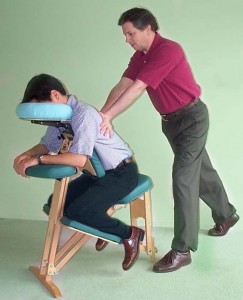 Chair massage often turns out to be just the right introduction people need to experience the joys and benefits of all varieties of structured touch. While not all chair massage clients will turn into table clients, often conversion success is simply a matter of not missing the opportunities presented by clients during the course of a chair massage encounter.