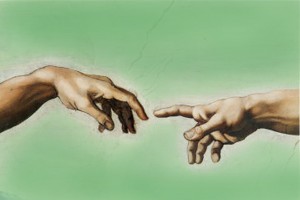
Which profession should hold the keys to the storehouse that contains all of the world’s knowledge about human touch? Besides bodyworkers, is there any other (legal) occupation with more practical and theoretical knowledge about touch? I don’t think so and yet I have been struck by the fact that the massage profession often seems to relate to touch the same way fish relate to water. We take it for granted.
I believe that the primary function of entry level massage programs is to train the next generation of touch specialists and, obviously, that means their highest priority should be teaching students how to give and receive touch. And that is not happening.
I know it is not happening because one of the questions I regularly ask bodyworkers in my classes is how many of them graduated from massage school with other students whom they didn’t want touching them? Most often, every hand goes up.
I also know massage schools aren’t prioritizing touch because although we have plenty of textbooks on anatomy, physiology, pathology, ethics, techniques, body mechanics or business and we also have general textbooks that cover all of those topics, we still have no single textbook that explains everything every bodywork professional needs to know about touch.
Graduates may study the anatomy of the skin and touch receptors, but do they study the emotional, psychological, familial and cultural anatomy out of which touch attitudes, perception and receptivity arises? They may learn how to take a medical history, but how many massage schools teach their students how to take a touch history?
As a profession we are squandering a golden opportunity to advocate for a part of the human experience as essential to the development and maintenance of good health and well being as the air we breath or the food and water we consume. Everyone needs touch and lots of it but because touch in our culture is the orphan sense, most people living in urban environments wake up every day with a serious touch deficit.
The ears have music, the eyes have art, the nose and taste buds have food and perfumes and our sense of touch has–what? How exactly do we feed our sense of touch? Family affection and sex are the two obvious answers, but I would suspect that in most contemporary lives these options are in short supply.
The obvious answer for filling this touch gap is massage. Isn’t it time for the massage profession to embrace touch? Sure, massage therapy trying to be a health care profession is good, but isn’t offering the gift of unconditional touch with simple massage even more fundamental?
At most, only 4.2% of the adult population in the United States gets regular massage. If we want to have any hope of breaking through that ceiling, then massage needs to go back to its roots. Turning “massage” into “massage therapy” has helped the industry shed its shady past but at the same time has sidelined the most important reason people actually get a massage: because it makes them feel better. Not better in a medical sense, but better because they feel more real, alive and whole.
With simple massage the left brain starts talking to their right brain and everything above the neck starts noticing everything below the neck. By the end of a massage people’s core sense of trust and security in a fundamentally unsafe world gets renewed and they are able to face their lives and the world with a calm, balanced optimism.
On a physical level massage enhances circulation so that the body’s own natural healing systems can function optimally. Little problems are far less likely to become big problems with regular massage.
Redefining “massage” as “massage therapy” as the AMTA did in 1983 was mostly a defensive move. The thinking went, if massage is a health care profession, no one will mistake us for prostitutes. But we are, for the most part, past that issue. It is time to get back to our roots and highlight what we are better at than anyone else in the culture.: touching people safely, unconditionally, with clear intentions, significant training and experience.
Question: What do you think is the most important role of massage professionals?

 Only in the Bay Area would there be a company called Plushy Feely Corp. that designs and promotes cuddly Kimochi dolls that helps kids learn to understand and express their feelings. The product that caught my eye was Huggtopus, a multi-limbed creature who is “very affectionate and strong and sometimes gets a little carried away by her big friendly personality. Huggs always means well but has to learn about boundaries.”
 Admittedly, since my oldest grandchild just entered second grade this year, I have been out of the loop regarding school board policies dealing with public displays of affection (PDA) between students. I guess, after watching Glee for three years, I had thought schools were getting more enlightened about the subject of consensual, non-sexual touch.