by David Palmer | Oct 2, 2014 | Chair Massage, Marketing
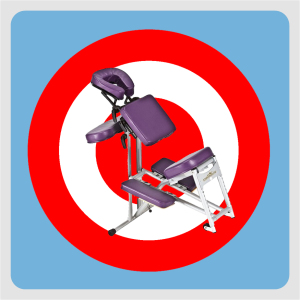 Here is a recent email from a massage student:
I will be graduating in December and have to write a business plan. I need to decide how chair massage will fit into the plan but don’t have much direction from school. I’m hoping you have some marketing advice or resources available to help my classmates and I know how we would move in the direction of chair massage.
In my reply, I first mentioned that there are some 26 articles about chair massage on this blog along with many others that have more generally to do with massage. Then I also sent her the following concise overview of the why’s and wherefore’s of chair massage marketing.
Options for including chair massage
There are three basic ways to integrate chair massage services into a professional practice:
- As a way to market your table practice. This typically means giving away free chair massage at events so that you can introduce people to your touch and your table work. Practitioners have done this successfully any place there is a group of people with time on their hands, e.g. queues on the sidewalk outside of popular restaurants or movies, church bazaars, charity events, health clubs, and waiting rooms of various stripes.This is a good option if your primary interest is in developing a table practice. After the practitioner has as many table customers as she wants, then the free chair massage tends to go by the wayside as the natural marketing momentum emerges from a well run table practice emerges.
- As a mix with your table practice. The difference from the first option is that here you are charging for your chair massage services in one or more of the three market segments described below. It still has the advantage of the first option in that you may also convert a certain portion of chair massage customers into table customers.Most practitioners use chair massage this way. In fact, I see a lot of experienced table practitioners adding chair massage to balance out their professional lives and raise their visibility in and connection to the community.
- As an exclusive chair massage practice. Some practitioners decide to focus
exclusively on chair massage. There are many possible reasons including:
- not wanting to deal with nudity,
- feeling more comfortable with shorter customer interactions,
- not wanting to work with oils or lotions,
- wanting to reach more people who can’t afford a table massage,
- not wanting to be restricted to four walls,
- not wanting to be working on the same 20 or so people every week.
Three markets for chair massage
There are also three general market segments where all chair massage is found:
- Events. These are situations jobs where you typically see customers once and never again. The largest markets are conventions, conferences, trade shows and corporate health fairs. However, the list of potential one-time events is endless ranging from weddings, reunions, back stage at theater events, athletic events, car racing, RV rallies, equestrian events and on and on. There are many local, as well as large regional and national chair massage businesses that focus exclusively on these markets.
- Workplace. This has also been a rich vein to mine for chair massage customers. Unlike events, these tend to be ongoing relationships with companies and their employees. The frequency of visits could be a long as a year apart or, more often, quarterly, bi-monthly, bi-weekly or even weekly.
- Retail. Providing chair massage services in a retail setting has been the slowest of the three segments to get off the ground because it requires the most up-front investment. However, the growth in retail chair massage has started to accelerate in the past 5 years, primarily due to the influx of Mainland Chinese immigrants flooding through the Los Angeles basin and scattering to shopping malls all across the country.
Finally, I mentioned that we have assembled an eBook in PDF format that can be ordered from the TouchPro Store here. It assembles the relevant articles from the blog into one convenient place and affordable price. (more…)
by David Palmer | May 8, 2014 | Business, Marketing
This article originally appeared in the May 2014 issue of MASSAGE Magazine.
 Seated, or chair, massage is alive, well and flourishing in the workplace, primarily because of two overarching trends: evolving public perception of massage therapy and the impact of the Internet. Large companies and corporations that have contracted with seated massage companies include JetBlue, The Walt Disney Company, Brandeis University, Boeing, The Weather Channel, Gillette, Delta Airlines, Apple Inc., SunTrust Bank, Bank of America Investments and IBM—as well as countless smaller businesses that rely on seated massage to reduce employee stress while improving morale and productivity.
A look back
In 1982, the concept of professional massage done through clothing, on seated customers, out in the open, was as unfathomable as the notion there would someday be a computer in every pocket. Thirty years ago, marketing chair massage to corporations was often done by picking up the telephone and cold-calling. Now, add to that the experience of trying to describe a service no one had ever heard of before. I recall one human resources director fretting about the need for an electric outlet in the massage room. It was an understandable confusion, since the only massage chair she was familiar with was the kind you had to plug in.
Seated massage has come a long way in three decades, and is now a familiar part of the cultural landscape, regularly appearing in malls, in movies and in the workplace. In cities large and small, companies of all sizes use seated massage to keep employees happy and healthy.
As Carrie Mudrick-Rubel, owner of Massage on Wheels in Toronto, Ontario, Canada, said, “The amount of people who are aware of massage has increased over the years. We rarely get funny looks anymore from people when we walk into a building.”
Certainly, visibility helps, making seated massage itself one of the biggest drivers of changing perceptions of massage therapy overall. “Within our culture, the image of massage is improving—and chair massage has been leading the way because it is so accessible,” says Larry Trager, who has offered seated massage since 1982.
The public is increasingly understanding the wide range of potential benefits of professional massage, ranging from the basic feel-better sensation of most massage, through relaxation, health-promotion and disease-prevention benefits, all the way up to specific treatment of a variety of emotional and physical challenges.
“There is greater enthusiasm for chair massage. People treat it more like a necessity than 10 years ago,” says Robin Faux, a seated massage practitioner in Los Cruces, New Mexico.
This visibility and awareness of benefits of massage inevitably reach corporate decision-makers, albeit sometimes more slowly than we would like. Massage therapist Mary Cheers, of Dayton, Ohio, tells the story of a CEO who had been a table client for years and only became interested in chair massage for her employees after reading in a trade magazine about how good it was for increasing morale.
Online impact
If successful public relations created a more receptive climate for chair massage services, it was the Internet that offered the ideal condition for stimulating its growth.
Trying to locate potential customers of workplace chair massage is like searching for the proverbial needle in the haystack. It takes a lot of time and energy. While doing cold calls, mailing flyers or knocking on doors can still sometimes be useful for getting a seated massage business off the ground, without question the best contemporary strategy is to create an Internet presence and let companies looking for seated massage services find you.
Massage therapist Jessica Lugo began offering chair massage in Kansas City, Missouri, a year ago. She now provides seated massage at eight companies. She was initially inspired by her work with a chiropractor who paid her to go into corporations to provide free seated massage to promote his practice. She noticed a lot of interest in seated massage, and decided specializing in it would provide the flexibility she, a mother of four children, required.
One of her customers came from the chiropractor connection, but the other seven were hard-won by sending hundreds of emails, mailing dozens of flyers to local companies, and offering to provide free sample sessions. It took months of follow-up phone calls and legwork to land those seven clients and, while her persistence has paid off, in retrospect Lugo says the return was not worth the effort. She is now convinced future growth of her business lies in developing a website and creating an online presence.
Indeed, some of the largest chair massage companies market almost exclusively through the Internet. Infinite Massage, for example, spends 95 percent of its marketing budget on online advertising to keep their pool of more than 1,000 practitioners busy with seated massage. No matter where you are in the U.S., an Internet search for chair massage or seated massage will nearly always bring Infinite Massage at or near the top of the listings.
Trying to persuade the unenlightened of the value of seated massage, while noble, is not the most efficient use of time or money. The unconscious and deep-seated personal resistance many people still have toward massage can rarely be overcome by data, no matter how bottom-line oriented or scientifically persuasive.
However, being visible through the Internet to corporate decision-makers who are already looking for seated massage services is, at this point, a necessity. Make certain your website is search engine optimized, and create a presence on the major review sites, like Yelp, as well social media sites such as Facebook and LinkedIn.
Recession-proof your practice
Workplace seated massage can be roughly divided into two sectors: one-time events and regular appointments. To minimize the effect of a downturn, don’t put all of your eggs in the event basket. This lesson was strongly reinforced when the economy downturned in 2008.
Infinite Massage, for example, derives two-thirds of its national income from one-time events—and by the end of 2008, it had lost 35 percent of its revenue. Smaller seated massage businesses are even more vulnerable. Massage therapist Maryuri Velazquez in Davie, Florida, focused 90 percent of her seated massage services on workplace events, particularly corporate health fairs. The recession hit her hard, and most of her event work disappeared. When times are tough, corporations make the easiest cuts—and special events are always high on the list.
Just to be clear, although workplace event massage may be first to go in a recession, it is still a significant income stream at all other times. For example, many millions of dollars have been spent on massage at corporate health fairs. There are regional and national massage companies whose primary revenue comes from providing seated massage practitioners to such events. They connect with companies primarily through referrals from insurance companies and by working with third-party organizers of corporate wellness programs.
Likewise, one-time chair massage for rewards and incentives will always be popular with companies like the Austin, Texas, branch of Apple Inc., which brings seated massage practitioners in from Seize the Day for an annual staff-appreciation day.
The second way to recession-proof your seated massage business is by having employees, rather than the company, foot the bill. As long as employees have a job, they are loath to give up their regular chair massage. In fact, they may believe they need it even more during stressful economic times.
That is what massage therapist Larissa Golden experienced at Boeing in Seattle, Washington, where her company has been providing seated massage since 2006. The employees were emphatic that Boeing would pry their massage away only at the company’s peril.
All of the most enduring seated massage businesses understand this survival tactic. Employees at USAA Insurance in Tampa, Florida, have been paying for chair massage without interruption for the past 22 years, a service provided by Vitality Break, one of the original seated massage companies in the state.
Conversely, massage therapists Larry and Stephanie Trager attribute much of the longevity—three decades and counting—of their business, Corporate Touch, to company clients paying for all or a portion of their fee. They have found companies that split even a small percentage of the cost of seated massage with their employees have a difficult time cutting the program despite a challenging economy. They also say when a company pays for at least part of the massage, it sends a message to employees: It is the difference between a company just allowing chair massage on their premises and actually encouraging it.
Active support
That kind of active support can be helpful for guaranteeing the success of seated massage in the workplace. Internet marketing works so well precisely because at least one person in the company is pre-sold on the value of chair massage—or she wouldn’t be searching for it online.
In addition to subsidizing massage, there are a number of other ways companies can demonstrate commitment to seated massage at little or no cost:
- Providing the space for seated massage.
- Designating a specific person as a liaison to the seated massage service.
- Giving employees time off to get massage, rather than taking the time away from a break.
- Maintaining a scheduling system. Massage therapist Marcy Basile has the office manager do the scheduling at a 150-person software company in Houston, Texas. A manual system may be adequate, but one that employees can access from their computers is even better.
- Promoting the service. At USAA Insurance in Tampa, Florida, not only can the employees book online, reminders to sign up also periodically scroll in the newsfeed at the bottom of every monitor.
- Implementing payroll deductions, if the employees are paying for all or a portion of the massage. This is a huge convenience for both the practitioner and the employee.
Getting company involvement in these ways will bind them into a closer relationship with your seated massage business and encourage a long-term the partnership.
But there are no iron-clad guarantees. If the seated massage cheerleader leaves the company or the corporate culture shifts, then there is always the danger of being marginalized or even ousted
New directions
Since selling chair massage to the workplace is a mostly passive, Internet-based process, our active marketing efforts must continue to be directed toward education and public information.
Traditionally we emphasized the individual benefits of an increase in circulation and a decrease in the negative impact of stress. Now, we are reframing those rationales. Over the past 20 years, researchers have been slowly shifting their attention from studying the mechanisms of pathology—why we get sick—to the mechanisms of health. This mirrors the broader paradigm shift within our health care system from treatment to prevention.

 This article originally appeared in the May 2013 issue of Massage Magazine. The focus of the issue was on the business of massage and I was asked to respond to the question: