Are We Solving the Wrong Problem?

Why the Interstate Massage Compact Misses a Larger Regulatory Opportunity.
By David Palmer

Over the past several years, a significant amount of attention, funding, and professional energy in the U.S. massage field has been devoted to the proposed Interstate Massage Compact. Its aim is straightforward: allow licensed massage therapists to practice across state lines without navigating multiple, duplicative licensure systems.

Portability matters. For therapists who move frequently, serve mobile populations, or live near state borders, the current system is inefficient and frustrating. The Compact seeks to address a real problem.

But an important question remains largely unexamined:

Is licensure portability the most important regulatory problem facing the massage profession today? Or has the profession focused on a technically complex issue that affects a relatively small segment of practitioners, while overlooking reforms that could have delivered broader public benefit?

A Solution for a Subset

The Interstate Massage Compact is designed to help massage therapists who wish to practice in multiple states. By definition, this is a subset of the profession. Most massage therapists practice in one state, often in one community, and do not routinely cross state lines for work.

For these practitioners, the primary regulatory challenges are not portability. They are barriers to entry, access to employment, scope-of-practice limitations, and the cost and duration of training relative to earning potential.

From a public-policy standpoint, this distinction matters. Regulation should prioritize changes that produce the greatest benefit for the greatest number—both practitioners and the public they serve. Measured against that standard, the Compact’s impact is limited.

At the same time, one of the most accessible and scalable forms of massage—chair massage—remains constrained by regulations that fail to reflect how it is actually practiced.

Chair Massage: Common in Practice, Absent in Policy

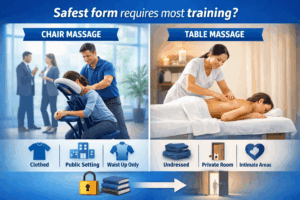
Chair massage is already woven into everyday life. It appears in workplaces, airports, conferences, healthcare facilities, senior centers, and community events. It is typically delivered:

    • Fully clothed
    • In open, observable settings
    • For short, defined periods
    • Without oils, lotions, or disrobing
    • Without diagnostic or therapeutic claims

In terms of risk profile, chair massage is fundamentally different from full-body table massage performed in private rooms. Yet in most states, it is regulated as if that distinction does not exist.

Chair massage is rarely recognized as a distinct modality. Instead, it is folded into full-scope massage licensure frameworks designed decades ago for a different practice context. As a result, practicing chair massage often requires the same regulatory investment—time, money, and education—as practicing unrestricted table massage.

The Consequences of Regulatory Mismatch

When regulation fails to distinguish between different kinds of practice, the result is not increased public safety. It is reduced access.

Overregulation of chair massage contributes to:

    • Fewer practitioners available for workplaces and public settings
    • Higher barriers to entry for new and career-changing practitioners
    • Reduced access to low-cost, preventive, stress-reducing services
    • Missed opportunities in community health and institutional care

Ironically, these outcomes undermine the very goals regulation is meant to serve: public protection, ethical practice, and a sustainable profession.

Good regulation is proportional. It differentiates based on actual risk and context. Treating all massage modalities as if they carry identical risks is not evidence-based policymaking—it is regulatory inertia.

The Opportunity Cost of the Compact

The Interstate Massage Compact has required years of coordinated effort, including federal funding, multistate legislative advocacy, administrative infrastructure, and extensive professional debate.

That investment represents an opportunity cost. Time, money, and political capital devoted to one regulatory pathway are not available for another.

Had even a portion of those resources been directed toward modernizing chair massage regulation, the results could have been immediate and tangible. Potential reforms might have included:

    • Explicit recognition of chair massage as a limited-scope practice
    • Tiered or entry-level credentials aligned with chair massage only
    • Education requirements calibrated to actual risk
    • Clear regulatory guidance for public and institutional settings

Such reforms would not eliminate full licensure pathways. They would complement them—creating legitimate on-ramps into the profession rather than guarding a single gate.

Public Safety and Public Access Are Not Opposites

Advocates of the Compact often frame their arguments around public protection. This concern is valid. But public safety is not enhanced by ignoring meaningful differences in practice context.

Chair massage’s defining characteristics—clothing, visibility, time limits, and public settings—already mitigate many of the risks regulators are rightly concerned about, including boundary violations and misconduct. These features make chair massage particularly well suited to scoped regulation.

Failing to account for these differences does not make regulation stronger. It makes it less precise.

A Question of Priorities

The debate over the Interstate Massage Compact has exposed divisions within the profession about governance, standards, and access. But beneath those disagreements lies a more fundamental question:

What kind of profession is massage becoming, and who is it for?

A regulatory strategy focused primarily on interstate portability benefits established practitioners who already meet full licensure standards. A strategy that also modernizes chair massage regulation would serve a wider range of stakeholders: new entrants, community programs, employers, institutions, and the public.

Conclusion

The Interstate Massage Compact may still move forward, and it may ultimately benefit a segment of the profession. But it is worth acknowledging what was not pursued with the same urgency.

Chair massage—safe, public, and widely accepted—has been hiding in plain sight, constrained by regulations that no longer reflect reality. If the goal of regulation is truly to protect the public while supporting a healthy profession, then the energy spent chasing portability may have been better spent opening doors.

The next chapter of massage regulation should focus less on crossing state lines—and more on removing the barriers that no longer make sense.
Separating Safety from Gatekeeping: The Case for Chair Massage as Entry-Level Practice

Why the regulations designed to protect the profession actually limit its reach

By David Palmer

The American massage profession has spent decades fighting for legitimacy. At the heart of this struggle has been a critical mission: separating professional massage from prostitution and the exploitation and trafficking that accompany it. This fight has been necessary, important, and ongoing. State regulations requiring 500-1000 hours of training have served as one tool in this battle, establishing clear professional standards and creating distance from illegal activities masquerading as massage.

But in pursuing this necessary goal, the profession has created an unintended casualty: accessibility. More specifically, we’ve allowed the regulations designed to address the real risks of table massage to inadvertently stifle a fundamentally different practice—chair massage—that poses none of the same concerns while holding the promise of dramatically expanding the market for all massage services.

I began experimenting with massaging seated customers in 1982 with a specific vision: making skilled touch accessible to the greatest number of people. What I’ve witnessed since is a regulatory structure that prioritizes professional acceptability over this accessibility, requiring practitioners to complete hundreds of hours of table massage training before they can practice a form of massage that, by its very nature, addresses the core concerns that justified those regulations in the first place.

It’s time to examine whether our regulatory structure actually serves its stated purpose—or whether it simply serves itself.

Understanding the Original Problem

Let’s be clear about why table massage required robust regulation. The concerns were legitimate and remain so:

The Risk Profile of Table Massage:

  • Clients undress and require draping protocols
  • Work occurs in private rooms behind closed doors
  • Practitioners access intimate and vulnerable body areas
  • Clients are in prone or supine positions, limiting their mobility and agency
  • The setting creates opportunities for exploitation and illegal activity
  • Without clear standards, illegitimate businesses could operate under the guise of massage

These regulations addressed real harm. They created professional boundaries, established training standards, required background checks, and built a framework that helps law enforcement distinguish legitimate practice from criminal enterprise. This framework has been essential to protecting both clients and the profession’s legitimacy.

The question is not whether these regulations are necessary for table massage. They are. The question is whether these same regulations make sense for a practice with none of the same risk factors.

Chair Massage: A Different Practice Entirely

Consider what chair massage actually is:

The Structure of Chair Massage:

  • Clients remain fully clothed throughout
  • Work is performed from the waist up or knees down only
  • Sessions occur in public or semi-public settings—airports, corporate offices, health fairs, farmers markets
  • The client sits in a specialized chair with their face in a cradle, able to stand and leave at any moment
  • No closed doors, no private rooms, no disrobing, no draping protocols
  • The practice is inherently transparent and observable

In other words, chair massage is designed around the very features that address the core concerns of massage regulation. It is massage practice with built-in safeguards.

The practitioner cannot access intimate body areas. The client never disrobes. The setting provides natural oversight. The positioning gives the client complete agency and easy exit. There are no closed doors behind which exploitation could occur.

If the regulatory mission is to prevent exploitation, trafficking, and illegitimate business operations, chair massage already accomplishes this through its structure. Requiring 500-1000 hours of table massage training to practice chair massage is like requiring a driver’s license to ride a bicycle—the safety concerns that justify the license simply don’t apply to the activity being regulated.

The International Perspective

This becomes even clearer when we look beyond US borders. In most countries, there is no training minimum for practicing chair massage. In France, where I helped establish professional standards, we created a 150-hour training program specifically for chair massage practitioners.

Are clients in these countries experiencing exploitation or harm? Is chair massage being used as a front for illegal activity? No. The structural features of chair massage—clothed, public, limited body areas—create inherent protection regardless of training requirements.

The US is one of the few countries requiring extensive table massage training for a practice that bears little resemblance to table massage. And we stand alone not because we’ve identified risks others have missed, but because we’ve applied a regulatory framework designed for one practice to a fundamentally different one.

The Cost of Regulatory Overreach

This misalignment has consequences:

For Aspiring Practitioners:

Consider someone who wants to work for themselves or for a company providing chair massage services in corporate offices, at trade shows, or in retail settings—the most common work path for chair massage practitioners. Or a single parent working full-time who wants to offer chair massage at community health fairs. Both must invest 500-1000 hours and thousands of dollars in training they don’t need for their actual practice. Many simply can’t make this investment, so they never enter the profession—and the businesses that would employ them can’t find enough qualified practitioners. We lose their skills, their perspectives, their potential service to their communities, and the economic opportunities this accessible work could provide.

For Underserved Communities:

Populations unfamiliar with massage, those with limited financial resources, those in rural areas—they’re most likely to encounter massage through chair massage at community events, workplaces, or public settings. But because we’ve made it so difficult to become a chair massage practitioner, there are fewer practitioners available, particularly in these underserved markets.

For the Profession:

We claim we want to normalize skilled touch, to make it part of everyday wellness rather than a luxury service. But chair massage is the most safe, convenient, and affordable way for people to experience professional touch for the first time. By restricting access to chair massage practice, we limit the profession’s ability to reach new populations and grow the overall market.

For Professional Legitimacy:

Perhaps most ironically, this regulatory structure actually undermines the profession’s legitimacy. When regulations appear arbitrary—when they can’t be justified by the actual risk profile of the practice—they invite criticism and resistance. They suggest gatekeeping rather than public protection.

A Risk-Appropriate Regulatory Model

What would regulations look like if they were designed around actual risk rather than regulatory inertia?

For Table Massage (higher risk profile):

  • 500-1000 hours of training covering anatomy, pathology, draping, ethics, boundaries, and therapeutic applications
  • Background checks and screening
  • Continuing education requirements
  • Clear scope of practice and professional standards
  • Robust enforcement mechanisms

For Chair Massage (lower risk profile):

  • 125-175 hours of training focused on the actual skills needed: pressure techniques, body mechanics, client communication, safety, professional boundaries in public settings, a theory of touch, and business practices
  • Background checks (same as table massage)
  • Clear scope of practice definition: clothed, from waist up or knees down, public or semi-public settings
  • Option to advance to table massage through additional training

This model aligns training burden with risk profile. It protects clients while expanding access. It maintains professional standards while removing unnecessary barriers.

The Acceptability vs. Accessibility Choice

The massage profession has made a choice, perhaps unconsciously, to prioritize acceptability over accessibility. In our quest for legitimacy—to be seen as serious, therapeutic, professional—we’ve adopted the trappings of medical professions: extensive training hours, complex licensing requirements, therapeutic positioning.

This strategy has brought real benefits. We are more accepted, more respected, more integrated into healthcare settings.

But we’ve paid a price. We’ve become less accessible—to practitioners who can’t afford extensive training, to communities that can’t access our services, to clients who find our profession intimidating or unfamiliar.

Chair massage was developed to address this accessibility gap. It’s massage for people who would never book a table massage session. It’s practice for practitioners who can’t or won’t invest 500-1000 hours in training. It’s skilled touch in everyday settings—the workplace, the shopping center, the community event—rather than only in therapeutic or spa environments.

By forcing chair massage through the same regulatory framework as table massage, we’ve eliminated its accessibility advantage. We’ve preserved acceptability at the cost of accessibility.

Moving Forward: A Call to Action

For the massage profession to truly serve the public, we need regulations that distinguish between different practices based on their actual risk profiles. This isn’t about lowering standards—it’s about right-sizing them.

To Regulators: Create a separate licensing pathway for chair massage that reflects its lower risk profile and its role as an entry point to the profession. Study outcomes in the many countries where chair massage is practiced with minimal training requirements. Ask whether current regulations serve public safety or simply protect the status quo.

To Schools: Develop chair massage certification programs lasting no longer than 200-hours that serve the students who actually want this training. Create articulation agreements so these hours can count toward table licensure for those who want to advance. Recognize that not every student wants or needs to practice table massage.

To Professional Associations: Advocate for risk-appropriate regulations. Acknowledge that chair massage and table massage are different practices requiring different training. Recognize that expanding accessibility doesn’t threaten professional legitimacy—it enhances it by demonstrating that we care more about serving the public than protecting our gates.

To Practitioners: Support pathways that make the profession more accessible. Mentor new chair massage practitioners. Recognize that someone practicing clothed massage in public settings isn’t competing with your therapeutic practice—they’re expanding the overall market for skilled touch.

Conclusion: Legitimacy Through Service

The massage profession fought hard to separate itself from prostitution and exploitation. That fight was necessary. The regulations that emerged from it have protected clients and established professional standards.

But chair massage was designed from the start to embody the features that address those concerns: clothed, public, limited body areas, inherent oversight. Applying table massage regulations to chair massage doesn’t enhance safety—it simply reduces access.

Real professional legitimacy comes not from how high we build our walls, but from how well we serve the public. Chair massage, as the true entry point into professional skilled touch, should be regulated as what it is: a distinct, lower-risk practice that makes skilled touch accessible to the greatest number of people.

The regulations designed to protect the profession shouldn’t be the same regulations that limit its reach. We can maintain rigorous standards for table massage while creating appropriate pathways for chair massage. We can protect clients while expanding access. We can be both legitimate and accessible.

But only if we’re willing to separate safety from gatekeeping—and build a regulatory structure that serves the public as much as it serves the profession.


David Palmer began experimenting with seated massage on stools in the early 1980s in Silicon Valley and San Francisco at such places as Apple Computer. In 1986, he introduced the first professional massage chair into the world, and his trainings have become the foundation for tens of thousands of practitioners around the globe. You can access a library of his writings at www.touchpro.com.

An Outsider Analyzes Massage

David Palmer

The shy David Palmer

I was a mama’s boy. The youngest of four males born to my parents within five years, I was the baby of the family and spoiled rotten. There are a number of family stories dramatizing that fact, my favorite of which is how I bravely got on the school bus for my first day in kindergarten only to run screaming down the aisle for my mother the moment the doors closed. I did get chauffeured to school that day but still the teacher had to peel me off my mother’s leg while firmly assuring Mom that I would be all right.

And, eventually, I was. The next day, and every subsequent day, I couldn’t wait to get on the bus. However, I remained a sometimes painfully shy kid until I graduated from high school and was living on my own making my own way in the world. I managed my shy nature with loving support and (mostly) outgrew it with self-sufficiency and self-awareness.

Today shy kids are diagnosed with “social anxiety disorder” and given Paxil or other medication. Our contemporary culture has a well-documented tendency to turn every cursory personal quirk into a disease that needs treatment. While I am certain that there are a few shy folk, overweight people, fidgety kids and existentially troubled adults who could benefit from a prescription, I harbor the sneaking suspicion that: a) these are symptoms of a cultural disorder, not a personal one, and b) that it only benefits the pharmaceutical companies to encourage us to believe that the reverse is true.

Virginia PostrelI was thinking of this tendency to pathologize life as I was re-reading an article by Virginia Postrel analyzing the massage industry. Ms. Postrel is a journalist who focuses on the intersection of culture and commerce. She has been a reporter for Inc. and The Wall Street Journal as well as a columnist for The New York Times and The Atlantic Monthly. She has also authored two books, The Future and Its Enemies and The Substance of Style about how cultural trends become commercial enterprises.

One of her columns from The Atlantic Monthly contained an insightful outsider’s critique of the massage industry tracing its history from the strip club to the strip mall. Below is a lengthy excerpt from the original piece published in The Atlantic.

As a business, massage has two basic problems. The first is that prostitution is generally illegal. A brothel can’t openly advertise its services: no “Madame Julia’s House of Great Sex.” Instead, Madame Julia pretends she runs a “massage parlor,” which creates confusion, and sometimes legal obstacles, for people who want to buy and sell back rubs.

The second problem is that most potential customers consider massage a luxury—an optional indulgence, if not a slightly shameful extravagance. So they’re acutely sensitive to price. A massage business can’t pass high labor costs along to consumers without suffering a rapid drop in sales.

One way to attack these problems is to declare massage a medical service. Hence in 1983 the American Massage & Therapy Association dropped its ampersand to create a new profession: “massage therapy.” Customers and legal authorities can be pretty sure—though not 100 percent certain—that a massage therapist isn’t selling sex. A therapist not only will keep the client discreetly draped with a sheet but also will take a reassuringly clinical approach to kneading naked flesh. A masseuse, on the other hand, may well be a hooker in a skimpy disguise.

Calling massage a “therapy” also suggests that it’s good for you, which means you don’t have to feel guilty about spending money on it. You might even be able to pass the bill on to your insurance company (only rarely, so far). Massage therapists understandably want their clients to think of massage as a necessity. “At one point in my career I had to defend massage against the ‘prostitution attitude,’” says Brenda L. Griffith, a massage therapist in Richmond, Virginia, who has been practicing since 1988. “Now I have to defend massage against the ‘pampering attitude.’” Many of her clients do, in fact, have chronic ailments for which massage offers some relief.

But relentlessly touting the healing power of touch makes too many massage therapists sound like quacks. The medical strategy also treats clients as patients, eliminating potential customers who feel healthy. It attracts clients by turning everyday life into a disease. Who, after all, doesn’t suffer from stress? Like graphic and industrial designers who refuse to talk about aesthetics, massage therapists seem embarrassed to say they make people feel good.

As something of a massage addict, I don’t buy the medical line, and I don’t think it’s necessary. Assuming it’s not too vigorous, a massage not only feels good but also helps me think. It’s relaxing, but not so relaxing that I fall asleep. Like a nice glass of wine with dinner or an all-white Heavenly Bed in a hotel room, a massage break adds a little pleasure to everyday life. Even if the massage does nothing for my health, I consider the money well spent.

Humans are sensory beings. Massage doesn’t need to justify pleasing our muscles and skin any more than music has to justify pleasing our ears. Chefs don’t have to call themselves “nutritional therapists.” Hairstylists don’t have to pretend that gray hair is a disease. Enjoyment is a perfectly fine reason to get a massage.

I love that last line. Why is it that people feel they are not allowed to get a massage unless something is wrong? In our quest to distance ourselves from a shady past have we turned massage into purely a medical treatment? Have we trained the public to see massage as being required only when we have something amiss in our soul, psyche or somatic self?

When I ran a retail chair massage studio, I noticed that virtually all new customers felt obligated to justify their visit with a medical complaint such as a crick in their neck, a headache or a sore back or shoulders. At the end of their visit, either their problem is resolved, or not, so regardless of the outcome, there is little motivation for them to return unless we take the time to reeducate them away from the point of view that there has to be something wrong before they can get a massage.

Interestingly, at the time the article was published in 2006 it provoked a harsh reaction from the American Massage Therapy Association.  The president at the time, Mary Beth Braun, wrote a letter of complaint to the magazine accusing Postrel both of connecting massage to prostitution and implying that massage is only to make people feel good.

Setting aside the fact that both charges are a gross misreading of the article, what exactly is the problem with “feeling good” being the foundation of massage? Wouldn’t it be a major contribution to society if the primary focus of massage was to make people feel good? It just might even be a non-pharmaceutical solution to “social anxiety disorder.” [And, for more on why a strong mother-son bond is crucial, check out this great article.]

Do you think “feeling good” is a legitimate goal for massage? Have we overemphasized the need to define massage as “therapy?” Your comments below are welcome.


Moving Massage from Acceptability to Accessibility

Acceptability-to-Accessibility ImageFor as long as people have been paying for therapeutic massage services, practitioners have feared being mistaken for prostitutes. That fear was the primary driving force that, in 1983, led the American Massage Therapy Association to re-brand “massage” into “massage therapy” in an attempt to define it as the health care profession. [Related article] I call this quest for professional legitimacy the “acceptability” strategy.

Within a decade this strategy was almost universally embraced by massage schools, educators, associations, regulators and vendors serving the industry. It seemed like an obvious strategy and the perfect solution. In point of fact, it was remarkably successful at validating therapeutic massage in the public mindset.

Unlike 20 years ago, nowadays no one blinks twice when a young woman announces her desire to attend massage school–no snickers, no raised eyebrows. The public generally perceives that there is a clear distinction between adult entertainment massage and therapeutic massage. The battle for acceptability has, for the most part, been won.

But now there is another front that needs our attention. What I call the “accessibility” problem.

While we have steadily increased the numbers of people who want a massage, the number of people who actually can get a regular massage has barely budged from less than 5% of the US adult population [see related article]. The reason is painfully simple. Massage therapy is  too expensive.

Since I am writing to a primarily professional audience, let me do a quick reality check. How many readers pay full price for at least one massage every two months? How many of your friends do? If you are at all like the typical massage practitioner in my continuing education classes, you can’t afford to pay $65 for a regular table massage, and neither can your friends. The primary reason people don’t get a massage is because they can’t afford it.

The only two significantly expanding models for massage services are the pay-by-the-month model pioneered by Massage Envy and chair massage in malls delivered by Chinese immigrants. What they both have in common is that they are lowering the price of massage.

Those of you who have experimented with online coupons also know what I am talking about. Discount massage shoppers rarely turn into full price regular customers. The only people who pay full price for regular table massage are the very wealthy, the very fanatical, and the very desperate people in pain.

While turning “massage” into “massage therapy” made our services more acceptable, it did little to make them more accessible. In fact, there is a case to be made that the effort to make massage into a health care profession has actually limited its growth.

Massage as health care

When you define massage as massage therapy in a health care context you are defining it as a treatment. The problem is that most massage is not performed as a health care treatment. Most massage, according to consumer surveys, is done for health promotion and relaxation. That has resulted in a huge disconnect between what massage practitioners think they are selling and the general public is looking to buy.

Massage schools graduates are encouraged to believe that they are training to become a health care professional–sort of junior physical therapist. [Indeed, I just searched “Physical Therapy Training” in Google and one of the three sponsored ads at the top was for a massage school.] But the reality is that the vast majority of graduates, if they are lucky enough to be working at all, will be doing massage, not massage therapy. While it may increase school enrollment to have them think otherwise, it does nothing for their level of frustration when the inner image of practitioners does not jive with their outer experience.

For massage customers, particularly new ones, defining massage as therapy often leads them to believe they have to have something wrong in order to get a massage. Every day that I work in a chair massage studio new customers invariably feel obligated to have a physical problem before they step through the front door.  “I woke up with a pain in my neck/back/shoulder,” being the most common statement.

Massage as personal care or fitness

If we want to make massage truly accessible, we need to recognize the difference between massage as a health care service and massage as a personal care service.

Defining massage as a health care profession only makes sense for that small, highly trained and experienced segment of practitioners that actually performs massage as treatment and for that small fraction of the public that actually needs and wants to pay for that service. Massage therapy should be defined for what it actually is–medical massage–and we should require far more than the standard 500 hours of training. Something closer to 2,300 or 3,000 hours of the Ontario and British Columbia models would be appropriate.

I admit that I am very conservative on the issue of training but, in my experience, 500 or 600 hours of training to become a massage therapist is totally inadequate, does nothing for creating credibility as a health care profession and sets totally unrealistic expectations for massage school graduates, the vast majority of whom will never make even a part-time living doing massage.

“Massage therapy” should never have been defined as entry-level into the profession. It is not. Plain old circulation/relaxation/prevention-oriented “massage” is entry-level. Let students focus on learning how to touch and be touched [Related article].

Massage has always rested comfortably in the personal care services arena along with spas, hair salons and nail studios. Over the past twenty-five years, massage has also grown up with the wellness and fitness industries. These two economic sandboxes are where the majority of massage practitioners should be playing and it is the kind of massage that massage schools should be selling and teaching.

Radically reinventing an industry

Knowing what we now know, if I was creating the U.S. massage industry from scratch, here is how it would be structured:

  • Entry-level into the field should be a 200-hour course in chair massage.
  • Table massage would be a second, optional level of training. Add on another 300-hours to make the current 500-hour standard and have the focus be on training practitioners to be wellness educators as well as table practitioners.
  • Massage Therapy would be true medical massage and require at least a masters level program.

There are some strong arguments for making chair massage entry-level. For the industry, chair massage provides a strong foundation:

  1. Chair massage is what the general public can afford and, because there is no disrobing or private rooms required, is more likely to try.
  2. Because it is affordable, people will get massaged more regularly.
  3. People who have had a chair massage are more likely to consider having a table massage or massage therapy.
  4. The net result will be far more work, more jobs, more successful students, and more sales for chair and table manufacturers.

For the budding massage practitioner, starting with chair massage will eliminate a lot of needless heartache and financial burden:

  1. Since there is really no way of knowing whether you will like doing massage professionally until you get into massage school, a 200-hour tuition mistake is a lot less painful than a 500-hour mistake.
  2. More students will be able to afford to go to massage school without going deep into debt and actually make a living doing upon graduation.
  3. After they are making a living doing chair massage, chair practitioners can save up money to pay for table massage school without taking out loans.
  4. It is easier for entrepreneurs to open chair massage businesses than table massage establishments resulting in more jobs.

The bottom line

Can my ideal industry model become real? Realistically, I doubt it. The massage schools, associations and regulatory agencies are far too entrenched to consider reforming the profession so radically. The quest for acceptability as a health care profession continues to be seen as the primary goal. Too bad. A lot of people just need to feel better through touch.