
 A new study explores how “smart touch” technologies could expand the reach of manual therapy
The Chinese been working hard for the past few years on practical applications for robotics and artificial intelligence. One of the areas of focus has been improving mechanical massage far beyond the electronic recliners costing thousands of dollars. Here is the latest from a recent paper.
Re-imagining the Skilled Hand
In traditional Chinese medicine, acupressure massage has long been valued for its ability to regulate energy, ease tension, and promote recovery from stress or illness. Yet as every practitioner knows, the heart of this work lies in the hand—its sensitivity, precision, and intuitive adaptability. Training that hand takes years. Reproducing its skill mechanically has seemed almost impossible.
That challenge is now being addressed by a new generation of soft robots—machines made from flexible, compliant materials that can bend, compress, and conform to the body in ways rigid devices never could. A recent engineering study introduces a Soft Massage Physiotherapy Robot (SMPR) that uses these principles to replicate acupoint stimulation safely and precisely.
From Hard Motors to Soft Touch
Most mechanical massage devices rely on rigid motors and gears. While powerful, they can feel artificial or even unsafe for therapeutic work, especially in sensitive or clinical settings. Soft robotics replaces those hard joints with air-powered actuators—essentially inflatable bladders that expand and contract like living tissue.
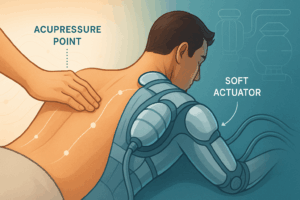
In this design, the researchers created a wearable “armor” equipped with several of these pneumatic physiotherapy actuators (PPAs). Each actuator can press, roll, or release against specific acupoints under computer control, generating movement patterns similar to those used by human practitioners.
The potential is enormous: gentle, wearable systems capable of providing localized massage therapy, rehabilitation support, or even assisted self-treatment at home.
The Core Challenge: Teaching the Robot to “Feel”
The biggest obstacle wasn’t mechanical—it was behavioral. Soft materials don’t move in a perfectly predictable way. They exhibit hysteresis, meaning that their responses lag behind the commands they receive. For practitioners, this would be like having your hand react a split second late every time you tried to adjust pressure.
To solve this, the research team built a sophisticated control system that learns to predict and compensate for these delays. Their approach combined several advanced strategies:
-
Inverse compensation, which corrects for the lag in actuator response.
-
Fuzzy logic algorithms, which “learn” to handle uncertainties—similar to how an experienced therapist senses and adjusts to subtle feedback.
-
Adaptive fuzzy integral sliding-mode control (AFISMC), a robust method that continuously fine-tunes movement in real time to maintain accuracy and stability even under variable conditions.
Together, these methods allowed the robot to deliver consistent, precisely modulated acupressure without the jerky or inconsistent behavior typical of earlier devices.
What the Experiments Showed
Through multiple test scenarios, the researchers demonstrated that the SMPR could track desired pressure and movement patterns with remarkable accuracy. The device maintained stability even when faced with external disturbances or small modeling errors.
Mathematical proofs confirmed that the system’s performance is predictably reliable—a necessary step before any therapeutic application can be considered safe for human use.
Why This Matters for the Massage Field
The authors of the study make clear that their goal is not to replace massage practitioners, but to make acupressure therapy more accessible, consistent, and measurable. Still, their work should serve as a wake-up call to the massage profession.
By merging soft robotics with traditional healing knowledge, researchers are taking real steps toward intelligent systems that embody some of the same hallmarks of skilled touch—sensitivity, adaptability, and safety—qualities once thought to belong only to the human hand.
In recent years, hundreds of millions—perhaps billions—of dollars have been invested in understanding the mechanics of touch. Nearly all of it, however, has come from engineering and robotics, focused on quantifying what practitioners feel intuitively: pressure modulation, responsiveness, and safety. And they are making impressive progress. By contrast, research generated from within the massage field remains minimal.
It is almost certain that physical therapy and spa industries will embrace these technologies as a way to deliver standardized “touch” without the need for expensive human practitioners. If the massage profession wishes to remain vital and relevant, it must take the lead in educating the public about what human touch uniquely provides—the empathy, intuition, and relational intelligence no machine can replicate.
Unless that happens, the future of massage could, quite literally, be left in the hands of robots.