
Why the regulations designed to protect the profession actually limit its reach
By David Palmer
The American massage profession has spent decades fighting for legitimacy. At the heart of this struggle has been a critical mission: separating professional massage from prostitution and the exploitation and trafficking that accompany it. This fight has been necessary, important, and ongoing. State regulations requiring 500-1000 hours of training have served as one tool in this battle, establishing clear professional standards and creating distance from illegal activities masquerading as massage.
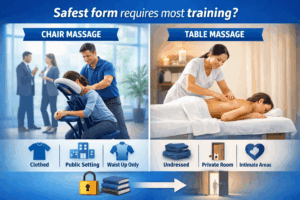 But in pursuing this necessary goal, the profession has created an unintended casualty: accessibility. More specifically, we’ve allowed the regulations designed to address the real risks of table massage to inadvertently stifle a fundamentally different practice—chair massage—that poses none of the same concerns while holding the promise of dramatically expanding the market for all massage services.
I began experimenting with massaging seated customers in 1982 with a specific vision: making skilled touch accessible to the greatest number of people. What I’ve witnessed since is a regulatory structure that prioritizes professional acceptability over this accessibility, requiring practitioners to complete hundreds of hours of table massage training before they can practice a form of massage that, by its very nature, addresses the core concerns that justified those regulations in the first place.
It’s time to examine whether our regulatory structure actually serves its stated purpose—or whether it simply serves itself.
Understanding the Original Problem
Let’s be clear about why table massage required robust regulation. The concerns were legitimate and remain so:
The Risk Profile of Table Massage:
- Clients undress and require draping protocols
- Work occurs in private rooms behind closed doors
- Practitioners access intimate and vulnerable body areas
- Clients are in prone or supine positions, limiting their mobility and agency
- The setting creates opportunities for exploitation and illegal activity
- Without clear standards, illegitimate businesses could operate under the guise of massage
These regulations addressed real harm. They created professional boundaries, established training standards, required background checks, and built a framework that helps law enforcement distinguish legitimate practice from criminal enterprise. This framework has been essential to protecting both clients and the profession’s legitimacy.
The question is not whether these regulations are necessary for table massage. They are. The question is whether these same regulations make sense for a practice with none of the same risk factors.
Chair Massage: A Different Practice Entirely
Consider what chair massage actually is:
The Structure of Chair Massage:
- Clients remain fully clothed throughout
- Work is performed from the waist up or knees down only
- Sessions occur in public or semi-public settings—airports, corporate offices, health fairs, farmers markets
- The client sits in a specialized chair with their face in a cradle, able to stand and leave at any moment
- No closed doors, no private rooms, no disrobing, no draping protocols
- The practice is inherently transparent and observable
In other words, chair massage is designed around the very features that address the core concerns of massage regulation. It is massage practice with built-in safeguards.
The practitioner cannot access intimate body areas. The client never disrobes. The setting provides natural oversight. The positioning gives the client complete agency and easy exit. There are no closed doors behind which exploitation could occur.
If the regulatory mission is to prevent exploitation, trafficking, and illegitimate business operations, chair massage already accomplishes this through its structure. Requiring 500-1000 hours of table massage training to practice chair massage is like requiring a driver’s license to ride a bicycle—the safety concerns that justify the license simply don’t apply to the activity being regulated.
The International Perspective
This becomes even clearer when we look beyond US borders. In most countries, there is no training minimum for practicing chair massage. In France, where I helped establish professional standards, we created a 150-hour training program specifically for chair massage practitioners.
Are clients in these countries experiencing exploitation or harm? Is chair massage being used as a front for illegal activity? No. The structural features of chair massage—clothed, public, limited body areas—create inherent protection regardless of training requirements.
The US is one of the few countries requiring extensive table massage training for a practice that bears little resemblance to table massage. And we stand alone not because we’ve identified risks others have missed, but because we’ve applied a regulatory framework designed for one practice to a fundamentally different one.
The Cost of Regulatory Overreach
This misalignment has consequences:
For Aspiring Practitioners:
Consider someone who wants to work for themselves or for a company providing chair massage services in corporate offices, at trade shows, or in retail settings—the most common work path for chair massage practitioners. Or a single parent working full-time who wants to offer chair massage at community health fairs. Both must invest 500-1000 hours and thousands of dollars in training they don’t need for their actual practice. Many simply can’t make this investment, so they never enter the profession—and the businesses that would employ them can’t find enough qualified practitioners. We lose their skills, their perspectives, their potential service to their communities, and the economic opportunities this accessible work could provide.
For Underserved Communities:
Populations unfamiliar with massage, those with limited financial resources, those in rural areas—they’re most likely to encounter massage through chair massage at community events, workplaces, or public settings. But because we’ve made it so difficult to become a chair massage practitioner, there are fewer practitioners available, particularly in these underserved markets.
For the Profession:
We claim we want to normalize skilled touch, to make it part of everyday wellness rather than a luxury service. But chair massage is the most safe, convenient, and affordable way for people to experience professional touch for the first time. By restricting access to chair massage practice, we limit the profession’s ability to reach new populations and grow the overall market.
For Professional Legitimacy:
Perhaps most ironically, this regulatory structure actually undermines the profession’s legitimacy. When regulations appear arbitrary—when they can’t be justified by the actual risk profile of the practice—they invite criticism and resistance. They suggest gatekeeping rather than public protection.
A Risk-Appropriate Regulatory Model
What would regulations look like if they were designed around actual risk rather than regulatory inertia?
For Table Massage (higher risk profile):
- 500-1000 hours of training covering anatomy, pathology, draping, ethics, boundaries, and therapeutic applications
- Background checks and screening
- Continuing education requirements
- Clear scope of practice and professional standards
- Robust enforcement mechanisms
For Chair Massage (lower risk profile):
- 125-175 hours of training focused on the actual skills needed: pressure techniques, body mechanics, client communication, safety, professional boundaries in public settings, a theory of touch, and business practices
- Background checks (same as table massage)
- Clear scope of practice definition: clothed, from waist up or knees down, public or semi-public settings
- Option to advance to table massage through additional training
This model aligns training burden with risk profile. It protects clients while expanding access. It maintains professional standards while removing unnecessary barriers.
The Acceptability vs. Accessibility Choice
The massage profession has made a choice, perhaps unconsciously, to prioritize acceptability over accessibility. In our quest for legitimacy—to be seen as serious, therapeutic, professional—we’ve adopted the trappings of medical professions: extensive training hours, complex licensing requirements, therapeutic positioning.
This strategy has brought real benefits. We are more accepted, more respected, more integrated into healthcare settings.
But we’ve paid a price. We’ve become less accessible—to practitioners who can’t afford extensive training, to communities that can’t access our services, to clients who find our profession intimidating or unfamiliar.
Chair massage was developed to address this accessibility gap. It’s massage for people who would never book a table massage session. It’s practice for practitioners who can’t or won’t invest 500-1000 hours in training. It’s skilled touch in everyday settings—the workplace, the shopping center, the community event—rather than only in therapeutic or spa environments.
By forcing chair massage through the same regulatory framework as table massage, we’ve eliminated its accessibility advantage. We’ve preserved acceptability at the cost of accessibility.
Moving Forward: A Call to Action
For the massage profession to truly serve the public, we need regulations that distinguish between different practices based on their actual risk profiles. This isn’t about lowering standards—it’s about right-sizing them.
To Regulators: Create a separate licensing pathway for chair massage that reflects its lower risk profile and its role as an entry point to the profession. Study outcomes in the many countries where chair massage is practiced with minimal training requirements. Ask whether current regulations serve public safety or simply protect the status quo.
To Schools: Develop chair massage certification programs lasting no longer than 200-hours that serve the students who actually want this training. Create articulation agreements so these hours can count toward table licensure for those who want to advance. Recognize that not every student wants or needs to practice table massage.
To Professional Associations: Advocate for risk-appropriate regulations. Acknowledge that chair massage and table massage are different practices requiring different training. Recognize that expanding accessibility doesn’t threaten professional legitimacy—it enhances it by demonstrating that we care more about serving the public than protecting our gates.
To Practitioners: Support pathways that make the profession more accessible. Mentor new chair massage practitioners. Recognize that someone practicing clothed massage in public settings isn’t competing with your therapeutic practice—they’re expanding the overall market for skilled touch.
Conclusion: Legitimacy Through Service
The massage profession fought hard to separate itself from prostitution and exploitation. That fight was necessary. The regulations that emerged from it have protected clients and established professional standards.
But chair massage was designed from the start to embody the features that address those concerns: clothed, public, limited body areas, inherent oversight. Applying table massage regulations to chair massage doesn’t enhance safety—it simply reduces access.
Real professional legitimacy comes not from how high we build our walls, but from how well we serve the public. Chair massage, as the true entry point into professional skilled touch, should be regulated as what it is: a distinct, lower-risk practice that makes skilled touch accessible to the greatest number of people.
The regulations designed to protect the profession shouldn’t be the same regulations that limit its reach. We can maintain rigorous standards for table massage while creating appropriate pathways for chair massage. We can protect clients while expanding access. We can be both legitimate and accessible.
But only if we’re willing to separate safety from gatekeeping—and build a regulatory structure that serves the public as much as it serves the profession.
David Palmer began experimenting with seated massage on stools in the early 1980s in Silicon Valley and San Francisco at such places as Apple Computer. In 1986, he introduced the first professional massage chair into the world, and his trainings have become the foundation for tens of thousands of practitioners around the globe. You can access a library of his writings at www.touchpro.com.