Is it time for massage to embrace touch?
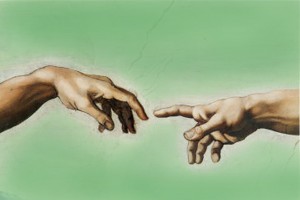
The hand of GodWhich profession should hold the keys to the storehouse that contains all of  the world’s  knowledge about human touch? Besides bodyworkers, is there any other (legal) occupation with more practical and theoretical knowledge about touch? I don’t think so and yet I have been struck by the fact that the massage profession often seems to relate to touch the same way fish relate to water. We take it for granted.

I believe that the primary function of entry level massage programs is to train the next generation of  touch specialists and, obviously, that means their highest priority should be teaching students how to give and receive touch. And that is not happening.

I know it is not happening because one of the questions I regularly ask bodyworkers in my classes is how many of them graduated from massage school with other students whom they didn’t want touching them? Most often, every hand goes up.

I also know massage schools aren’t prioritizing touch because although we have plenty of  textbooks on anatomy, physiology, pathology, ethics, techniques, body mechanics or business and we also have general textbooks that cover all of those topics, we still have no single textbook that explains everything every bodywork professional needs to know about touch.

Graduates may study the anatomy of the skin and touch receptors, but do they study the emotional, psychological, familial and cultural anatomy out of which touch attitudes, perception and receptivity arises? They may learn how to take a medical history, but how many massage schools teach their students how to take a touch history?

As a profession we are squandering a golden opportunity to advocate for a part of the human experience as essential to the development and maintenance of good health and well being as the air we breath or the food and water we consume. Everyone needs touch and lots of it but because touch in our culture is the orphan sense, most people living in urban environments wake up every day with a serious touch deficit.

The ears have music, the eyes have art, the nose and taste buds have food and perfumes and our sense of touch has–what? How exactly do we feed our sense of touch? Family affection and sex are the two obvious answers, but I would suspect that in most contemporary lives these options are in short supply.

The obvious answer for filling this touch gap is massage. Isn’t it time for the massage profession to embrace touch? Sure, massage therapy trying to be a health care profession is good, but isn’t offering the gift of unconditional touch with simple massage even more fundamental?

At most, only 4.2% of the adult population in the United States gets regular massage. If we want to have any hope of breaking through that ceiling, then massage needs to go back to its roots. Turning “massage” into “massage therapy” has helped the industry shed its shady past but at the same time has sidelined the most important reason people actually get a massage: because it makes them feel better. Not better in a medical sense, but better because they feel more real, alive and whole.

With simple massage the left brain starts talking to their right brain and everything above the neck starts noticing everything below the neck. By the end of a massage people’s core sense of trust and security in a fundamentally unsafe world gets renewed and they are able to face their lives and the world with a calm, balanced optimism.

On a physical level massage enhances circulation so that the body’s own natural healing systems can function optimally. Little problems are far less likely to become big problems with regular massage.

Redefining “massage” as “massage therapy” as the AMTA did in 1983 was mostly a defensive move. The thinking went, if massage is a health care profession, no one will mistake us for prostitutes. But we are, for the most part, past that issue. It is time to get back to our roots and highlight what we are better at than anyone else in the culture.: touching people safely, unconditionally, with clear intentions, significant training and experience.

Question: What do you think is the most important role of massage professionals?

Why I Do Chair Massage – Part Two

When I was a kid, my Mom and I used to lie at opposite ends of the couch with our legs entwined. When I was a kid my Dad used to kiss me goodnight.

Then, somewhere around ten or eleven, I became too big or perhaps too much of a “boy” to get a leg cuddle or a Dad kiss. I don’t really know why. I just noticed that the good feelings, the physical affirmations of security and love were gone.

I also learned from my culture and my Catholic religion other things about kinds of touch and times when touch was inappropriate between myself and others and even with myself. Pre-adolescence was the beginning of the numbing of my body as I began to override the natural instinct to touch with the cortical control that resulted from social inhibitions.

I became increasingly awkward, cautious, self-conscious and stiff throughout my teenage years. By the time I was twenty, I had developed chronic torticollis and woke up with a painful stiff neck every morning. Some mornings it was too painful to even get out of bed.

A few years later, I decided that I had had enough of the pain and began altering my lifestyle. Daily stretching (this was before yoga), a Tai Chi class and, most importantly, ten sessions of Rolfing eliminated the torticollis and changed my life forever.

Rolfing was the first kind of structured touch I had ever experienced. It was an awakening and a remembering of how good it was possible to feel in my body and in the world. I never forgot the lesson and it is no accident that in 1980 I ended up attending massage school, becoming a massage professional and eventually owning my own school.

For me, and for many bodyworkers, touch has been pivotal to our personal development and well-being. But it is essential and no less dramatic for most people. While it is true that recent generations have been raised to be more comfortable with their bodies on an individual level, our cultural relationship to touch is more pathological than ever.

We can’t touch our neighbors’ kids, teachers can’t touch their students, pastors can’t hug their parishioners, and colleagues can’t offer a supportive touch in the workplace. Touch is the physical manifestation of relationship and, when we touch, it signals a deep intimacy, a deep connection and bond of trust between two human beings. Unfortunately, contemporary media tends to emphasize that touch means sex.

Thus, the fear of touch and a discomfort with intimacy, along with an impossibly high price point for table massage, are the biggest barriers our profession has to overcome if more than four percent of the population is going to get massage on a regular basis (see How Sticky is Massage?).

That is the second reason why I do chair massage. Of all forms of bodywork, it is the least threatening and requires the least vulnerability on the part of the customer. We let you keep your clothes on, there are no messy oils involved, you can sit down rather than lie down and it takes a fraction of the time required in table massage.

Chair massage is kindergarten touch. It doesn’t require a high investment of either money or trust and it doesn’t require you to have something wrong with you. It is the gift of touch for its own sake. The many varieties of table massage all require a secondary, college level or post-graduate level understanding of, or comfort level with touch.

A close friend of mine, Rika, tells the story of the ten-year old boy who wanted to get a chair massage from her at the hotel where she worked for many years. After receiving permission from his father, the boy jumped in the chair and proceeded to receive his chair massage like a pro. When he was paying for the massage, the father said, “You don’t remember us, but a year ago we were here and you gave us both a chair massage. Every night since then, my son asks for a back rub as part of his bedtime ritual. It has been one of the best parts of both of our days.”

And I’ll bet that is one kid who will never lose touch with his “sensational” body.

I Believe in Touch

In 2004, National Public Radio (NPR) began airing readings of brief essays entitled This I Believe written by youth and adults from all walks of life about the core values that guide their daily lives. It was based on a 1950s radio program of the same name, hosted by acclaimed journalist Edward R. Murrow.

I looked forward to hearing each week’s selection, which felt like a breath of fresh air in a glass-is-half-empty world.  During Thanksgiving week of 2005, after hearing a particularly moving piece, I went to the website and searched for any essays about “touch.” There were none.

Here is the essay I submitted on November 24, 2005 . You can also view it at the This I Believe website along with the now dozens of other contributions on the topic of touch. About a year later, I was one of a number of Bay Area residents selected to participate in a conversation about the This I Believe organization on the KQED radio program Forum. A portion of my essay was read and discussed.


I believe in the power of touch.

I have experienced the power of touch to calm an infant, to comfort the dying, and to mend a relationship.

I believe in offering a hand or a hug to say hello or goodbye.

I believe in putting my arm around a good friend while we sit and talk on the sofa.

I believe in saying “Thank you,” when someone accidentally bumps up against me on a crowded sidewalk.

I believe that touch makes me whole.

I believe that the touch of another person connects me to my personal history, to their personal history, and to the history of all humanity.

I have seen touch in times of crisis bring relief to emergency workers, firefighters and police after a natural disaster and heal soldiers and civilians in time of war.

I have seen that a simple handshake between political opponents can spark years of hope between warring peoples and sometimes actually signal the end of years of conflict.

I believe that touch can reconnect the innate wisdom of my body to the rational calculations of my brain.

I have watched touch reawaken sensations in me that I thought were gone forever.

I am aware that as touch heals me, it also heals my relationships, heals the institutions of work, religion and politics that I participate in, and I believe that ultimately it helps to heal the world.

I believe that, if everyone got as much positive touch as they wanted for free, the need for wars, racism, drug abuse, child abuse, spousal abuse, anti-depressants, and the need to blame others for the conditions of our lives would mostly disappear.

I believe that touch reminds me that human beings are supposed to feel good, not bad.

I believe that touch is the orphan sense in our world because of our fear of intimacy.

I believe that touch has the power to turn “you” and “me” into “us.”

I believe that unless we learn how to touch and be touched, we will never learn how to love ourselves and each other.

I believe in touch.

In touch,
David

“Sound is touch at a distance.”

That wonderfully rich quote comes from Anne Fernald, the head of Stanford Institute’s Center for Infant Studies during an interview on a  RadioLab podcast, one of my favorite  NPR science programs. The program segment was titled Sound as Touch and explores the mechanical, biochemical and electrical nature of our sound receptors along with sound’s psychological impact.

Professor Fernald took her tape recorder around the world and discovered that there are four universal “melodies” that all infants can understand no matter the culture or language. For example, when praising an infant (“Good baby.”) everyone invariably drops the pitch of the second word. Even though the child doesn’t understand the words, she knows she is being praised. Professor Fernald compares this to the universality of the non-verbal essence of touch communication.

Sound waves literally touch the bones in our ear and set them to vibrating. Indeed, these waves wash over our whole body and can touch us very deeply physically and emotionally. Orators and musicians are especially tuned in to this phenomenon. As a bodyworker I know that my massage starts the moment I greet a customer.

You can listen to the full segment Sound as Touch. By the way, the other three universal melodies that infants understand are those that comfort, that call attention, and that stop.

In touch,
David