Change-ability: Mastering the Inevitable

Note: This is the fourth and last of a series of articles called “C”-ing Your Way to Success about  the value of Conviction, Clarity, Consistency and Change-ability in business.

The first three “C”s discussed in this series (Conviction, Clarity, Consistency) are paths, not destinations. While the successful development and execution of a business plan may use these guideposts, it is a mistake to think that the ultimate goal is 100% conviction, clarity or consistency in your operation. That is because other than death, change is the only certainty. In fact, the one often defines the other. When something ceases growing or responding, it is considered dead.

Our job then, is to become experts at understanding the nature of change, the patterns of growth.

While the quality of consistency gives your business stability, nurturing “change-ability” gives your business flexibility. Both are essential. One of the best books you can study on the subject of change is not a business book at all. It is a philosophical treatise disguised as a book of divination. The I Ching, or Book of Changes, is one of the classics of Chinese literature and is at least three thousand years old. The I Ching catalogs sixty-four aspects of change, in the same number of chapters, which are essentially meditations on the patterns of growth in the universe.

Mastering change-ability is important in two ways. It makes you increasingly skillful at predicting what will happen next in your business, and it makes you flexible in your ability to respond to change.

Predictability

When you study the nature of change you become expert at seeing the larger patterns in which your business operates. The most common example of these patterns are business cycles. This is the normal ebb and flow of the activity in your business. These patterns repeat daily, weekly, monthly, yearly, or over even longer periods of time. The more skillful you are at recognizing these patterns the more accurately you will be able to create reliable forecasts in your business plan.

Let’s look at some examples of business cycles.

  • The street fairs you work at tend to be slow in the morning, busy through the afternoon, with a late rush of customers, mostly people who worked in the other booths at the fair. Knowing that you will be about the last one to pack up and leave, you make certain that there is adequate staff and energy, for this final wave of business.
  • You notice that when you provide chair massage in the workplace certain types of clients prefer to have a massage at the beginning of the week, others in the middle, and still others at the end of the week. Because you also have a table massage business on Mondays and Tuesdays, you can more easily target your marketing to the mid and late week groups.
  • Your business increases the first and third week of every month because that is when you client base tends to get paid and can afford a massage. Consequently you plan your marketing and administrative chores for the second and fourth weeks of the month.
  • You anticipate that you will always sell more gift certificates around holidays and special occasions and you know you have to begin your promotion plans at least two months in advance.
  • Perhaps your business focus is on relaxation massage and you anticipate that most of your customers, after a year or so of allowing touch into their lives, will seek out other types of bodywork. To plan for that transition you establish mutual referral relationships with remedial therapists, Rolfers, Feldenkrais practitioners, sports massage bodyworkers, and the like.

The greater your ability to understand the processes of change, the more refined and accurate your business forecasts will be. As you become increasingly expert at recognizing the patterns inherent in your business you will develop an intuitive sense of what steps are needed at any given moment to keep your business healthy. Intuition, despite what some people claim, does not come from the cosmos. It is most often the result of awareness–paying attention to the smallest shifts in the world around us–and experience, lots of experience, over many years. The more we consciously accumulate business experience, the better we become at asking the right questions when faced with a business decision, and the more likely we are to arrive at the right answer.

Flexibility

Change-ability also means the ability to respond to the constantly changing business climate. When external and internal conditions alter, do we resist modifying our plans and actions, or do we smoothly adapt to the new circumstances? Developing flexibility in business is essential to long-term survival. There is no hiding from rapid change in our world. Being conscious of change makes it more predictable and being prepared for change makes it more manageable. Flexibility is the key to preparedness.

Practicing flexibility starts with exercising a flexible mind. Hopefully, the older we get, the more we appreciate the importance of accepting that what we believe is not always the way things are. Prejudice has no role in a flexible mind. When you start saying things like, “I can’t stand Republicans/Democrats/Jews/Mormons,” be careful. Not only are you limiting your options, but the world has a funny way of creating circumstances that may turn exactly those people into your next market.

A flexible mind also sees opportunities where other people see only problems. When circumstances in the business climate change it is always an opportunity for you to learn something new about your market, your service, the nature of business, or yourself. Don’t resist change, embrace it. Without change the world would be a very dull place. With change our businesses remain fresh, vibrant, and exciting places to spend our time.

Hygiene Protocol for Chair Massage

Click on the picture to view the video demonstration

While there are probably more infectious agents on the doorknob customers touch as they enter your massage space than are on your massage chair, the public nature of chair massage makes a solid hygiene protocol essential. It is a matter both of perception and professionalism.

I have seen potential customers stand in front of a line of massage chairs at an event carefully scrutinizing the hygiene habits of the various practitioners to find the one that best lives up to their standards. As the media continues to spotlight drug-resistant infections and virulent pathogens spreading around the globe, the general public is becoming increasingly germ-phobic.

Since we are trying to reduce stress, rather than increase it, we need to set customer’s minds at ease by being proactive about hygiene. There should never be a concern about customers spreading bugs to one another, or to me, or from me to them.

In terms of liability, having a simple, consistent hygiene protocol makes it easier to explain clearly to customers, health department personnel and lawyers the impossibility of someone, for example, having acquired herpes from sitting in your chair.

Wipe down. Cover up.

The two-step protocol TouchPro recommends starts with a canister of hospital-grade sanitary wipes. We use two sheets, one in each hand, to sanitize the chair at the start of the day as well as between each customer.

At the beginning of the shift, every vinyl surface is wiped, along with the adjustment hardware and any other metal or plastic parts around the face cradle. Between each customer the minimum rule is to wipe down the face cradle, arm rest and any other part of the chair that might have had skin to vinyl contact, typically the leg rests if the previous customer was in a skirt or shorts. The final step is to put the two sanitizer sheets together and wipe your own hands thoroughly.

Here’s a note about the wipe down process. The basic rule is, the juicier the better. The effectiveness of the sanitizers at killing the bugs is directly related to how long the moisture stays on the vinyl or your hands. That’s why we recommend wiping down the chair immediately after a massage, so you don’t have to keep the customer waiting before a massage for the alcohol to evaporate.

After the wipe down, the face cradle should be covered up to prevent the customer’s face from touching vinyl. The preference of the practitioner determines whether paper towels, cut-out or form-fitted disposable covers, or washable cloth covers are used.

Back in 1986, we started with paper towels but quickly moved to the round, disposable nurses caps with a breathing hole or slit cut into the center. When the form-fitted disposable face cradle covers came on the market around 2005, we switched to those and never looked back.

Addition hygiene issues

Obviously, everything you learned in massage school about keeping your fingernails, hands, breath and “pits” clean applies to chair massage, but there are a couple of other issues that should also be considered in your hygiene protocol.

In 2009, during the H1N1 avian flu pandemic scare, the media was in a frenzy over the potential deadly effects of the virus. To allay any fears of our customers, I wanted to advertise that all of the chair massage practitioners in our studio had been vaccinated to prevent them from contracting and/or spreading the virus. Unfortunately, because it was a new strain, the vaccine was rationed to the very young, old, immune-suppressed and front-line healthcare workers. Because of the shortage we were never able make that guarantee but every year since, I get myself vaccinated as early as possible. Annual flu vaccination as part of a chair massage hygiene policy just makes sense.

And, finally, what about those doorknobs? In a chair massage studio, I do disinfect them at the beginning of every day, unless they are brass. Brass doorknobs disinfect themselves in about eight hours, while stainless steel and aluminum knobs never do. It’s called the “oligodynamic effect.”

In summary, have a hygiene policy, write it down, and make sure everyone in your business follows it.

Check out the companion video.

How Sticky is Massage?

Stickability ImageIn the world wide web, “stickiness” refers to how long you can keep a user on your website or how often you can get them to return. It is a measure of user engagement and loyalty.

So how loyal and engaged, that is to say, how sticky are massage customers? Judging by the frequency with which Americans get regular massage, the sad answer would have to be that massage is not very “sticky” at all. [Note: If you want to bypass the calculations and jump to the bottom line numbers, scroll down to the last three paragraphs.]

There are only two professional consumer surveys done for the massage profession. The one commissioned by the American Massage Therapy Association (AMTA) is annual and the other, sponsored by the Associated Bodywork and Massage Professionals (ABMP), is biennial.

While neither of them explicitly states how often American adults get massaged, with a bit of combining and extrapolation of the two surveys, we can arrive at a reasonable approximation.

The most recent ABMP survey reports that, of the number of people who actually got a massage in 2010, their frequency of utilization was as follows:

  • 22% had 1 massage
  • 22% had 2 massages
  • 28% had 3-5 massages
  • 6% had 6-10 massages
  • 17% had 11-20 massages
  • 3% got 21 or more massages

The previous ABMP survey, for 2008, reported these percentages:

  • 32% had 1 massage
  • 21% had 2 massages
  • 35% had 3-5 massages
  • 5% had 6-10 massages
  • 5% had 11-20 massages
  • 2% got 21 or more massages

Now, since both the AMTA and ABMP surveys report the total number of adults getting a massage in a twelve month period, we can use the percentages above to get a range of how many total U.S. adults appear in each frequency category. In the AMTA survey, the total number of adults getting massaged ranges from a high of 24% in 2007 (pre-recession) to their current figure of 18% (between July 2010 and July 2011, unchanged from the prior 12 months). The ABMP figures are strikingly lower. In their latest survey only 16% of US adults got a massage in 2010, up from 14% in 2008.

To chart it out I multiplied the ABMB frequency of utilization percentages by the percentages of people in the U.S. reporting they received a massage in the two time periods surveyed by each organization. Here are the results of each survey by category.

Frequency of Massages Per Year AMTA ABMP
2007/08 – 24% 2010/11 – 18% 2008 – 14% 2010 -16%
1
Massage
7.7% 5.8% 4.5% 3.5%
2
Massages
5.0% 3.8% 2.9% 3.5%
3-5
Massages
8.4% 6.3% 1.0% 4.5%
6-10
Massages
1.2% 0.9% 0.7% 1.0%
11-20
Massages
1.2% 0.9% 0.7% 2.7%
21+
Massages
0.5% 0.4% 0.2% 0.5%

Hang in there. We are almost to the finish line. While I wish that the ABMP survey had broken out the specific number of people who got 3, 4 or 5 massages in a year, using the data we have, we can sort the frequency into three sub-categories:

  • Infrequent users – 1 or 2 massages per year
  • Occasional users – 3-5 massages per year
  • Regular users – 6 or more massages per year (less than the average number of haircuts per year)

With these definitions and using the best case ABMP figures, we can see that, at the most, only 4.2% of the adult population in the U.S. are regular users of massage. The best case data from the AMTA puts the percentage at 2.9%. Ouch! No wonder the associations do not make it easy to get this number and prefer us to focus on the 16 to 24% who got at least one massage in a year. In another article I make the case that this lack of loyalty and engagement, of “stickiness,” is primarily a result of the high price of massage and discuss what we can do to make massage more affordable and accessible.

One final note: We need to have better data and better analysis of the data we currently have. We can’t make good decisions about our future unless we have good data. The calculations above should have been readily accessible to anyone. The glaring discrepancies in the results between the two surveys should be explainable. The ABMP should be congratulated for the relatively comprehensive and transparent way in which it presents its data compared to the AMTA. However, I would urge both organizations to make all of their raw data from every study they commission available to anyone for analysis. The truth is out there, we are just having a hard time finding it.

Moving Massage from Acceptability to Accessibility

Acceptability-to-Accessibility ImageFor as long as people have been paying for therapeutic massage services, practitioners have feared being mistaken for prostitutes. That fear was the primary driving force that, in 1983, led the American Massage Therapy Association to re-brand “massage” into “massage therapy” in an attempt to define it as the health care profession. [Related article] I call this quest for professional legitimacy the “acceptability” strategy.
Within a decade this strategy was almost universally embraced by massage schools, educators, associations, regulators and vendors serving the industry. It seemed like an obvious strategy and the perfect solution. In point of fact, it was remarkably successful at validating therapeutic massage in the public mindset.

Unlike 20 years ago, nowadays no one blinks twice when a young woman announces her desire to attend massage school–no snickers, no raised eyebrows. The public generally perceives that there is a clear distinction between adult entertainment massage and therapeutic massage. The battle for acceptability has, for the most part, been won.

But now there is another front that needs our attention. What I call the “accessibility” problem.

While we have steadily increased the numbers of people who want a massage, the number of people who actually can get a regular massage has barely budged from less than 5% of the US adult population [see related article]. The reason is painfully simple. Massage therapy is  too expensive.

Since I am writing to a primarily professional audience, let me do a quick reality check. How many readers pay full price for at least one massage every two months? How many of your friends do? If you are at all like the typical massage practitioner in my continuing education classes, you can’t afford to pay $65 for a regular table massage, and neither can your friends. The primary reason people don’t get a massage is because they can’t afford it.

The only two significantly expanding models for massage services are the pay-by-the-month model pioneered by Massage Envy and chair massage in malls delivered by Chinese immigrants. What they both have in common is that they are lowering the price of massage.

Those of you who have experimented with online coupons also know what I am talking about. Discount massage shoppers rarely turn into full price regular customers. The only people who pay full price for regular table massage are the very wealthy, the very fanatical, and the very desperate people in pain.

While turning “massage” into “massage therapy” made our services more acceptable, it did little to make them more accessible. In fact, there is a case to be made that the effort to make massage into a health care profession has actually limited its growth.

Massage as health care

When you define massage as massage therapy in a health care context you are defining it as a treatment. The problem is that most massage is not performed as a health care treatment. Most massage, according to consumer surveys, is done for health promotion and relaxation. That has resulted in a huge disconnect between what massage practitioners think they are selling and the general public is looking to buy.

Massage schools graduates are encouraged to believe that they are training to become a health care professional–sort of junior physical therapist. [Indeed, I just searched “Physical Therapy Training” in Google and one of the three sponsored ads at the top was for a massage school.] But the reality is that the vast majority of graduates, if they are lucky enough to be working at all, will be doing massage, not massage therapy. While it may increase school enrollment to have them think otherwise, it does nothing for their level of frustration when the inner image of practitioners does not jive with their outer experience.

For massage customers, particularly new ones, defining massage as therapy often leads them to believe they have to have something wrong in order to get a massage. Every day that I work in a chair massage studio new customers invariably feel obligated to have a physical problem before they step through the front door.  “I woke up with a pain in my neck/back/shoulder,” being the most common statement.

Massage as personal care or fitness

If we want to make massage truly accessible, we need to recognize the difference between massage as a health care service and massage as a personal care service.

Defining massage as a health care profession only makes sense for that small, highly trained and experienced segment of practitioners that actually performs massage as treatment and for that small fraction of the public that actually needs and wants to pay for that service. Massage therapy should be defined for what it actually is–medical massage–and we should require far more than the standard 500 hours of training. Something closer to 2,300 or 3,000 hours of the Ontario and British Columbia models would be appropriate.

I admit that I am very conservative on the issue of training but, in my experience, 500 or 600 hours of training to become a massage therapist is totally inadequate, does nothing for creating credibility as a health care profession and sets totally unrealistic expectations for massage school graduates, the vast majority of whom will never make even a part-time living doing massage.

“Massage therapy” should never have been defined as entry-level into the profession. It is not. Plain old circulation/relaxation/prevention-oriented “massage” is entry-level. Let students focus on learning how to touch and be touched [Related article].

Massage has always rested comfortably in the personal care services arena along with spas, hair salons and nail studios. Over the past twenty-five years, massage has also grown up with the wellness and fitness industries. These two economic sandboxes are where the majority of massage practitioners should be playing and it is the kind of massage that massage schools should be selling and teaching.

Radically reinventing an industry

Knowing what we now know, if I was creating the U.S. massage industry from scratch, here is how it would be structured:

  • Entry-level into the field should be a 200-hour course in chair massage.
  • Table massage would be a second, optional level of training. Add on another 300-hours to make the current 500-hour standard and have the focus be on training practitioners to be wellness educators as well as table practitioners.
  • Massage Therapy would be true medical massage and require at least a masters level program.

There are some strong arguments for making chair massage entry-level. For the industry, chair massage provides a strong foundation:

  1. Chair massage is what the general public can afford and, because there is no disrobing or private rooms required, is more likely to try.
  2. Because it is affordable, people will get massaged more regularly.
  3. People who have had a chair massage are more likely to consider having a table massage or massage therapy.
  4. The net result will be far more work, more jobs, more successful students, and more sales for chair and table manufacturers.

For the budding massage practitioner, starting with chair massage will eliminate a lot of needless heartache and financial burden:

  1. Since there is really no way of knowing whether you will like doing massage professionally until you get into massage school, a 200-hour tuition mistake is a lot less painful than a 500-hour mistake.
  2. More students will be able to afford to go to massage school without going deep into debt and actually make a living doing upon graduation.
  3. After they are making a living doing chair massage, chair practitioners can save up money to pay for table massage school without taking out loans.
  4. It is easier for entrepreneurs to open chair massage businesses than table massage establishments resulting in more jobs.

The bottom line

Can my ideal industry model become real? Realistically, I doubt it. The massage schools, associations and regulatory agencies are far too entrenched to consider reforming the profession so radically. The quest for acceptability as a health care profession continues to be seen as the primary goal. Too bad. A lot of people just need to feel better through touch.

The Leg Problem in Chair Massage

Steve Knobles called today from North Seattle Community Acupuncture clinic. He recently started seating patients in a massage chair because it allowed easy access to their necks, backs and arms for needling and was often more comfortable than lying on a table. However, some of the patients complained of tired shins after sitting in a massage chair for longer than 30 minutes and he wanted to know if there was any way to extend their comfort time.

This is a phenomenon noted soon after the first massage chair came on the market in 1986. While spreading the weight among the seat, leg rest, chest pad and face cradle is great for support, it is not great for fidgeting. And, despite what your 3rd grade teacher may have told you, humans are made to fidget and be in motion, not to “sit still.” Movement creates circulation and, as we all know, circulation is not optional, even when we are asleep. Just check out the nearest napping infant.

Thus, we have always recommended a maximum 30-minute length for a chair massage. Unlike a massage table where people can fidget to their hearts content, in a massage chair using the lower legs as a support prevents movement and having the knees bent can reduce circulation and create discomfort. While it is true that some people can tolerate longer periods in that position, since a significant percentage cannot, the 30-minute rule is the safest compromise.

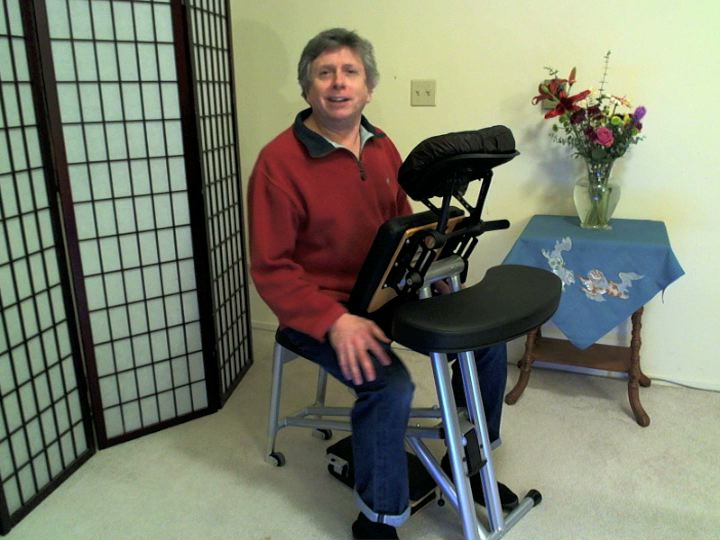
However, there are a couple of ways to compensate if, for whatever reason, you want to do a longer massage. My suggestion to Steve was simple. Since he was using a Stronglite Ergo Pro massage chair, I told him to remove the leg rests and flatten the seat so that it was parallel to the floor. Voila! No leg rests, no problem. Customers can now squirm to their hearts content.

Removable leg rests are so essential on a massage chair that I am surprised all manufacturers don’t include them. Even if you are only doing short massages, you need them. I would guess that 5% of chair massage customers have knee or leg issues that make leg rests uncomfortable. While putting your legs straddling or in front of the knee rests is the solution used on other chairs, it is less than optimal or professional. [Full disclosure: I helped co-designed the Stronglite chair, of course…]

Another way we got around the 30-minute limit was developed in the TouchPro retail chair massage studio business model. There we offered up to 30-minutes of upper body massage and 10- or 20-minutes of lower leg/foot massage meaning people could receive up to 50-minutes of massage in a chair. However, the catch was that, before the foot massage, the customer had to get up and reverse themselves in the chair, which was adjusted for the massage.

If you want to see how it all works in action, click here to view a video demonstration.