by David Palmer | Jul 15, 2016 | Business, Chair Massage
[Click to download a PDF of the press release version.]
France recently became the first country in the world to recognize seated massage as an occupational category with a professional certification. On June 7, 2016, the National Professional Certification Commission (Le Répertoire National des Certifications Professionnelles) approved Xavier Court Training as the sole provider of diplomas for Practitioners of Seated Massage.
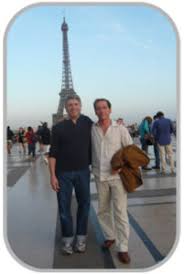
Xavier and David
Xavier Court, owner of the school, began the application process three years ago after joining forces with chair massage pioneer, David Palmer, and becoming an affiliate of Palmer’s organization, TouchPro International. Their application received a Level 2 certification under the French grading system (Level 1 is University diplomas) giving it a high degree of professional credibility. Throughout Europe the training is also rated as EuroPass Level 6 (the highest being Level 8) making the credential easily portable between all EU countries.
The approved curriculum is 170 hours and includes training in the TouchPro acupressure approach to chair massage developed by Palmer in 1986. While over 40,000 table massage practitioners around the globe have already been taught this system in continuing education seminars, this is the first time it has been the centerpiece of an entry-level massage program. Besides mastering the TouchPro technique, requires training in anatomy, physiology, hygiene, ethics, customer relations, and marketing to qualify graduates as world class chair massage specialists.
This also marks the first time that France has approved a specific credential for any massage services. Up to this point, the physiotherapists have prevented massage practitioners from being recognized as an independently titled profession. Palmer speculates that because seated massage was specifically defined in this instance as non-therapeutic, relaxation massage the French physiotherapists found it less objectionable than table massage therapy being provided as a health care service.
Another TouchPro affiliate in Trinidad & Tobago has an application in process for Caribbean-wide chair massage credentialing as a discrete occupation and Palmer looks forward to other countries adopting similar curriculum. The likelihood of North America following suit is slim as both Canada and the United States still require practitioners to complete 500- to 2200-hour table massage programs in most states and provinces before practitioners can legally offer chair massage services.
[For further information, please contact David Palmer at dp@touchpro.com.]
by David Palmer | Feb 5, 2012 | Chair Massage, Videos

Click on the picture to view the video demonstration
While there are probably more infectious agents on the doorknob customers touch as they enter your massage space than are on your massage chair, the public nature of chair massage makes a solid hygiene protocol essential. It is a matter both of perception and professionalism.
I have seen potential customers stand in front of a line of massage chairs at an event carefully scrutinizing the hygiene habits of the various practitioners to find the one that best lives up to their standards. As the media continues to spotlight drug-resistant infections and virulent pathogens spreading around the globe, the general public is becoming increasingly germ-phobic.
Since we are trying to reduce stress, rather than increase it, we need to set customer’s minds at ease by being proactive about hygiene. There should never be a concern about customers spreading bugs to one another, or to me, or from me to them.
In terms of liability, having a simple, consistent hygiene protocol makes it easier to explain clearly to customers, health department personnel and lawyers the impossibility of someone, for example, having acquired herpes from sitting in your chair.
Wipe down. Cover up.
The two-step protocol TouchPro recommends starts with a canister of hospital-grade sanitary wipes. We use two sheets, one in each hand, to sanitize the chair at the start of the day as well as between each customer.
At the beginning of the shift, every vinyl surface is wiped, along with the adjustment hardware and any other metal or plastic parts around the face cradle. Between each customer the minimum rule is to wipe down the face cradle, arm rest and any other part of the chair that might have had skin to vinyl contact, typically the leg rests if the previous customer was in a skirt or shorts. The final step is to put the two sanitizer sheets together and wipe your own hands thoroughly.
Here’s a note about the wipe down process. The basic rule is, the juicier the better. The effectiveness of the sanitizers at killing the bugs is directly related to how long the moisture stays on the vinyl or your hands. That’s why we recommend wiping down the chair immediately after a massage, so you don’t have to keep the customer waiting before a massage for the alcohol to evaporate.
After the wipe down, the face cradle should be covered up to prevent the customer’s face from touching vinyl. The preference of the practitioner determines whether paper towels, cut-out or form-fitted disposable covers, or washable cloth covers are used.
Back in 1986, we started with paper towels but quickly moved to the round, disposable nurses caps with a breathing hole or slit cut into the center. When the form-fitted disposable face cradle covers came on the market around 2005, we switched to those and never looked back.
Addition hygiene issues
Obviously, everything you learned in massage school about keeping your fingernails, hands, breath and “pits” clean applies to chair massage, but there are a couple of other issues that should also be considered in your hygiene protocol.
In 2009, during the H1N1 avian flu pandemic scare, the media was in a frenzy over the potential deadly effects of the virus. To allay any fears of our customers, I wanted to advertise that all of the chair massage practitioners in our studio had been vaccinated to prevent them from contracting and/or spreading the virus. Unfortunately, because it was a new strain, the vaccine was rationed to the very young, old, immune-suppressed and front-line healthcare workers. Because of the shortage we were never able make that guarantee but every year since, I get myself vaccinated as early as possible. Annual flu vaccination as part of a chair massage hygiene policy just makes sense.
And, finally, what about those doorknobs? In a chair massage studio, I do disinfect them at the beginning of every day, unless they are brass. Brass doorknobs disinfect themselves in about eight hours, while stainless steel and aluminum knobs never do. It’s called the “oligodynamic effect.”
In summary, have a hygiene policy, write it down, and make sure everyone in your business follows it.
Check out the companion video.
