The Genetic Roots of Massage

Genetic Roots of Massage ImageOften overlooked in the ongoing quest for a coherent identity for the massage profession are its evolutionary roots. In other words, what is the genetic basis for what we now call massage?

In the animal kingdom the general impulse to touch one another is termed social touch and is not only clearly evident in our primate ancestors but has also been identified in insects, birds, bats and virtually all mammals. That means that social touch has been hard wired into our genomic heritage for over 200 million years. What part of social touch gave rise to massage?

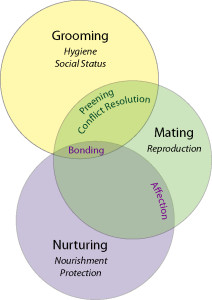
In primates, social touch can be divided into three overlapping functional categories: nurturing, grooming, and mating.

    • Nurturing touch originated from the need of infant mammals to be fed and protected.
    • Social grooming evolved for hygienic reasons, the need to keep the hair, fur, feathers and other skin coverings clean and free of leaves, twigs, insects, parasites and other objects.
    • The reproductive/mating instinct is fundamental to all animals for propagation of their species.
Genetics_img_2

Other overlapping functions of the varieties of social touch are also important. All three are examples of bonding behavior in its broadest sense of the word. Not only does touch tie parents to their offspring, mates to each other and individuals to the family or tribe, but touch has two other deep existential functions that often get overlooked. Touch creates a subjective sensation in  recipients that validates their unique individuality (bonding to myself) while, at the same time, it provides a “reality check” of their objective presence in and connection to the exterior environment. In an era of increasingly virtual relationships both of these benefits take on a new significance.

Grooming and nurturing kinds of touch overlap with mating touch in the forms of preening and affection, as noted in the illustration. Grooming and mating touch in some species, such as hominids, are also overlap when they are used for conflict resolution or reconciliation.

Wither professional massage?
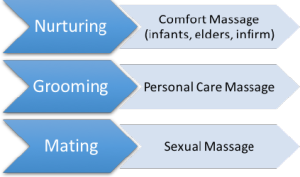
Genetic RootsAll massage done today by trained practitioners can trace its roots to at least one of these instinctual categories touching.

While every massage can be said to have a nurturing component (as described above in the discussion of bonding), nurturing touch is specifically the progenitor for what could be called comfort massage. These massage practitioners either provide massage services or massage training for populations such as the very young, the very old and the infirm. Examples include infant massage, geriatric massage and hospice massage.

Next, the grooming instinct has birthed the largest category of professional massage services: the personal care massage.

Parents or other family members are the primary groomers of their infants and children. They attend to the hygiene of their hair, nails, ears, nose, eyes and, most importantly, of their skin. They bathe and anoint their young with oils, lotions, and powders and, in this interaction, give them their first experience of the benefits of interpersonal touch.

As our children get older and more independent they begin to assume many of these grooming responsibilities for themselves. But society has also developed a whole economic sphere that can perform these functions called personal care services and its occupational categories include:

    • Hair stylists
    • Manicurists
    • Skin Care Specialists
    • Makeup artists
    • Massage practitioners

Most professional massage being provided today is personal care massage and it is easy to argue that it is more necessary than ever. With the emergence of higher levels of consciousness and more complex social systems, humans have the dubious distinction of being the only primate that can choose to override its natural instincts and live without interpersonal touch. Indeed, in many contemporary cultures, touching is now demonized, restricted or outright prohibited. Most people walk around today with a touch deficit. Personal care massage is one of the few ways that this primal need for touch can be safely met.

Finally, professional sexual massage services are a clear outgrowth of the mating touch instinct and, where they are not illegal, these days are often euphemistically described as “adult” or “tantric” massage.

Implications for our professional identity

Health care massage is the label that most massage schools, associations prefer for massage services. However, using touch techniques to ameliorate pain or injuries is actually a second order of massage services once removed from instinctual nurturing or grooming touch. It could be argued that the genetic roots of health care massage are  in self-touch, i.e. rubbing my sore spot to make it feel better. It wasn’t until some primates (and most particularly human primates) developed a capacity for empathy (feeling the pain of another) that interpersonal touch for relief became conceivable, i.e. rubbing your sore spot to make it feel better.

That’s not to say that health care or wellness massage can’t have the same benefits of comfort and personal care massage. It can and often does. However, it is the difference between eating chicken soup because you are hungry and eating (or feeding someone) chicken soup to cure what ails you. The former is instinctual and the latter requires a higher level of intention.

That distinction is important and often overlooked. The best use of massage is not to act as an ambulance at the bottom of a cliff (health care treatment), but rather to be the guard rail at the top of the cliff (health maintenance). Conflating (personal care) “massage” with (health care) “massage therapy” over the past 30 years has, unfortunately, resulted in the wide spread impression that massage is only useful when something has gone wrong. If we want to have a coherent identity for professional massage, it will have to include, but make a distinction between, both massage and massage therapy.

If you have any comments or thoughts about the genetic roots of our profession, please share them below.

The Realms of Massage

The first professional massage I ever received was around 1970 in an old Russian Banya on the near-North Side of Chicago called the Luxor Baths. The clientele was a mix of the old Jewish expats who had moved to the suburbs (Nelson Algren used to hang out here) and the new Hispanic locals. Luxor was an artifact from an earlier time complete with swimming pool, wet and dry saunas, a steam room and metal tables where friends would beat and brush each other with soapy oak leaf brooms.

Luxor also had a massage room and, with some encouragement from my friends, I finally gave massage a try. It was a memorable experience and I have been hooked ever since.

Notably, I didn’t get my first massage because something was wrong with me. I got a massage because it made me feel great and that is the experience I have been seeking to share with the world ever since.

Traditionally, within most cultures, professional massage has operated in two very discreet economic realms: the personal care services industry and the health care industry.

  • As a personal care service, massage is found in saunas, spas, hair salons, in the foot massage services provided in the streets of near- and far-Eastern Asian countries as well as neighborhood bathhouses and as various forms of seated massage now throughout the world. This is the kind of massage I received at the Luxor Baths.
  • In the health care industry, massage evolved through a variety of healing modalities, such as osteopathy and chiropractic, orthopedic practice, nursing and physical therapy (called physiotherapy in many countries).

These two domains were easily distinguished from one another both by terminology (customers vs. patients) and by intention (relaxation vs. treatment) and there was generally little confusion or overlap.

That clarity started to dissolve in the 1970s as a new economic arena began to emerge. It was called “health promotion” or “wellness” and was a reaction to the dominant health care paradigm, which in fact did not focus on health care, but rather sickness care.

The counterculture that emerged from the sixties first manifested this new approach by embracing such practices as natural childbirth, organic and vegetarian diets, supplements and herbs, and varieties of personal growth dubbed the “human potential movement.” Books such as Our Bodies Ourselves began to advocate rejection of the cult of experts in favor of personal responsibility and control. The goal became prevention, not treatment, and creating a balance that integrated the mind, body and spirit into a unified whole.

Inevitably, business began to capitalize on this cultural trend and the fitness industry was born. Health clubs replaced gyms, Nike shoes replaced sneakers, wellness centers replaced spas and self-help programs replaced the confessional. Also about this time, corporate wellness programs started to get a foothold as companies began to suspect that the only way to reduce their ever-rising health care costs was by encouraging employees to maintain good health through proper exercise, diet, and emotional balance.

Massage slipped easily into this new and exciting economic domain. The Esalen Institute in California championed new approaches to massage that focused on mind/body integration as well as a new category called “bodywork” that included innovative modalities developed by Ida Rolf, Milton Trager  and Moshe Feldenkrais.

The advent of this new wellness arena, however, has muddied the once clear distinction between personal care services and health care services as both try to carve for themselves a slice of the wellness pie.

And where has that left the massage industry? Also very muddied. According to the massage schools, associations and regulators, massage is no longer a personal care service, it is a health care service. I can no longer get a massage like I did 40 years ago at the Luxor Baths. Now I have to get massage therapy. But I don’t want a health care massage. I don’t even want a wellness massage. I just want to lie down and bliss out in the hands of someone who makes me feel good. I don’t care if the practitioner has 50 or 500 hours of training. If I like the massage, I will go back. If I don’t, I won’t.

We need to bring back and validate the personal care massage realm. That is where the most growth is happening (chair massage and franchise table massage), that is where the jobs are, and that is where I want to get my massage.

Do you believe massage should reclaim its identity as a personal care service? Does defining massage exclusively as “therapy” confuse the public and needlessly restrict our growth?

Moving Massage from Acceptability to Accessibility

Acceptability-to-Accessibility ImageFor as long as people have been paying for therapeutic massage services, practitioners have feared being mistaken for prostitutes. That fear was the primary driving force that, in 1983, led the American Massage Therapy Association to re-brand “massage” into “massage therapy” in an attempt to define it as the health care profession. [Related article] I call this quest for professional legitimacy the “acceptability” strategy.

Within a decade this strategy was almost universally embraced by massage schools, educators, associations, regulators and vendors serving the industry. It seemed like an obvious strategy and the perfect solution. In point of fact, it was remarkably successful at validating therapeutic massage in the public mindset.

Unlike 20 years ago, nowadays no one blinks twice when a young woman announces her desire to attend massage school–no snickers, no raised eyebrows. The public generally perceives that there is a clear distinction between adult entertainment massage and therapeutic massage. The battle for acceptability has, for the most part, been won.

But now there is another front that needs our attention. What I call the “accessibility” problem.

While we have steadily increased the numbers of people who want a massage, the number of people who actually can get a regular massage has barely budged from less than 5% of the US adult population [see related article]. The reason is painfully simple. Massage therapy is  too expensive.

Since I am writing to a primarily professional audience, let me do a quick reality check. How many readers pay full price for at least one massage every two months? How many of your friends do? If you are at all like the typical massage practitioner in my continuing education classes, you can’t afford to pay $65 for a regular table massage, and neither can your friends. The primary reason people don’t get a massage is because they can’t afford it.

The only two significantly expanding models for massage services are the pay-by-the-month model pioneered by Massage Envy and chair massage in malls delivered by Chinese immigrants. What they both have in common is that they are lowering the price of massage.

Those of you who have experimented with online coupons also know what I am talking about. Discount massage shoppers rarely turn into full price regular customers. The only people who pay full price for regular table massage are the very wealthy, the very fanatical, and the very desperate people in pain.

While turning “massage” into “massage therapy” made our services more acceptable, it did little to make them more accessible. In fact, there is a case to be made that the effort to make massage into a health care profession has actually limited its growth.

Massage as health care

When you define massage as massage therapy in a health care context you are defining it as a treatment. The problem is that most massage is not performed as a health care treatment. Most massage, according to consumer surveys, is done for health promotion and relaxation. That has resulted in a huge disconnect between what massage practitioners think they are selling and the general public is looking to buy.

Massage schools graduates are encouraged to believe that they are training to become a health care professional–sort of junior physical therapist. [Indeed, I just searched “Physical Therapy Training” in Google and one of the three sponsored ads at the top was for a massage school.] But the reality is that the vast majority of graduates, if they are lucky enough to be working at all, will be doing massage, not massage therapy. While it may increase school enrollment to have them think otherwise, it does nothing for their level of frustration when the inner image of practitioners does not jive with their outer experience.

For massage customers, particularly new ones, defining massage as therapy often leads them to believe they have to have something wrong in order to get a massage. Every day that I work in a chair massage studio new customers invariably feel obligated to have a physical problem before they step through the front door.  “I woke up with a pain in my neck/back/shoulder,” being the most common statement.

Massage as personal care or fitness

If we want to make massage truly accessible, we need to recognize the difference between massage as a health care service and massage as a personal care service.

Defining massage as a health care profession only makes sense for that small, highly trained and experienced segment of practitioners that actually performs massage as treatment and for that small fraction of the public that actually needs and wants to pay for that service. Massage therapy should be defined for what it actually is–medical massage–and we should require far more than the standard 500 hours of training. Something closer to 2,300 or 3,000 hours of the Ontario and British Columbia models would be appropriate.

I admit that I am very conservative on the issue of training but, in my experience, 500 or 600 hours of training to become a massage therapist is totally inadequate, does nothing for creating credibility as a health care profession and sets totally unrealistic expectations for massage school graduates, the vast majority of whom will never make even a part-time living doing massage.

“Massage therapy” should never have been defined as entry-level into the profession. It is not. Plain old circulation/relaxation/prevention-oriented “massage” is entry-level. Let students focus on learning how to touch and be touched [Related article].

Massage has always rested comfortably in the personal care services arena along with spas, hair salons and nail studios. Over the past twenty-five years, massage has also grown up with the wellness and fitness industries. These two economic sandboxes are where the majority of massage practitioners should be playing and it is the kind of massage that massage schools should be selling and teaching.

Radically reinventing an industry

Knowing what we now know, if I was creating the U.S. massage industry from scratch, here is how it would be structured:

  • Entry-level into the field should be a 200-hour course in chair massage.
  • Table massage would be a second, optional level of training. Add on another 300-hours to make the current 500-hour standard and have the focus be on training practitioners to be wellness educators as well as table practitioners.
  • Massage Therapy would be true medical massage and require at least a masters level program.

There are some strong arguments for making chair massage entry-level. For the industry, chair massage provides a strong foundation:

  1. Chair massage is what the general public can afford and, because there is no disrobing or private rooms required, is more likely to try.
  2. Because it is affordable, people will get massaged more regularly.
  3. People who have had a chair massage are more likely to consider having a table massage or massage therapy.
  4. The net result will be far more work, more jobs, more successful students, and more sales for chair and table manufacturers.

For the budding massage practitioner, starting with chair massage will eliminate a lot of needless heartache and financial burden:

  1. Since there is really no way of knowing whether you will like doing massage professionally until you get into massage school, a 200-hour tuition mistake is a lot less painful than a 500-hour mistake.
  2. More students will be able to afford to go to massage school without going deep into debt and actually make a living doing upon graduation.
  3. After they are making a living doing chair massage, chair practitioners can save up money to pay for table massage school without taking out loans.
  4. It is easier for entrepreneurs to open chair massage businesses than table massage establishments resulting in more jobs.

The bottom line

Can my ideal industry model become real? Realistically, I doubt it. The massage schools, associations and regulatory agencies are far too entrenched to consider reforming the profession so radically. The quest for acceptability as a health care profession continues to be seen as the primary goal. Too bad. A lot of people just need to feel better through touch.