Whenever customers sit in my massage chair, I know that their subjective experience of my touch will be the result of at least four factors:
- Their genetic profile (Are they male/female? Do they have biological disorders such as autism).
- Their personal touch history (Have they had massage before? Have they experienced healthy touch or abusive touch in the past? Have they experienced touch at all?).
- The attitudes and experiences with touch they had in the family (Were they breastfed, or not? Was their family highly affectionate, or not?).
- The customs and attitudes toward touch that are emphasized by the culture in which they are immersed.
This fourth element is the subject of this article. As the world continues to shrink and multi-cultural societies becomes the norm rather than the exception, understanding the cultural environment in which a customer was raised is crucial to healthy professional touch relationships. In this article I will give two examples of how culture affects how we touch.
Defining pain
I began my massage career in 1980 working at Kabuki Hot Spring, a spa in San Francisco’s Japantown. I was the only Caucasian male working in a sea of mostly Asian, mostly female faces. While I had been trained in traditional Japanese massage at a school that was run by the owners of the Hot Spring, a majority of the other practitioners had been trained in Japan. It was at Kabuki that I began to understand why Japanese massage had gotten a reputation in the United States as “beat-me-up” massage.
While the Kabuki had private rooms, most of the customers availed themselves of the public baths and the communal massage room, which had 14 massage tables lined up in an open space. Doing massage alongside Japanese practitioners introduced me to what I have since come to understand is a differentiation in how cultures define pain.
I would regularly notice a poor customer at another table squirming uncomfortably under the strong thumbs of a Japanese colleague. If the customer tried to get the practitioner to ease up they were likely to get a slap on the back and be commanded to, “Relax! Relax!”
In the immortal line from Cool Hand Luke, “What we got here is a failure to communicate.”
In Japan, China and many other Asian cultures, if you are feeling a strong sensation while getting a massage, you are happy because you believe the massage is working. In the West, we often interpret the same strong sensation as pain and we think it is a bad massage.
The Japanese practitioners I was working alongside were clearly mystified that anyone would want a lighter massage. From their point of view the problem was not that the massage was too strong, but that the customer was resisting the benefits. To the American customers, the massage simply hurt.
This mistake is still being perpetuated by the flood of Chinese immigrants providing chair massage in malls throughout the U.S. Nobody has taught them that they need to regularly ask their customers for feedback about the pressure and there is often a serious language barrier making it difficult to do so.
For my part, every time I have someone in my massage chair born in the Far East I keep that cultural difference in mind. More often then not they like pressure on the strong side of the spectrum. In all cases, of course, I ask for feedback.
The French form of connection
I use a martial arts approach to teach massage through “Katas,” highly choreographed sequences of select acupressure points and Japanese massage techniques.
Over the years hundreds of people have used my DVDs and other curriculum material as the basis for training thousands of chair massage practitioners around the world. Last year, for example, I discovered that my basic chair massage Kata was famous in France and literally thousands of practitioners were using some variation. They even have a name for it: the Amma Kata.
When I saw a video of one chair massage trainer demonstrating his work, I was amazed. He had been trained by a person who had been trained by a person who had been trained by me. Despite this fourth generational relationship, I was impressed that my original Kata was plainly visible.
What caught my eye, however, was not what was similar, but what was different. The trainer had added two full minutes of slow, deep, luxurious scalp massage at almost the end of the 15-minute sequence.
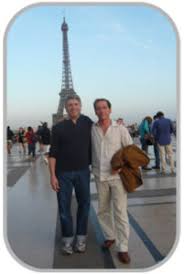
Recently I had an opportunity to meet with this trainer, Xavier Court, in Paris and spend a week working on the Kata with him and the other trainers working with him. When I experienced his head massage in a chair, I loved it. He had given thousands of chair massages to French people in the workplace and at events and was convinced that the additional work on the scalp was essential to a satisfying experience for his customers.
I explained to him that, in the United States, we had almost exactly the opposite experience. If there is one part of the massage that people most often ask us to leave out, it is the scalp. Here it seems that customers want us to get to the parts of the body that they perceive “need” the work—most often the neck, shoulders and back. If we spent two minutes “just” doing the scalp, people would feel like they were not getting their money’s worth.
In France, on the other hand, there is a cultural recognition that deep relaxation is a goal in and of itself. This is the land dedicated to the 35-hour workweek, five weeks of annual vacation and dinners that don’t start until 9 p.m. Unlike its neighbors to the north (Germany, Netherlands, England, Scandinavia), France is an essentially Mediterranean country with all of the sensuousness and slow pace that implies. It was truly an eye-opening experience that reminded me of an analysis by Virginia Postrel about what is missing from American attitudes toward massage.
What do you see?
These examples highlight the need for cultural sensitivity when doing massage. There are many more differences in cultural perceptions of massage most obviously ones that stem from cultural attitudes and norms about touch and sexuality. Please share your cross-cultural insights in the comments section below.